The Surrey Puma Mystery: Britain’s Rogue Big Cat Under the Microscope
A British mystery with paw prints, not flying saucers
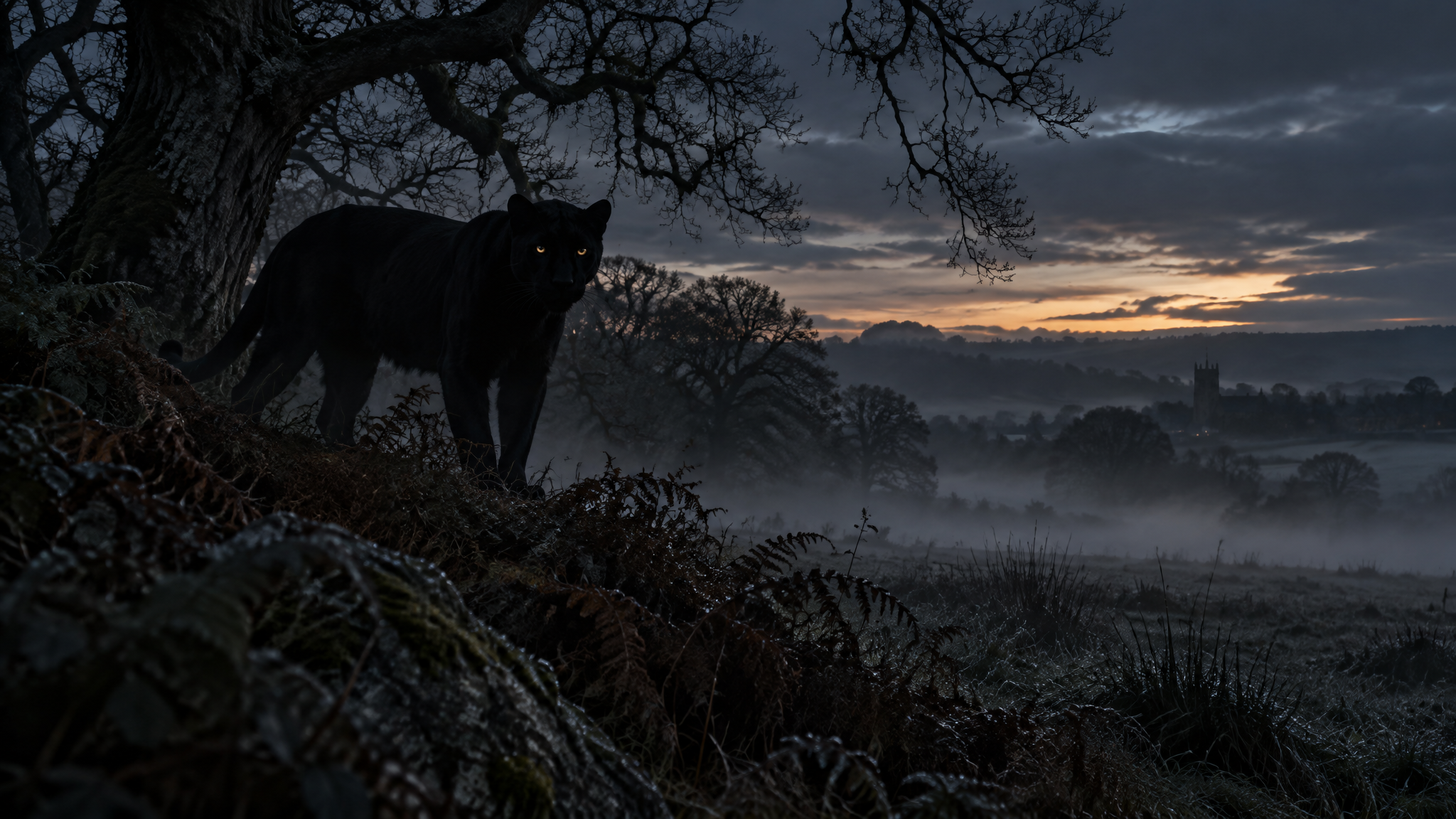
Every region has its enduring field mystery, and in the south of England one of the most persistent is the so-called Surrey Puma. It is not a single incident, but a loose pattern of sightings reported over years: a large dark cat moving through fields, crossing roads at night, vanishing into hedgerows, and leaving witnesses with the distinct impression that they had seen something far larger than a domestic pet.
The question is not whether people have reported such animals. They have. The real question is what, exactly, they saw. That distinction matters, because the Surrey Puma sits in the uncomfortable space between folklore, misidentification, and the possibility—however small—of a genuine exotic predator living beyond official records.
What the reports actually describe
Accounts from Surrey and surrounding counties tend to share a few recurring details: a cat-like animal with a long body, powerful shoulders, a low stalking gait, and a size that witnesses estimate well beyond a fox, dog, or ordinary house cat. Some reports mention a tail carried low or level with the body. Others describe an all-black coat, though color is often hard to judge in poor light.
These observations are important for one reason: they are not absurd on their face. Britain does have wild mammals that can be mistaken at a glance, especially in dusk or headlights. But the same conditions that create confusion also create consistency. If people repeatedly describe a big black cat, that pattern deserves to be examined rather than dismissed outright.
The larger British big cat story
The Surrey Puma did not emerge in isolation. Britain has a long-running tradition of big cat reports, from the Beast of Bodmin Moor in Cornwall to sightings in Scotland, Wales, and the Midlands. The modern wave of interest is often traced to the mid-20th century, when the Exotic Animals Act 1976 later made it harder for private owners to keep potentially dangerous species without licensing. Before and after that legal shift, private menageries, collectors, and casual owners did keep unusual animals in Britain.
That history matters because it provides a plausible origin point. If a number of exotic cats were once kept privately, some could have escaped or been released. A few might have survived long enough to establish local legends. The difficulty is proving it. Unlike a single escaped zoo animal, a long-running wild cat mystery leaves behind very little definitive evidence unless a carcass, clear photograph, or verified track set is recovered.
Tracks, carcasses, and the evidence gap
In mystery cases, the absence of hard evidence can mean two different things. It can mean the phenomenon is exaggerated. Or it can mean it is real, but elusive. With the Surrey Puma, we do not have a body, a confirmed DNA sample, or a chain of custody on any physical trace that has settled the question.
What we do have are sightings, blurred images, and occasional reports of livestock kills. But livestock deaths are not a clean diagnostic marker. Foxes, dogs, and other predators can cause damage that is later interpreted through the lens of a local legend. Likewise, a poor-quality image can seem persuasive until the scale, distance, and lighting are scrutinized.
That is where investigators need discipline. A claimed big cat must be evaluated against the most ordinary explanations first: domestic dogs, deer, coyotes in regions where they exist, escaped pets, or even visual error. A witness can be truthful and still be mistaken. That is not a weakness of eyewitnesses; it is a property of perception.
Why people see big cats where big cats may not be
There is a strong psychological component to these reports. Once a region becomes associated with a predator, the human mind begins to organize ambiguous observations around that expectation. This is not fraud; it is pattern recognition. A shadow in bramble, a fleeting shape in a field, a low animal crossing a road—each may be interpreted differently once the big-cat idea is in circulation.
That said, the reverse is also true. A real animal can be repeatedly misread as something ordinary and then disappear into the background of rural life. Britain is full of hidden edges: wooded lanes, hedgerows, abandoned farmland, drainage corridors, and riverbanks that can shelter wildlife far better than many urban observers assume.
So the Surrey Puma question sits in a narrow corridor. It is not impossible. It is not proven. The case survives because the region offers just enough concealment, and just enough anecdotal consistency, to keep the subject alive.
Could a big cat actually survive in Surrey?
The ecological question is not entirely absurd. A small number of medium-sized predators can, in theory, persist unnoticed if food is available and if human pressure is low enough. Britain has deer populations, rabbits, rodents, and livestock, all of which could support a limited predator. But a large cat is not invisible in the absolute sense. It sheds hair, leaves tracks, kills prey, and eventually dies. Over time, those traces should accumulate.
That is why the strongest argument against a free-ranging population is not that it would be impossible, but that it would likely be detected more conclusively by now. A lone animal could plausibly evade capture for a long time. A breeding population would be much harder to hide.
Still, the absence of certainty cuts both ways. No one has produced a verified specimen that settles the matter decisively. And in mystery writing, that keeps the door ajar.
Escapes, releases, and the private exotic trade
If there is a mundane explanation that fits best, it may be this: isolated escapes or releases of exotic pets. Big cats were once far easier to obtain than many people assume. Some were bought out of curiosity, others as status symbols, and some were kept by collectors who were not prepared for the realities of feeding and containment.
This explanation does not require a secret breeding population. It requires only that a few animals entered the landscape over time, with some sightings arising from those individuals and others from misidentification. In other words, the Surrey Puma may not be one mystery but several overlapping ones.
What the case teaches investigators
The Surrey Puma endures because it is just ambiguous enough to resist easy closure. It is a reminder that not every mystery is cosmic. Some are terrestrial, local, and stubbornly ordinary in origin. Yet ordinary does not mean trivial. A puzzling animal report still demands careful source checking, geographic context, and an understanding of how memory, light, distance, and expectation can shape testimony.
For investigators, that is the lesson. A claim becomes stronger when it survives skepticism, not when it is merely repeated. In the Surrey Puma story, the evidence remains suggestive but incomplete. Sightings continue to surface, and the idea of a hidden big cat in the English countryside remains culturally potent. But until there is verified physical evidence, the Surrey Puma should be treated as an open question rather than a solved case.
That is often where the most interesting mysteries live: not in certainty, but in the evidence gap that refuses to close.