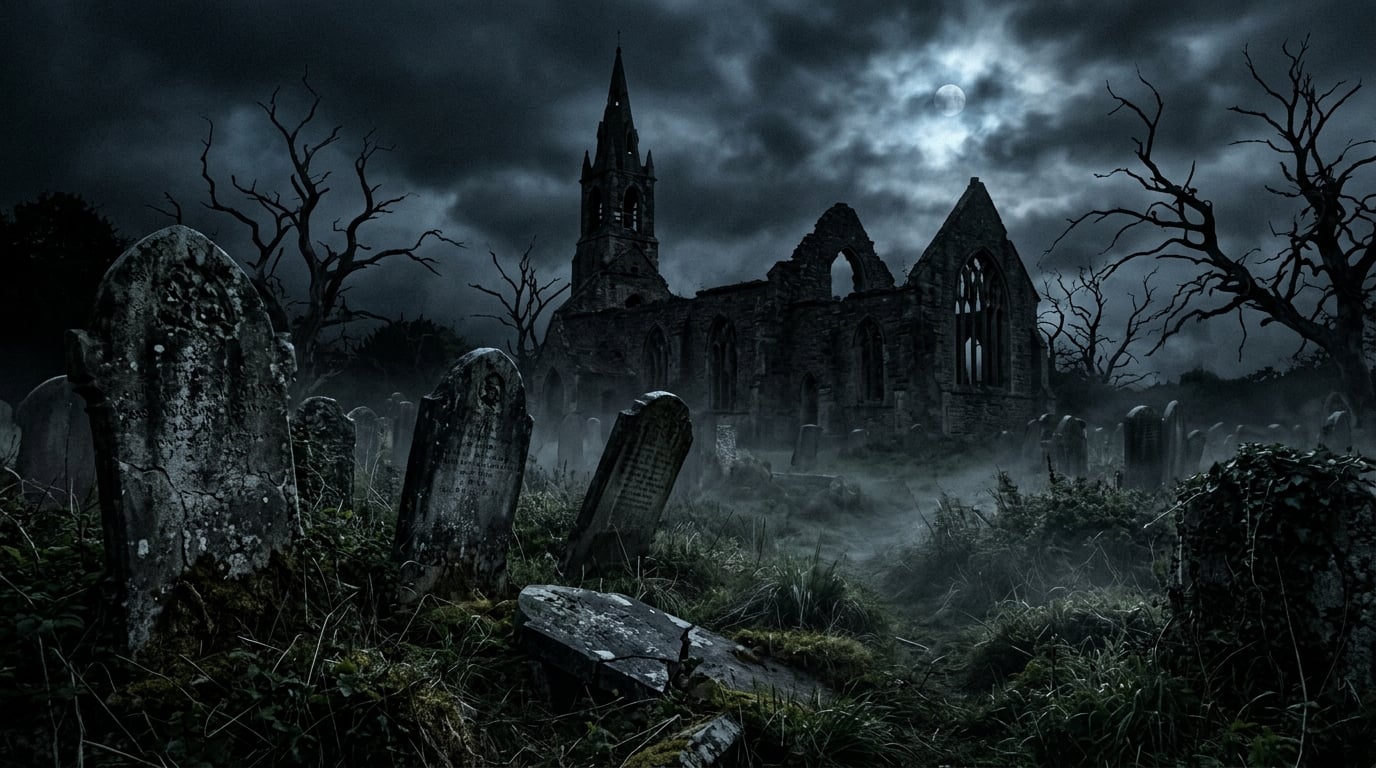
Stull Cemetery: Kansas Graveyard, Hell Gate Legend, and the Anatomy of a Modern Myth
At the edge of a quiet Kansas town sits a cemetery that has been called a gate to hell, a place where the devil allegedly walks, where prayers fail, and where the dead are said to rise on certain nights. I have spent enough years as an analyst to know that the most durable mysteries are rarely built on one dramatic event. More often, they are assembled slowly: a fragment of local history, a few eyewitness claims, a handful of repeated rumors, and then the human instinct to make a pattern out of darkness.
Stull Cemetery is one of those places. Its reputation is louder than its footprint. The graveyard itself is small, unremarkable, and, in daylight, almost painfully ordinary. Yet in the folklore surrounding it, Stull has become something larger: a landmark in American occult mythology, a site tourists seek out after midnight, and a case study in how a place can be transformed by repetition.
I approached Stull the same way I would any sensitive intelligence file: by separating the claim from the echo, the original witness from the story that later grew around them, and the verifiable detail from the atmosphere that someone else supplied. What remains is not a supernatural certainty. But it is still a mystery worth examining.
The Birth of the Stull Legend
A cemetery, a small town, and the power of proximity
Stull is an unincorporated community in Douglas County, Kansas, not far from Lawrence and the University of Kansas. That geographical detail matters more than it first appears. Universities are engines of rumor. They concentrate young people, late-night travel, local traditions, and a constant appetite for stories that feel just beyond the edge of explanation. When a haunted place sits near a campus, it rarely stays local for long.
According to the most common version of the story, Stull Cemetery is one of only a few places on earth where the devil can walk directly onto the mortal plane. Other versions say the cemetery is built over a gateway to hell, or that the ground becomes unstable when the supernatural is near. As with many legends, the details vary depending on who is telling the story and how much they want to frighten the listener.
What can be documented is less dramatic. The cemetery is old, rural, and tied to the history of a church and community that existed long before the legend took shape. Like many graveyards associated with ghost stories, it contains real human loss, weathered markers, and a physical isolation that invites imagination. Darkness fills in the blanks. So does silence.
The staircase story and the myth of the broken threshold
The most famous element of the Stull legend is the so-called staircase to nowhere. In some tellings, the remains of an old church stairway sit in the cemetery, and the devil is said to use the steps as a crossing point into our world. In others, the staircase is a test: step onto it under the wrong conditions, and something irreversibly bad will follow you home.
That detail is especially useful because it is visual. Folklore survives best when it can attach itself to an image. A staircase in a graveyard is easy to remember, easy to retell, and easy to stage in the imagination. Whether a set of old steps existed, how they were used, and what they meant historically are questions that matter far more than the legends do. But legends often do not begin with truth; they begin with a shape.
In this case, the shape is a threshold. Humans are deeply sensitive to thresholds. Doorways, bridges, staircases, and intersections all carry symbolic weight because they represent transition. The old language of haunting often gravitates toward places where one state changes into another. A cemetery is already a boundary between the living and the dead. Add a staircase, and the symbolism almost writes itself.
What the Record Actually Supports
Local history versus folklore inflation
When I compare a mystery’s popular version against the documentary record, I look for three things: first, whether the core claim is present in older sources; second, whether the details become more dramatic over time; and third, whether the story begins to serve a social function beyond mere explanation. Stull passes that test in a very familiar way. The legend grows stronger as it spreads.
Older local histories do not support the idea that Stull was long known as a literal portal to evil. Instead, the cemetery’s notoriety appears to develop later, especially as students, visitors, and journalists began repeating the same unsettling themes. That does not make the story meaningless. It makes it traceable. The timeline suggests a modern folklore cycle: a real location, a suggestive feature, and then a story that became more elaborate with each retelling.
The importance of that sequence cannot be overstated. In intelligence analysis, a claim repeated often enough can begin to feel corroborated, even when each repetition traces back to the same weak source. That is the trap. A rumor does not improve just because it becomes familiar. It merely becomes louder.
Why the church and cemetery matter more than the devil
The cemetery’s history includes the remnants of a church and a community that declined over time. Churches are central to many American haunted-site narratives because they combine moral authority, ritual, and decay. When the structure is abandoned or demolished, the imagination rushes in to occupy the vacuum.
In the case of Stull, the old church site and cemetery have been described in ways that blur architectural history with supernatural dread. But the records that survive point to ordinary, if sometimes somber, local history: settlement, worship, burial, and eventual change. That is not a disappointment. It is the first clue that the paranormal reputation may be a product of cultural layering rather than an active haunting.
There is also a more practical point. Remote rural cemeteries often become magnets for trespassing, vandalism, and staged midnight visits precisely because they are rumored to be haunted. The activity then feeds the legend. Broken stones, damaged grounds, and anecdotal reports of strange behavior can be used as proof that something sinister is present, when in fact they may be consequences of the myth itself.
Why Stull Became So Powerful
The campus rumor mill and the need for forbidden places
One of the most reliable engines of paranormal lore is youthful repetition. A story shared at the right age, in the right setting, acquires a charge that makes it feel like a secret. Stull became part of that ecosystem. Students heard about it. Students visited it. Students reported experiences. The tale then moved outward, helped along by newspapers, books, television segments, and eventually the internet.
In other words, the legend did not merely describe the place. It trained people to experience the place in a certain way.
That is an important distinction. If you arrive at a cemetery expecting dread, your mind becomes an active participant. Every sound is sharpened. Every shadow deepens. A loose branch becomes a footstep. Wind moving through grass becomes a whisper. None of that requires deceit. It requires only priming, which is one of the oldest tools in the human perception toolkit.
How atmosphere becomes evidence
Many haunted locations share the same basic ingredients: isolation, darkness, history, and a story with enough repetition to create expectation. In daylight, the place may feel normal. In the dark, the same environment becomes unreadable, and unreadability is fertile ground for belief. Our brains are not built for silence. They are built to detect threat. When information is scarce, the mind supplies it.
This is why I am cautious when people present a mysterious location as if atmosphere itself were proof. Atmosphere is real. It is just not conclusive. A cold wind does not authenticate a ghost. A feeling of pressure does not establish a portal. A photograph of a shadow does not prove that the dead are walking. It proves only that under certain conditions, human beings become excellent storytellers.
That said, the emotional force of Stull should not be dismissed. A successful legend tells us something about the people who keep it alive. Stull resonates because it offers a simple narrative structure: a hidden place, a forbidden boundary, and the possibility that the world is less sealed than we would like to think. People are drawn to that idea for reasons that are not entirely irrational. Mystery gives shape to uncertainty.
What the Paranormal Claims Leave Out
Missing documentation, shifting anecdotes, and selective memory
When I evaluate a paranormal case, I always ask what is missing from the record. Not what people wish were there, but what can actually be demonstrated. For Stull, the gaps are revealing. The most dramatic claims tend to be difficult to source cleanly. Dates move around. Details change. Witnesses are often second- or third-hand. A story may sound ancient, yet its earliest clear appearance is surprisingly recent.
That pattern is common in folklore, and it is why I resist treating modern legends as if they were ancient records. Stories can feel old because they echo older themes. A gateway to hell is a medieval idea in new clothes. A cursed cemetery is a local version of a much older human fear: that certain places are not merely dangerous but morally charged.
But moral charge is not evidence. It is interpretation.
Environmental explanations and the human factor
Could there be environmental factors that contribute to the mood of Stull Cemetery? Certainly. Rural night settings can be disorienting. Weather, uneven ground, and the acoustics of open space can all produce unsettling experiences. In some cases, stress and expectation can generate sensations that feel profoundly external. In intelligence terms, this is a classic environment-and-observer problem: the same terrain produces different reports depending on who enters it, what they expect, and what they are primed to notice.
That does not make every report false. It means the report alone is not enough. A serious investigation asks for independent confirmation, chronology, and context. It asks whether an event is reproducible, whether the claim predates the legend, and whether alternative explanations account for the same facts more efficiently. Stull does not provide the sort of hard physical evidence that would force a supernatural conclusion. What it does provide is a highly efficient folklore machine.
My Assessment: Legend, Place, and the Human Need for Thresholds
After stripping away the folklore, Stull Cemetery remains a real place with a real local history and a reputation that has outgrown its geography. The supernatural claims are compelling in the way good legends are compelling: they are simple, vivid, and adaptable. But the evidence points more convincingly toward cultural construction than toward an active occult site.
From my perspective, the most interesting thing about Stull is not whether the devil ever set foot there. It is how easily a cemetery became a stage for the supernatural once the right ingredients were present. A rural setting. A decaying historical site. Young people looking for a story. A staircase with symbolic value. And a public ready to believe that some places are too charged to be ordinary.
If I were writing this in a classified assessment format, I would mark the paranormal claim as unsubstantiated, the folklore as well-established, and the social significance as substantial. Stull Cemetery is not evidence that the dead walk. It is evidence that legends walk quickly, especially when fear gives them a destination.
That, in the end, is the deeper mystery. Not whether Stull is a gate to hell, but why human beings keep building such gates in the first place. In that sense, the cemetery tells us less about the supernatural than it does about ourselves: our hunger for forbidden places, our instinct to mythologize the dark, and our refusal to let silence remain empty for long.