The Staffordshire Hoard: 3,500 Pieces of Anglo-Saxon Gold and Zero Answers
The Field That Rewrote History
On July 5, 2009, Terry Herbert was sweeping a farmer's field in Staffordshire, England with a secondhand metal detector when his equipment started screaming. It didn't stop for five days. By the time archaeologists finished excavating the site near the village of Hammerwich, they had recovered 3,500 individual items — gold, silver, and garnet — weighing a combined 5.1 kilograms. The Staffordshire Hoard, as it came to be known, was immediately declared the largest Anglo-Saxon gold hoard ever discovered. It dwarfed everything that came before it.
I've spent time reviewing classified intelligence assessments of archaeological sites in conflict zones — places where artifacts get buried fast and for desperate reasons. The Staffordshire Hoard triggers every analytical instinct I developed in that work. Something went very wrong for whoever put this treasure in the ground. And whatever it was, they never came back for it.
What Was Actually Found
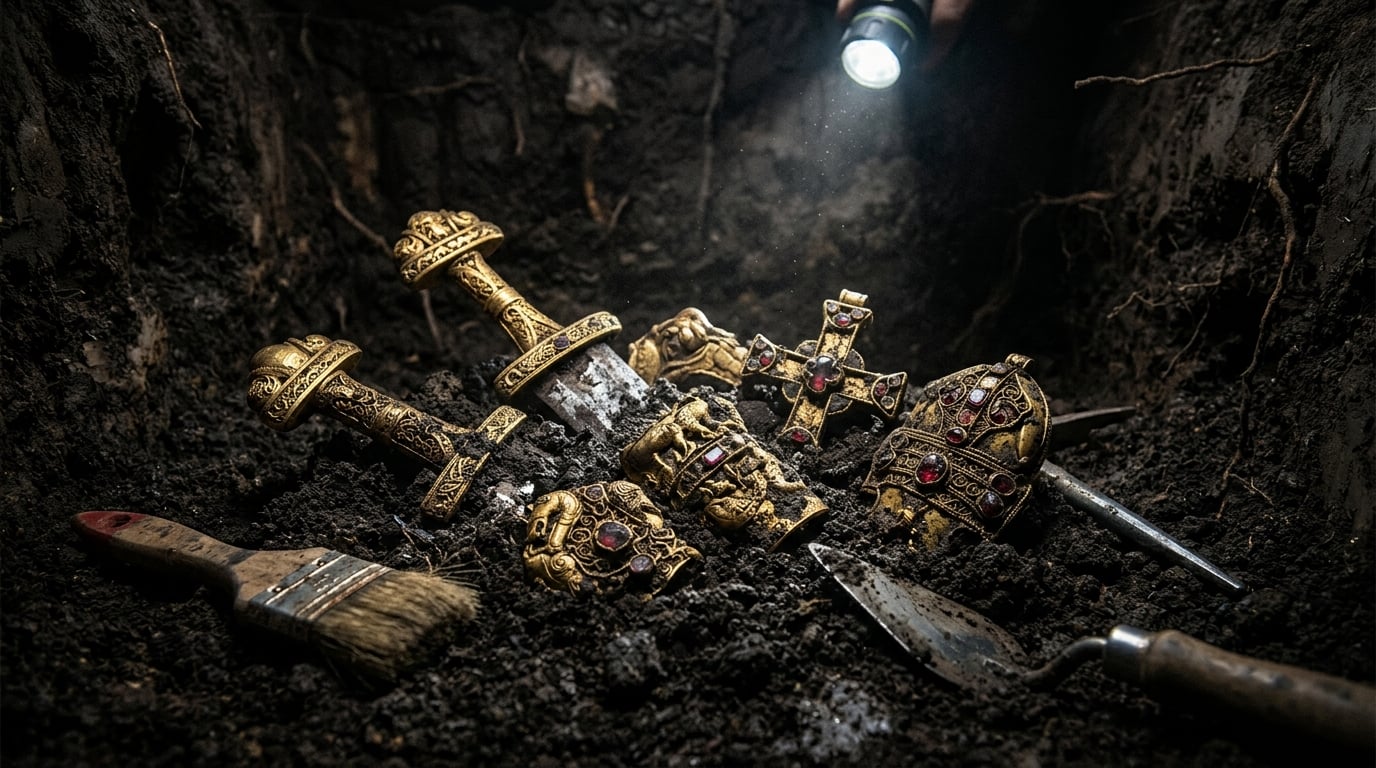
Let me be precise about the inventory, because precision matters here. The hoard contains almost exclusively military objects — sword fittings, helmet fragments, and war gear decorated with extraordinary craftsmanship. There are pommel caps, hilt plates, and sword pyramid mounts, many inlaid with garnets cut to tolerances that would challenge a modern jeweler. There are pieces of at least one — possibly two — ceremonial helmets of a quality reserved for kings or the highest nobility.
Conspicuously absent: coins, jewelry, domestic items, religious relics of the kind typically buried with the dead. This is not a grave hoard. It is not a merchant's savings. It is, by every material indicator, the stripped war gear of defeated warriors — trophies, possibly, or the spoils of a catastrophic military defeat collected and buried in a single, urgent event.
One item stands apart from the rest. A small gold strip, bent and folded, bears a Latin inscription from the Book of Numbers: Surge domine et dissipentur inimici tui et fugiant qui oderunt te a facie tua — "Rise up, Lord, and may your enemies be scattered; let them who hate you flee before you." A war prayer. Stamped in gold. Folded as if discarded or deliberately defaced.
"The quality of the craftsmanship is the best I've ever seen from this period," said Leslie Webster, former keeper of the British Museum's Department of Prehistory and Europe. "Whoever made these objects was working at the absolute pinnacle of Anglo-Saxon artistic achievement."
The Dating Problem
Archaeologists have dated the hoard to roughly 600–650 AD, the heart of the Mercian kingdom's rise to dominance in central England. This was a period of near-constant warfare between Anglo-Saxon kingdoms — Mercia, Northumbria, East Anglia, Wessex — each fighting for territorial supremacy in the power vacuum left by Rome's collapse two centuries earlier.
The dating creates a specific historical window, but it doesn't narrow the suspects. At least a dozen significant military engagements occurred in the Midlands during this fifty-year span. The hoard could represent the aftermath of any one of them, or none of them. The historical record from this period is fragmentary at best — we're working from Bede's Ecclesiastical History and a handful of annals written decades after the events they describe.
What the dating does tell us is this: whoever buried the hoard expected to return. The items were not ritually destroyed or ceremonially interred. They were wrapped, stacked, and placed in a pit with the practical urgency of someone who intended to dig them up again. They never did.
The Theories, Ranked by Evidence
I approach competing theories the way I approached competing intelligence assessments — by asking which one requires the fewest unsupported assumptions.
Theory One: War spoils buried by a victorious Mercian king. This is the leading academic hypothesis. A Mercian war band defeats a coalition of enemies, strips their war gear as trophies, and buries the collection for safekeeping before a subsequent campaign goes badly wrong. It fits the military composition of the hoard and the geography — Hammerwich sits squarely in the Mercian heartland. The problem: no historical source records a battle of sufficient scale to produce this volume of high-status military equipment.
Theory Two: Tribute or ransom payment. The hoard represents wealth assembled from multiple sources — payments extracted from subordinate kingdoms, perhaps, or a ransom for a captured king. This explains the diversity of artistic styles in the metalwork, which suggests objects originating from different workshops across multiple kingdoms. The problem: tribute was typically paid in coin and livestock, not stripped war gear.
Theory Three: A royal treasury buried during invasion. A king or high nobleman buries his most portable wealth ahead of an advancing enemy force. The enemy wins. The king dies. The hoard stays in the ground for 1,400 years. This is emotionally satisfying but archaeologically thin — the hoard's military specificity argues against a general treasury.
None of these theories is wrong. None of them is provably right.
What the Ground Isn't Telling Us
The excavation site itself offers frustratingly little. No structure, no burial, no associated artifacts that might identify the depositor. The soil conditions that preserved the metalwork so remarkably also destroyed any organic material — leather, wood, textile — that might have provided context. We have the treasure without the story.
Ongoing analysis using X-ray fluorescence and 3D scanning has revealed construction details invisible to the naked eye, including evidence of repair work and reuse suggesting some items were already antiques when they were buried. Someone was collecting old things. That detail has never been adequately explained.
The Question That Keeps Me Up
In intelligence work, the most dangerous document is the one that doesn't fit any existing framework. The Staffordshire Hoard is that document. It is too large to be personal, too military to be ceremonial, too urgent to be planned, and too valuable to be abandoned without catastrophic cause.
Fifteen years of expert analysis have produced better questions, not better answers. The hoard sits in the Birmingham Museum and Art Gallery, magnificently displayed, thoroughly studied, and fundamentally unexplained. Whoever buried it took the explanation with them into a history that didn't bother to write their name down.
That's the part that gets me. Not the gold. The silence around it.