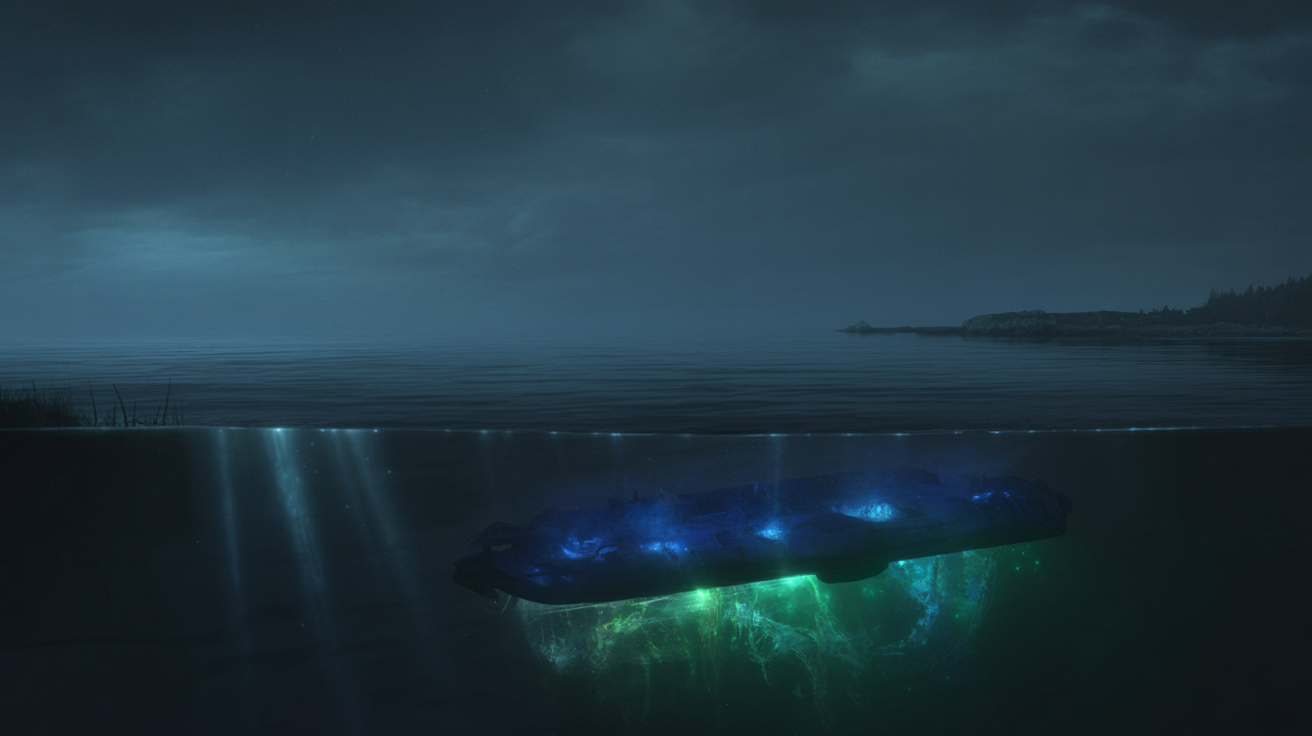
The Shag Harbour Incident: Canada's Best-Documented UFO Crash
I've spent years analyzing intelligence reports, and I can tell you that the quality of documentation often determines whether a case deserves serious attention. The Shag Harbour incident of 1967 stands apart from most UFO reports for one simple reason: it generated official paperwork. Coast Guard reports, RCMP files, military communications—all confirming that something crashed into the Atlantic that night, and that the Canadian government took it seriously enough to mount an extensive search operation.
What makes this case particularly compelling to me isn't just the physical evidence or the multiple witnesses. It's the fact that after more than five decades, the official explanation remains unsatisfying, and the documentation trail leads to classified files that have never been fully released.
The Night of October 4, 1967
At approximately 11:20 PM, residents of Shag Harbour, a small fishing village on Nova Scotia's south shore, witnessed something extraordinary. Multiple independent witnesses—including teenagers, fishermen, and a Royal Canadian Mounted Police officer—reported seeing a large object, roughly 60 feet in diameter, descending toward the water. The object displayed four bright lights in a horizontal pattern and was making a whistling sound as it descended at a 45-degree angle.
Laurie Wickens, then seventeen years old, was driving with four friends when they spotted the object. Convinced they were witnessing a plane crash, Wickens drove to the nearest phone and called the RCMP detachment. What he didn't know was that Constable Ron Pound had already witnessed the same event and was heading to the shore.
This is where the case diverges from typical UFO reports. Within minutes, official emergency response protocols were activated. This wasn't a story that would emerge years later through hypnotic regression or dubious second-hand accounts. This was happening in real-time, with multiple authorities responding to what they believed was an aircraft in distress.
The Search Operation
When Constable Pound and other witnesses reached the shore, they observed a large patch of yellow foam on the water's surface, approximately 80 feet wide, glowing in the darkness. The object itself was no longer visible, but the foam—described as thick and bright yellow—was clearly illuminated and slowly drifting with the current.
The Coast Guard dispatched vessels to the site. Local fishermen joined the search, their boats equipped with drag lines. The Rescue Coordination Center in Halifax was notified. This was a full-scale search and rescue operation, documented in official logs and reports.
Here's what troubles me about the official record: the search continued for three days, involving military divers from the Royal Canadian Navy. According to declassified documents, the divers were searching for an object that had been tracked underwater, moving along the ocean floor. Then, abruptly, the search was called off. The official explanation? No object was found.
The Underwater Track
The most intriguing aspect of this case emerged from witness testimony years later, corroborated by multiple sources. According to reports, the object didn't simply sink and remain stationary. Navy divers allegedly tracked it moving underwater for approximately 25 miles northeast, toward a location near Shelburne. Even more remarkably, some accounts suggest a second object may have joined the first before both disappeared from the area.
I've reviewed the available Canadian Forces documents through Access to Information requests. What strikes me is not what they contain, but what they don't contain. For a search operation of this magnitude—involving Coast Guard vessels, RCMP personnel, and Navy divers—the documentation is surprisingly sparse. Key reports remain classified or, according to official responses, cannot be located.
The Government Response
In 1993, the incident gained renewed attention when researchers began filing formal inquiries. The Department of National Defence acknowledged the incident but maintained that no wreckage was recovered and no explanation was ever determined. They confirmed that something was detected on sonar, that a search was conducted, but that the object—whatever it was—was never found.
This official ambiguity is what keeps me returning to this case. We're not dealing with anonymous witnesses or blurry photographs. We have named RCMP officers, Coast Guard personnel, and Navy divers who participated in an official search for an unidentified object. The Canadian government spent resources and deployed military assets in response to this incident. Yet the official conclusion is essentially: we don't know what it was.
Alternative Explanations
I've considered the conventional explanations, as any serious investigator must. Could it have been a meteor? Possible, but meteors don't typically descend at controlled angles, hover, or leave foam on the water's surface. Could it have been a crashing aircraft? The search found no debris, no oil slick, no bodies, and no aircraft were reported missing. Could it have been a Soviet submarine during the Cold War? This theory has some merit, but doesn't explain the aerial descent witnessed by multiple observers, nor the glowing foam.
The Russian submarine theory gained traction in later years, particularly given the Cold War context and the object's reported underwater movement. However, declassified Soviet naval records from that period show no submarine activity in that area, and no incidents involving Soviet vessels off the Canadian coast on that date.
The Witness Credibility
What separates Shag Harbour from many UFO cases is the caliber and consistency of witnesses. Constable Ron Pound was a serving RCMP officer with no history of making extraordinary claims. Laurie Wickens and his friends were local teenagers with no apparent motive for fabrication. The fishermen who participated in the search were experienced mariners familiar with the waters and typical phenomena in the area.
I've learned to be skeptical of cases that rely on a single witness or emerge years after the alleged event. Shag Harbour had multiple independent witnesses reporting the same event in real-time to authorities. Their descriptions aligned. Their credibility remained intact over decades of follow-up interviews.
What the Documents Tell Us
The paper trail is both the strength and the frustration of this case. We know from official records that:
- The RCMP responded to reports of an object crashing into the water
- The Coast Guard conducted an active search
- The Rescue Coordination Center was involved
- Navy divers were deployed to search underwater
- Something was detected but never recovered
- The case was never officially solved
What we don't have are the complete military files, the full sonar records, or detailed reports from the Navy divers. These gaps in the documentation are telling. In my experience analyzing classified information, what's withheld is often more significant than what's released.
The Enduring Mystery
More than fifty years later, Shag Harbour remains one of the most credible UFO incidents on record. It's not credible because it proves extraterrestrial visitation—it doesn't. It's credible because it's well-documented, involved multiple reliable witnesses, and generated an official response that acknowledged something unexplained occurred.
The Canadian government has never provided a satisfactory explanation. The object was never identified. The search operation found nothing, yet something prompted that search in the first place. The witnesses never recanted. The documentation, while incomplete, confirms the basic facts of the incident.
As an investigator, I'm comfortable with uncertainty when the evidence doesn't support a definitive conclusion. Shag Harbour represents exactly that kind of case—too well-documented to dismiss, too unexplained to categorize. Whatever descended into those waters on October 4, 1967, it left behind something more valuable than wreckage: a documented mystery that challenges our assumptions about what we know and what remains unknown.
The files that could provide answers remain classified or missing. Until they surface, Shag Harbour stands as a reminder that some of the most credible mysteries are the ones with the best documentation—and the most frustrating gaps in the official record.
🛸 Video: Shag Harbour Incident Canadas
A Knight Phenomena Investigation