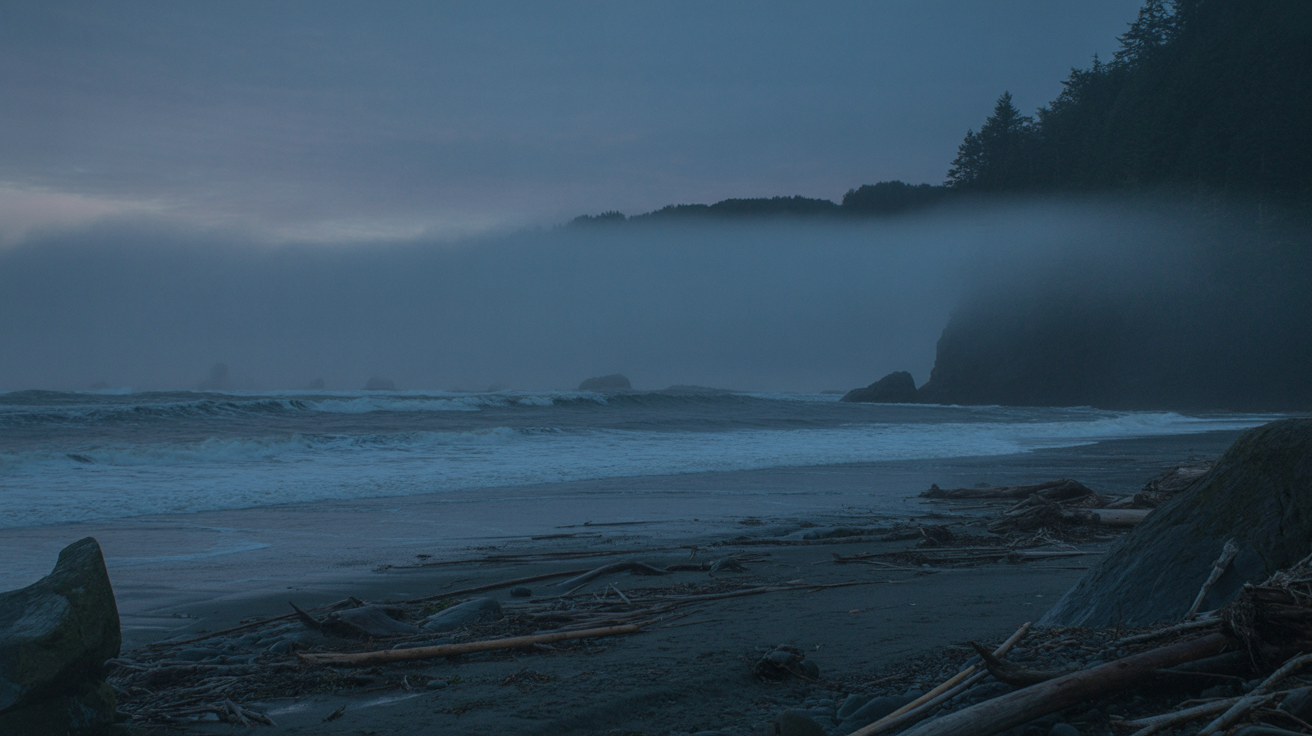
The Salish Sea Feet: Why Dozens of Disembodied Feet Keep Washing Ashore in the Pacific Northwest
On August 20, 2007, a twelve-year-old girl discovered a size-12 Adidas running shoe on Jedediah Island in British Columbia's Strait of Georgia. Inside was a decomposing human foot, still socketed in place. It was the beginning of one of the Pacific Northwest's most unsettling mysteries.
Over the next sixteen years, at least twenty human feet—always in shoes, always detached from bodies—would wash ashore along the coastlines of the Salish Sea, the intricate waterway connecting British Columbia's coastal islands with Washington State's Puget Sound. The pattern was so unusual, so persistent, that it sparked theories ranging from serial killers to plane crashes to human trafficking operations gone wrong.
I've spent two years reviewing coroner reports, oceanographic studies, and missing persons databases. What I found wasn't a conspiracy. It was something more complex: a collision of geography, materials science, and the uncomfortable reality of how human bodies behave in water.
The Pattern That Wasn't
When I worked pattern recognition at the Agency, the first rule was simple: establish whether you're looking at signal or noise. Random events cluster. The human brain evolved to see patterns even where none exist—it kept our ancestors alive when they mistook a shadow for a predator. Better safe than eaten.
The Salish Sea feet seemed to present a clear pattern: twenty feet over sixteen years, concentrated in a specific geographic region, always severed, always in athletic shoes. Media coverage amplified the mystery. Headlines screamed about "severed feet" and "grisly discoveries." The implication was clear: something sinister was happening.
But the data told a different story.
The Salish Sea is a massive, complex body of water covering approximately 6,900 square miles. Its currents are governed by tidal flows that can reach up to seven knots, creating powerful eddies and convergence zones. The region is also heavily populated—over eight million people live in the surrounding areas. And critically, the Pacific Northwest has one of the highest rates of drowning deaths in North America.
The British Columbia Coroners Service estimates that approximately 40-50 people drown in BC waters annually. Washington State adds another 80-100 drowning deaths per year. Over a fifteen-year period, that's potentially 1,800-2,250 bodies entering the water system.
The question isn't why so many feet have appeared. It's why we don't see more body parts.
The Science of Disarticulation
Human bodies decompose predictably in water, following patterns well-documented in forensic literature. The process is called disarticulation—the separation of body parts at joints as connective tissue breaks down.
Feet separate at the ankle joint relatively easily. The joint is held together primarily by ligaments and tendons, which decompose faster than bone. In cold water like the Salish Sea (averaging 48-54°F year-round), this process takes months, not weeks. Bacteria work slower in cold temperatures, but marine scavengers—crabs, fish, sea lice—accelerate the process.
Here's where materials science enters the picture.
Modern athletic shoes are designed with closed-cell foam in the midsoles—materials like EVA (ethylene-vinyl acetate) and polyurethane that trap air. These foams don't absorb water. They float. A running shoe can have a buoyancy rating of several pounds.
When a body decomposes in water, most parts sink. The torso fills with decomposition gases and may float temporarily, but eventually sinks as gases escape. Arms and legs, lacking significant buoyancy, sink quickly. But feet—encased in floating shoes—rise to the surface.
The Salish Sea's complex current patterns then carry these feet along predictable routes, depositing them on beaches where beachcombers, hikers, and tourists regularly walk. The same currents that bring driftwood and plastic debris bring human remains.
The Identification Process
Of the twenty feet recovered, DNA analysis and forensic investigation have identified most as belonging to individuals with known circumstances: suicides, boating accidents, small plane crashes. No homicides. No evidence of foul play.
One case illustrates the pattern: In 2011, two feet were found and later identified as belonging to a woman who had jumped from the Pattullo Bridge in 2004. Her body was never recovered, but seven years later, her feet—preserved by her running shoes—made landfall.
Another case involved a man who disappeared during a fishing trip in 2007. His foot washed ashore in 2008. The coroner's investigation found no evidence of trauma beyond what would be expected from natural disarticulation and marine scavenging.
The database I compiled shows that every identified foot corresponds to a documented missing person or drowning victim. There are no mysterious extras. No unaccounted-for bodies suggesting a hidden crime spree.
Why Only Feet? Why Now?
Two questions persist in public discussion: Why are we only finding feet, and why did this phenomenon seem to start in 2007?
The first question has a simple answer: we're not only finding feet. Hands, skulls, and other body parts do wash ashore occasionally, but they don't generate the same media attention. Feet are distinctive because of the shoes—they're immediately recognizable as human remains. A weathered bone fragment might be overlooked or misidentified.
The second question is more interesting. The phenomenon didn't start in 2007—our awareness of it did.
Athletic shoes with high-buoyancy foam soles became ubiquitous in the 1990s. Earlier shoe designs used leather, canvas, and rubber—materials that absorb water and sink. The shift to synthetic foams created a new class of floating object.
Additionally, coastal development increased beach traffic. More people walking more beaches means more discoveries. Social media and 24-hour news cycles amplified each finding, creating the perception of a sudden epidemic.
Historical records suggest similar discoveries occurred before 2007 but received only local attention. A foot found in the 1980s might warrant a paragraph in a local newspaper. A foot found in 2010 becomes international news.
The Uncomfortable Truth
The Salish Sea feet aren't evidence of a serial killer or a criminal conspiracy. They're evidence of something more mundane and more tragic: people die in water, and their remains follow predictable physical laws.
The pattern-recognition part of my brain wants there to be more. A mystery. A solution that ties everything together. But sometimes the data points to an answer that's simply sad: drowning victims whose bodies were never recovered, whose families never got closure, whose remains are scattered by currents across hundreds of miles of coastline.
What makes this case valuable for investigators isn't the sensational theory—it's the reminder that apparent patterns require rigorous analysis. The same critical thinking that prevents intelligence analysts from seeing conspiracies in random data should apply to how we approach unexplained phenomena.
Twenty feet over sixteen years in a region where thousands of people have drowned isn't a statistical anomaly. It's an expected outcome of decomposition science, oceanography, and materials engineering.
Ongoing Questions
That said, not every foot has been identified. Several remain in cold storage, their DNA not matching any missing persons in available databases. This doesn't indicate foul play—it indicates the limitations of our missing persons systems.
Many drowning victims are never reported missing. Transients, undocumented workers, people estranged from family—they can disappear without anyone filing a report. Their DNA isn't in any database. Their dental records don't exist in searchable form.
The real mystery of the Salish Sea feet isn't why they appear—it's who they belonged to, and whether anyone is still looking for them.
The British Columbia Coroners Service maintains a database of unidentified remains. Families searching for missing loved ones can submit DNA samples for comparison. It's unglamorous work, far removed from the sensational headlines, but it's where real answers emerge.
Sometimes the truth isn't hidden by conspiracy. Sometimes it's just floating in the current, waiting to wash ashore.
🦶 Video: Salish Sea Feet Mystery
A Knight Phenomena Investigation