Roanoke: What Happened to the Lost Colony?
Few mysteries have been burdened with as much legend as Roanoke, and few deserve a more careful reading of the record. The story is familiar: an English colony established on the edge of the Atlantic world, a failed resupply effort, and then, in 1590, an empty settlement with no bodies, no battle scene, and no clear explanation. What remains is not a supernatural puzzle, but a human one—one shaped by isolation, weather, politics, and the fragile logistics of colonization.
The Colony That Arrived Too Early
Roanoke was not England’s first attempt at planting a foothold in North America, but it was among the most ambitious. In the 1580s, Sir Walter Raleigh backed expeditions to the Carolina coast in hopes of establishing a base for trade, privateering, and imperial expansion. The final group, led by John White, arrived in 1587 and settled on Roanoke Island, off what is now North Carolina.
It was a precarious beginning from the start. The colony included men, women, and children, but it lacked the resources of a mature settlement. Relations with nearby Indigenous groups varied, and supplies were limited. White soon returned to England to seek aid, expecting to come back within months. He did not.
History intervened. England was under threat from the Spanish Armada, and naval priorities shifted sharply. White’s return was delayed for three years. When he finally reached Roanoke in 1590, he found the settlement abandoned.
What Was Left Behind
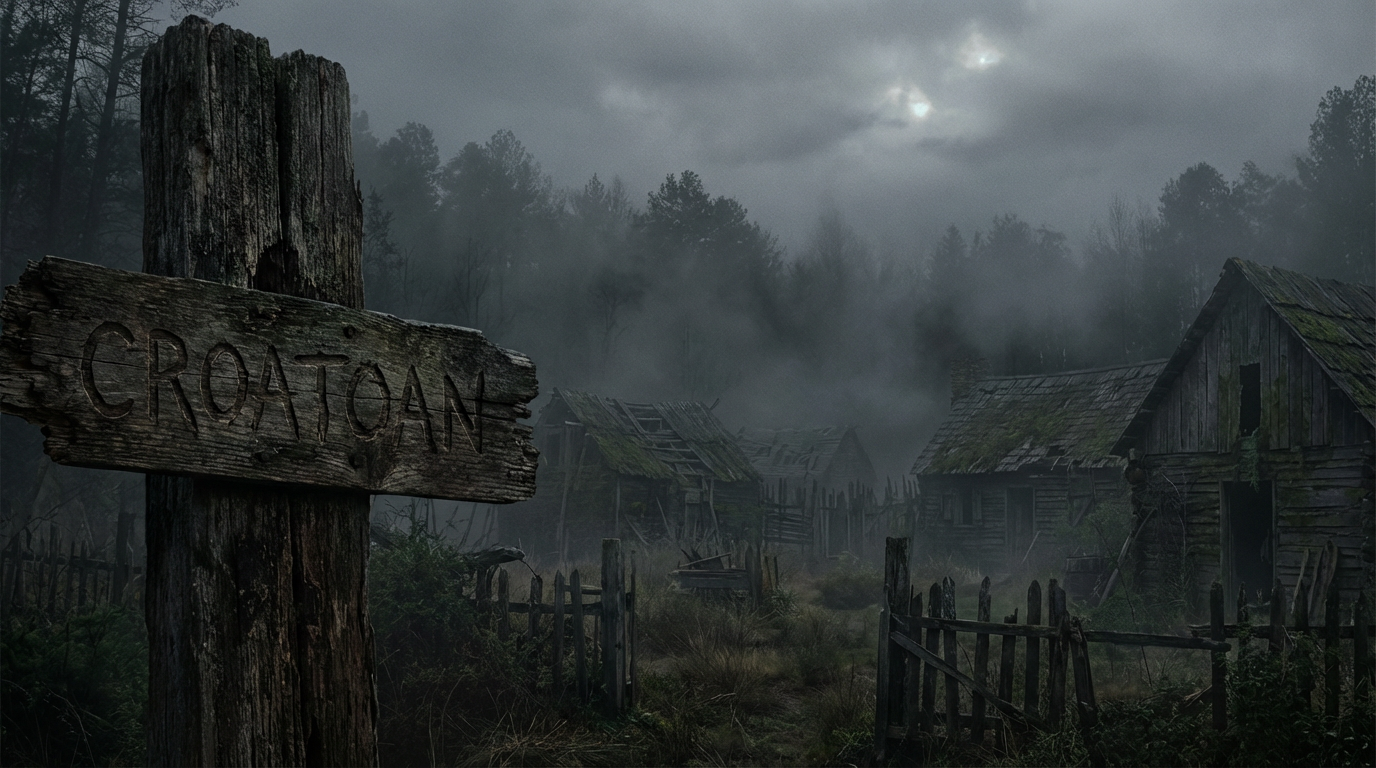
The evidence was sparse, but not empty. The houses had been dismantled rather than destroyed. There were no obvious signs of a struggle. The most famous clue was the word “CROATOAN” carved into a post, with the letters “CRO” found on a tree or nearby structure, depending on the account. White had previously agreed with the colonists that, if they moved, they should leave a message indicating their destination. If they were forced away, a cross would supposedly accompany the sign.
No cross was found. That fact has fueled centuries of speculation. But it also matters that the word itself was not random. Croatoan referred to both an island and the people living there, in what is now the vicinity of Hatteras. In other words, the clue points not to a mystery location on a map, but to a plausible direction of movement.
That is where the story becomes less sensational and more difficult. The colonists may have left deliberately, likely seeking food, allies, or protection. If so, they may have survived for a time by moving inland or by merging with nearby communities. The record, however, becomes thin almost immediately after their disappearance.
Theories That Hold Up Best
Over the centuries, the Roanoke mystery has attracted every kind of theory, from massacre to abduction to exotic collapse. Most do not survive serious scrutiny. There is no solid evidence of a foreign attack. There is no archaeological sign of a sudden catastrophe on the scale of an annihilating fire or epidemic at the original site. And there is no credible basis for imagining a single dramatic event that neatly explains all the missing people.
The strongest explanations are also the least glamorous. One is that the colony split up. Some settlers may have joined Indigenous communities, voluntarily or under necessity. Others could have attempted to relocate to the mainland, where they would have faced disease, hunger, and the challenges of living without secure supply lines. In a fragile frontier environment, disappearance does not require mystery in the cinematic sense; it only requires repeated failure under harsh conditions.
Another possibility is that the colony was absorbed into existing Native networks over time. Several historical accounts and later archaeological interpretations suggest possible contacts, alliances, and intermarriage between Europeans and Indigenous people in the region. That does not prove that every colonist survived, but it offers a more plausible framework than the idea of a neatly frozen, vanished settlement.
Archaeology and the Limits of Certainty
Archaeological work has produced clues, though not a final answer. In the broader region, investigators have found European-style artifacts that suggest some settlers may have moved away from the original island site. These findings are important, but they are also difficult to interpret. A shard of pottery or a tool fragment can indicate presence, trade, or later disturbance. It does not, by itself, map an entire population’s fate.
That is the central problem with Roanoke: the evidence is suggestive but incomplete. History often gives us enough data to rule out fantasy while still withholding the one piece that would close the case. We know the colony was abandoned. We know White found no sign of a massacre. We know a message pointed toward Croatoan. Beyond that, certainty starts to weaken.
Recent research has also emphasized the environmental context. Colonists arrived during a period of climate stress, and the region may have been experiencing drought or shifting resource conditions. For a settlement dependent on imported supplies and local cooperation, even modest environmental pressures could have become decisive. In that sense, Roanoke may be less a tale of sudden disappearance than of gradual attrition.
Why the Mystery Endures
Roanoke persists because it sits at the intersection of documentation and absence. We have a colonial paper trail, but not enough to reconstruct the outcome. We have a single surviving clue that seems purposeful, but not enough to confirm where it led. We have names, dates, and maps, but the people themselves have slipped through the historical net.
There is also a deeper reason it continues to fascinate. Roanoke is the kind of mystery that forces us to confront the gap between what was recorded and what actually happened. Colonial history often reads like a ledger of ambitions, yet the lived experience was fragile and improvisational. A settlement could fail for reasons that leave almost no dramatic trace.
That is not a satisfying ending, but it may be the most honest one. The Lost Colony was not necessarily erased by an extraordinary event. It may simply have been scattered, absorbed, starved, or displaced until the original identity dissolved. If that sounds anticlimactic, it is only because history is rarely obligated to provide a neat reveal.
A Measured Conclusion
After four centuries, the Roanoke Colony remains unresolved, but not incomprehensible. The most defensible reading is that the settlers likely relocated after conditions on the island became untenable, possibly seeking refuge with Croatoan people or other nearby groups. Some may have survived longer than others. Some may have been integrated into local communities. Some may have died along the way. The evidence allows for movement, hardship, and partial survival more readily than for a single catastrophic event.
What it does not allow is certainty. And that is precisely why Roanoke matters. It reminds us that the past is not always hidden by conspiracy or spectacle. Sometimes it is hidden by logistics, by weather, by distance, and by the simple fact that human beings can vanish from the written record without vanishing entirely from history.
🏝️ Video: Roanoke Lost Colony Mystery
A Knight Phenomena Investigation