The Phaistos Disc: An Undeciphered Message from Ancient Crete
The Phaistos Disc: An Undeciphered Message from Ancient Crete
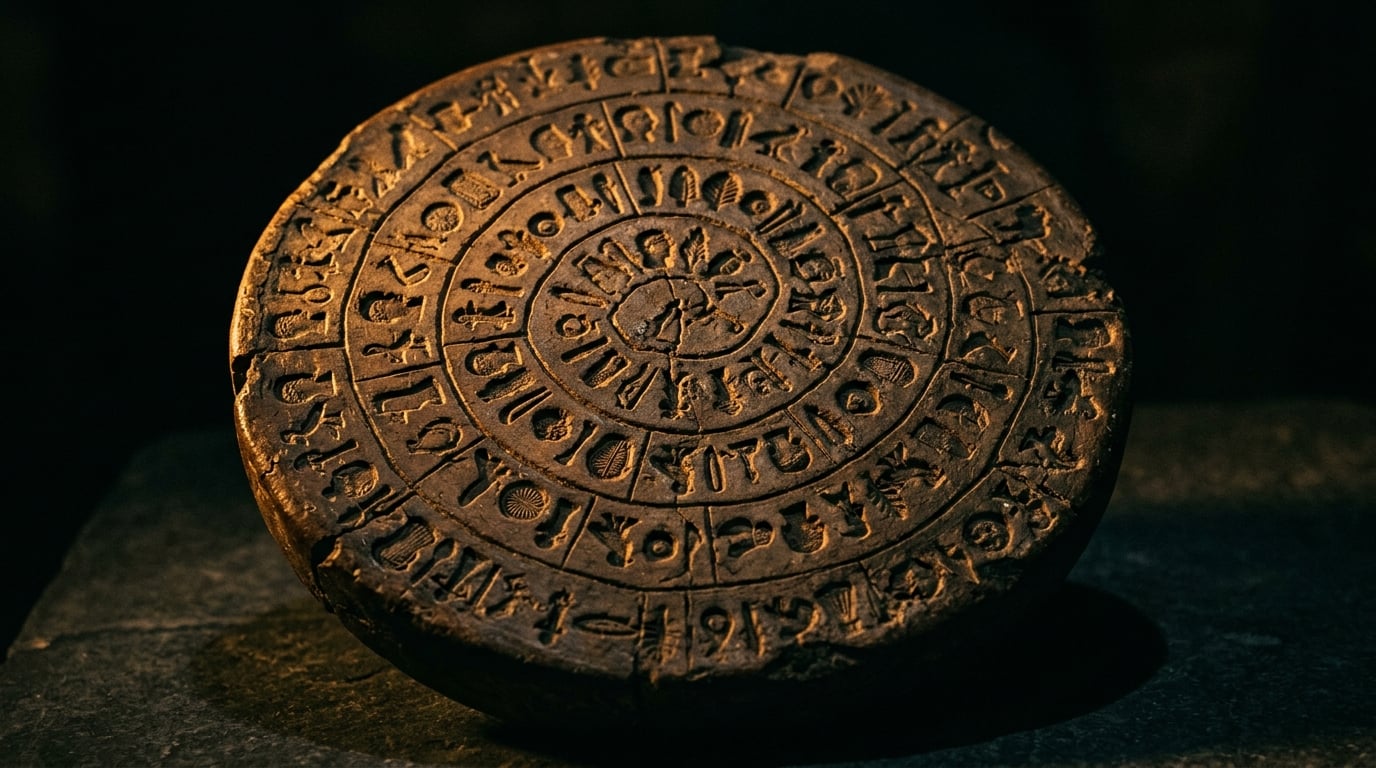
In the summer of 1908, Italian archaeologist Luigi Pernier was excavating a basement room in the Minoan palace of Phaistos on the southern coast of Crete when he uncovered something that would baffle scholars for over a century. Nestled among the ruins was a fired clay disc, approximately 16 centimeters in diameter, covered on both sides with a spiral arrangement of stamped symbols unlike anything seen before or since in the archaeological record.
The Phaistos Disc, as it came to be known, represents one of archaeology's most enduring mysteries. After more than 115 years of study, we still cannot read it. We don't know what it says, who made it, or even whether it's genuine. What we do know raises more questions than answers.
The Physical Evidence
Let's start with what's verifiable. The disc is real—it sits today in the Heraklion Archaeological Museum in Crete, where it's been examined by countless experts. It's made of fired clay, dated to approximately 1700 BCE based on the archaeological context of its discovery. Both sides contain 241 tokens comprising 45 distinct signs, arranged in a spiral pattern that reads from the outside edge toward the center.
Here's where it gets interesting: the symbols weren't hand-drawn. They were stamped into the soft clay using individual seals or punches before firing. This makes the Phaistos Disc potentially the world's oldest example of movable type printing, predating Gutenberg by over three millennia. Each symbol appears to have been created with a separate tool, suggesting a deliberate system of reproduction.
The symbols themselves depict recognizable objects: human figures, animals, plants, tools, and geometric shapes. There's a walking man, a plumed head, a fish, a bird, a ship, various plants, and architectural elements. They're clearly representational, but whether they're pictographic (representing the objects themselves), ideographic (representing concepts), or phonetic (representing sounds) remains unknown.
The Context Problem
During my years analyzing intelligence, I learned that context is everything. A message without context is just noise. The Phaistos Disc suffers from a severe context deficit.
Pernier's excavation notes indicate the disc was found in a basement room alongside a Linear A tablet, pottery, and other artifacts from the Middle Minoan period. But we have no comparable objects. No other examples of this script have ever been found—not in Crete, not anywhere in the Mediterranean, not anywhere in the world. It's a unique artifact, which immediately raises red flags for any serious investigator.
In cryptanalysis, you need multiple examples to establish patterns, frequency distributions, and contextual usage. The Phaistos Disc gives us exactly one data point. Imagine trying to crack a code with only a single encrypted message and no key. That's the challenge scholars face.
Theories and Attempts at Decipherment
Over the decades, researchers have proposed numerous interpretations. Some have claimed it's a prayer, others a calendar, a board game, a geometric theorem, or even an ancient hymn. Various scholars have attempted to read it as an early form of Greek, as Luwian (an Anatolian language), or as a completely unknown language.
The problem with most decipherment attempts is methodological. Without a bilingual text (like the Rosetta Stone) or a large corpus of examples, any proposed translation is essentially unfalsifiable. You can make the symbols say almost anything if you're creative enough with your assumptions. I've reviewed dozens of these proposals, and while some are ingenious, none have achieved scholarly consensus.
One persistent theory suggests the disc isn't Cretan at all, but was imported from elsewhere—possibly Anatolia or the Levant. The stamped nature of the symbols and the unique character set could indicate a foreign origin. But again, without comparative evidence, this remains speculation.
The Forgery Question
Any investigator worth their salt has to consider the possibility of fraud. Could the Phaistos Disc be a modern forgery?
The arguments for authenticity are strong. The disc was found in a controlled archaeological excavation by a reputable archaeologist. The clay composition and firing technique are consistent with Minoan pottery. The archaeological context—the stratum in which it was found—appears legitimate. Creating a convincing forgery in 1908 would have required knowledge of Minoan archaeology that barely existed at the time.
However, the disc's uniqueness is troubling. In intelligence work, when something seems too convenient or too unusual, we dig deeper. The fact that nothing like this has ever been found before or since, despite extensive excavations across Crete and the broader Aegean, is statistically anomalous. It's not proof of forgery, but it warrants skepticism.
What We Can Reasonably Conclude
After examining the evidence with the same rigor I'd apply to any intelligence assessment, here's what I can state with confidence:
- The Phaistos Disc is almost certainly an authentic ancient artifact from approximately 1700 BCE
- It represents a writing system or symbolic notation that was created using stamped seals
- The symbols are representational and appear to follow some organizational logic
- We cannot currently read it, and may never be able to without additional examples
- Any claimed "translation" should be viewed with extreme skepticism
The Larger Mystery
Perhaps the most intriguing question isn't what the disc says, but why only one exists. If this was a functional writing system, where are the other examples? If it was a one-off creation—perhaps a religious object or a diplomatic gift—why go to the trouble of creating individual stamps for each symbol?
The Phaistos Disc reminds us that the ancient world still holds secrets we may never fully unlock. Sometimes the most honest answer an investigator can give is: "We don't know." That's where we stand with this enigmatic artifact from Bronze Age Crete—fascinated, frustrated, and still searching for answers that may not exist.
The disc continues to sit in its museum case, its spiral of symbols still keeping their secrets after more than three millennia. Perhaps that's exactly as it should be. Not every mystery needs to be solved to be valuable. Some simply remind us how much we have yet to learn.