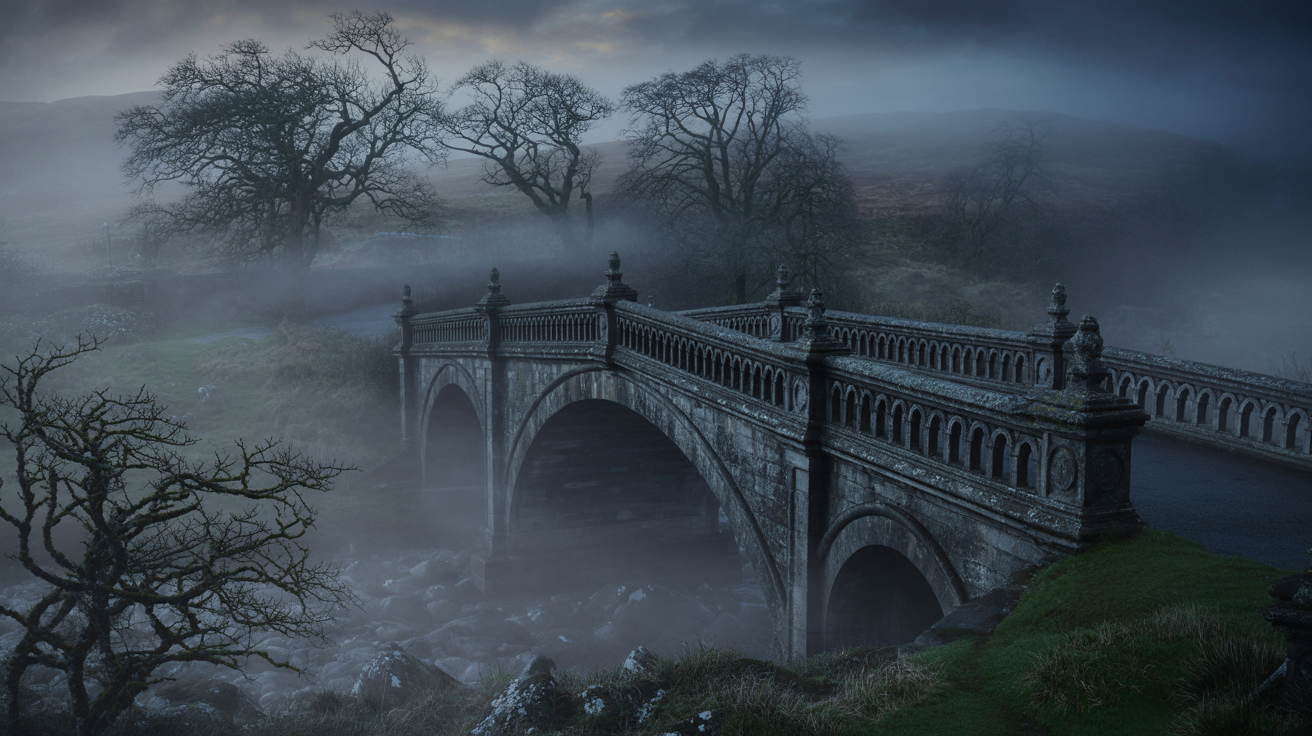
The Overtoun Bridge: Where Dogs Leap to Their Deaths
During my years at the CIA, I learned that the most compelling mysteries aren't always the ones involving classified documents or covert operations. Sometimes, the most unsettling patterns emerge from seemingly ordinary places—like a picturesque stone bridge in the Scottish countryside where dogs have been leaping to their deaths for more than half a century.
Overtoun Bridge, located near the village of Milton in West Dunbartonshire, Scotland, is an architectural marvel from the Victorian era. Built in 1859, it spans fifty feet above Overtoun Burn, a rocky stream that winds through a lush glen. The bridge itself is beautiful—an elegant arc of granite that has graced countless photographs and paintings. But since the 1950s, it has earned a far darker reputation.
The Pattern Emerges
The first documented cases began appearing in the 1950s and 1960s, but it wasn't until the 1990s that the phenomenon gained widespread attention. Dogs, often while walking calmly with their owners, would suddenly and without warning leap over the bridge's parapet wall. The jump always occurred from the same side—the right-hand side facing toward Overtoun House—and almost always from the same two parapets between the final two spans.
The statistics are chilling. Conservative estimates suggest that over 600 dogs have jumped from Overtoun Bridge since the 1950s. Of these, approximately 50 have died from the fall, while many others sustained serious injuries. What makes this pattern particularly disturbing is its specificity: the dogs don't jump randomly along the bridge's length. They jump from one particular spot, as if responding to something imperceptible to their human companions.
Even more unsettling are the cases of dogs that survived the initial fall, recovered from their injuries, and then returned to the bridge only to jump again. This behavior defies the basic principles of animal learning and self-preservation that we understand.
The Witnesses
In my investigative work, witness testimony forms the foundation of pattern analysis. At Overtoun Bridge, the accounts are remarkably consistent. Donna Cooper, whose collie Ben jumped from the bridge in 2014, described the incident to local media: "He just jumped up on the wall and leaped off. There was no hesitation, no looking around. It was like he was in a trance."
Kenneth Meikle experienced an even more tragic version of this phenomenon. In 1994, his dog jumped from the bridge and died. Grief-stricken, Meikle later threw his infant son from the same bridge, believing the location to be an exit to heaven. The child died, and Meikle was subsequently committed to a psychiatric hospital. While this case involves clear mental illness, it demonstrates how the bridge's reputation has taken on a life of its own, feeding into local folklore and psychological distress.
Paul Owens, a local historian who has studied the bridge for years, has documented case after case with eerie similarities: clear weather, calm dogs, sudden compulsion, the same jumping point. The consistency of the pattern is what drew my attention. In intelligence work, when you see the same behavior repeated across different actors with no apparent coordination, you look for an environmental trigger.
The Theories
Several explanations have been proposed, ranging from the scientific to the supernatural. Let me address them with the same analytical framework I used when evaluating intelligence reports.
The Mink Hypothesis: Animal behaviorist Dr. David Sands conducted an investigation in 2010 and concluded that the scent of mink, which inhabit the area below the bridge, might be overwhelming dogs' senses. Dogs have up to 300 million olfactory receptors compared to humans' mere 6 million. The theory suggests that certain breeds—particularly long-nosed breeds like collies, retrievers, and labradors, which are overrepresented in the incidents—might be so stimulated by the mink scent that they leap toward it without perceiving the danger.
This theory has merit. Mink were introduced to Scotland in the 1950s for fur farming, and many escaped into the wild—the same period when the jumps began. The scent would be concentrated in the specific area where the bridge's solid granite sides give way to open parapets, explaining the location specificity. However, this doesn't fully explain why dogs would override their depth perception and self-preservation instincts, or why some dogs return to jump again.
The Acoustic Explanation: Some researchers have suggested that high-frequency sounds, inaudible to humans but detectable by dogs, might emanate from the area below the bridge. Water flowing over rocks can create ultrasonic frequencies, and the bridge's architecture might amplify certain sound waves. Dogs hearing these sounds might become disoriented or compelled to investigate the source.
This theory aligns with documented cases of animals behaving strangely in response to sounds humans cannot detect. However, no comprehensive acoustic study of the bridge has been conducted to verify the presence of such frequencies or their potential effect on canine behavior.
The Supernatural Interpretation: Local legend holds that Overtoun Bridge is haunted. The nearby Overtoun House has its own dark history, and some believe that supernatural forces draw the dogs to jump. The "White Lady of Overtoun" is said to haunt the area, grieving for her husband who died in 1908. Others point to the bridge's proximity to ancient Celtic sites and suggest residual energies.
As a former intelligence analyst, I'm trained to seek evidence-based explanations. However, I'm also trained not to dismiss patterns simply because they don't fit conventional frameworks. The supernatural explanation fails to account for why only dogs are affected, why the phenomenon began in the 1950s rather than earlier, and why it occurs at such a specific location.
The CIA Analyst's Perspective
When I analyze this case, several elements stand out that would have triggered further investigation in my previous work:
Geographic Specificity: The jumps occur from a precise location—always the same side, almost always the same two parapets. In intelligence analysis, this level of geographic clustering suggests a localized trigger rather than a widespread phenomenon. If this were purely behavioral or psychological, we would expect more random distribution along the bridge's length.
Temporal Patterns: The phenomenon appears to have begun in the 1950s and continues to the present day. This timeline correlates with environmental changes in Scotland, including the introduction of mink, changes in local wildlife populations, and potentially alterations to the acoustic environment due to modern development.
Breed Correlation: Long-nosed breeds are disproportionately represented. This suggests a sensory component—these breeds have enhanced olfactory capabilities and may be detecting something that other breeds, and certainly humans, cannot perceive.
Weather Conditions: Most incidents occur on clear, dry days. This is significant. Scent carries differently in various weather conditions, and acoustic properties change with humidity and air pressure. The pattern suggests that whatever triggers the behavior is most potent under specific atmospheric conditions.
If I were to approach this as an intelligence problem, I would recommend a multi-disciplinary investigation combining:
- Comprehensive olfactory mapping of the bridge area under various weather conditions
- Acoustic analysis across the full spectrum of frequencies, including those beyond human hearing
- Detailed geological survey to identify any unusual mineral compositions or electromagnetic properties
- Behavioral study using controlled conditions with various dog breeds and scent stimuli
- Historical analysis of the local ecosystem changes since 1859
The Unanswered Questions
Despite Dr. Sands' investigation and various other studies, Overtoun Bridge continues to claim canine victims. In 2019, a dog jumped despite the owner's awareness of the bridge's reputation and attempts to keep the animal on a short leash. The compulsion, whatever its source, appears strong enough to overcome restraint and training.
What troubles me most about this case is the repeat jumpers—the dogs that survive, recover, and then attempt to jump again when brought back to the bridge. This behavior suggests something more than simple curiosity or prey drive. It indicates a compulsion that overrides learned experience and survival instinct.
In my career, I've learned that the absence of a definitive explanation doesn't mean we should stop asking questions. The Overtoun Bridge phenomenon may ultimately have a prosaic explanation rooted in animal behavior and environmental factors. The mink hypothesis remains the most scientifically credible theory we have. But the specificity of the pattern, the consistency of the behavior, and the override of basic survival instincts suggest we may not yet have all the pieces of this puzzle.
Conclusion
Today, warning signs are posted at both ends of Overtoun Bridge, advising dog owners to keep their pets on short leashes. Local residents have become accustomed to cautioning visitors about the bridge's deadly reputation. Yet the jumps continue, adding to a statistical pattern that spans more than six decades.
The Overtoun Bridge mystery reminds us that some of the most perplexing phenomena occur not in remote deserts or deep oceans, but in ordinary places where the familiar suddenly becomes inexplicable. Whether the answer lies in animal neurology, environmental science, or some combination of factors we haven't yet considered, the bridge stands as a testament to how much we still don't understand about the world around us—and the animals we share it with.
For now, the dogs of Overtoun Bridge continue their inexplicable leaps, and we continue to search for answers. In intelligence work, we have a saying: the pattern is the message. At Overtoun Bridge, the pattern is clear and consistent. We're just still learning how to read it.
🐕 Video: Overtoun Bridge Dog Suicides
A Knight Phenomena Investigation