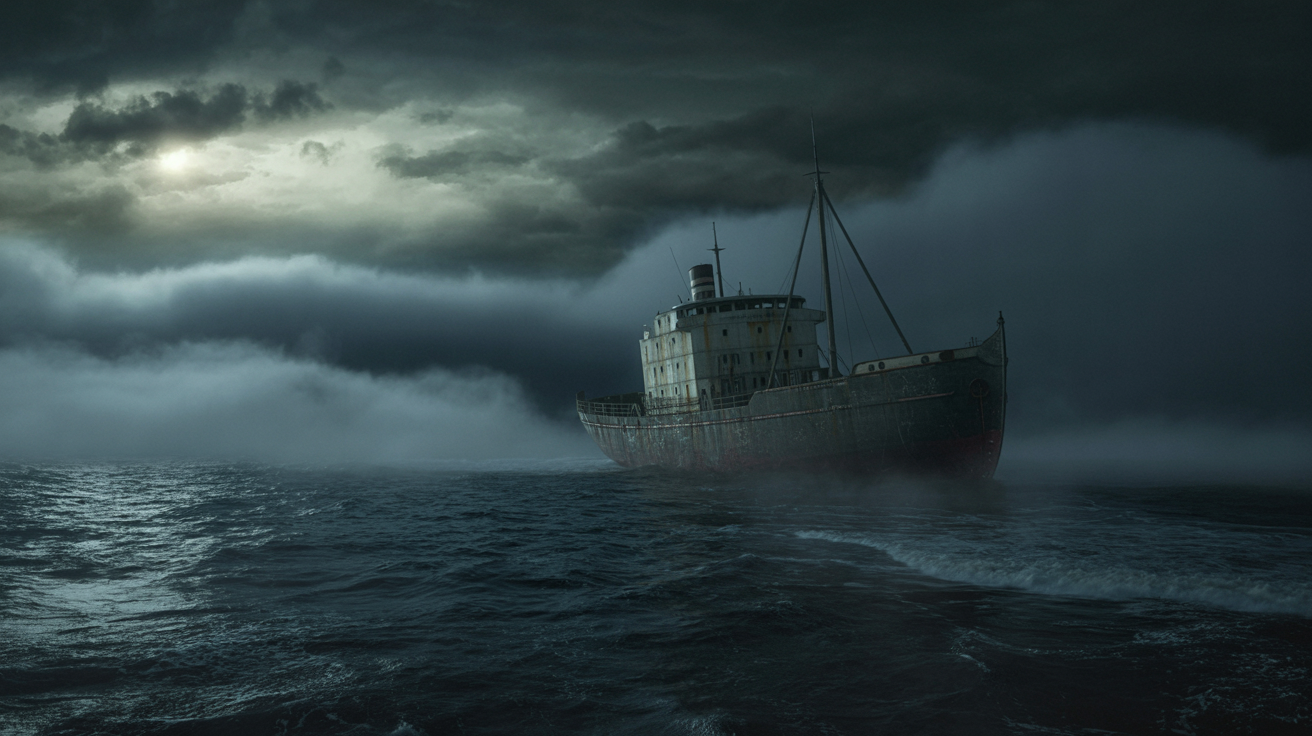
The Ourang Medan: The Ghost Ship That May Never Have Existed
A Distress Call From the Void
Some mysteries begin with a body. The Ourang Medan begins with a radio signal.
According to the most enduring version of the story, sometime in the late 1940s a series of desperate Morse messages crackled across the airwaves from the Strait of Malacca. First came a warning that the ship’s captain and crew were dead. Then a final message, reportedly transmitted by an unnamed operator on board, read something close to this:
“I am dying.”
When rescuers allegedly reached the vessel, they found a ghost ship drifting in calm water, its deck strewn with corpses, faces frozen in expressions of terror. Then, as the story goes, the freighter caught fire and exploded before anyone could examine the wreckage properly.
If that sounds like the opening act of a supernatural thriller, that is because it has all the ingredients: a remote sea lane, an invisible emergency, dead men without visible wounds, and a final destruction that conveniently erased evidence. But the Ourang Medan has never been an easy case to handle, because the story itself behaves like a fog bank. The closer you move toward it, the less there is to hold.
The Story Everyone Knows
The legend usually places the incident in 1947 or 1948, somewhere in waters between Sumatra and Malaysia. The Ourang Medan was said to be a Dutch merchant vessel, though even that detail is slippery. The ship allegedly transmitted an SOS in broken English, followed by a chilling sequence of updates from someone aboard who seemed to be in a state of shock.
One widely repeated version says the ship’s message included phrases like “All officers including captain dead lying in chartroom and on bridge,” followed by “possibly whole crew dead.” Another claim is that a final burst of static carried the words “I am dying.” Those messages have been reproduced so often that they have acquired the texture of fact, even though their original source is deeply uncertain.
In the legend, a nearby American or British vessel answered the distress call and approached the drifting ship. Boarding parties reportedly found every crew member dead, eyes open, bodies rigid, no visible trauma. Then came the fire. Then the explosion. Then silence.
It is exactly the sort of story that invites a broad range of explanations: poison gas, a hidden cargo, Soviet experimentation, paranormal intervention, or a classic maritime cover-up. But before any of those theories can be weighed, a more basic question has to be answered: what contemporaneous evidence actually exists?
The Paper Trail Gets Thin Very Quickly
Here is where the case turns from eerie to forensic.
Researchers who have tried to trace the Ourang Medan back to first-hand records hit a wall almost immediately. There is no universally accepted ship registry entry that cleanly confirms the vessel’s existence. No widely cited Lloyd’s record has settled the question. No official crash report, no preserved radio log, and no verified naval inquiry has emerged as the definitive document that would anchor the story in hard history.
The modern legend appears to have gained traction after it was mentioned in publications and newspapers in the 1950s, especially through accounts associated with maritime researchers and pulp-era retellings. The problem is that each new account seems to borrow from the previous one rather than from a verifiable source. That is how folklore often grows in the twentieth century: one anecdote hardens into a citation, the citation becomes a reference, and soon the reference is treated as proof.
That does not mean nothing happened. It means the story, as it is usually told, may be a reconstruction built on rumors, secondhand memory, and dramatic embellishment. In investigative terms, the Ourang Medan is less a case file than a weather system. You can see the shape of it, but you cannot always find the center.
What Could Have Happened?
If we strip away the ghost ship language, several practical explanations remain on the table.
The most plausible is toxic exposure. A ship carrying chemicals, fuel, or contraband could have leaked lethal fumes into enclosed compartments, killing the crew while leaving the bodies apparently intact. Carbon monoxide poisoning, in particular, has a long history of producing sudden, eerie deaths without obvious external wounds. A tightly sealed vessel could transform into a death chamber faster than outsiders might realize.
Another possibility is misidentification. Stories from the sea spread quickly and are often transformed during transmission, especially when the original details are vague. A damaged or abandoned ship in distress may have been misremembered, relabeled, or folded into a more dramatic tale as it moved through language and geography. By the time the Ourang Medan reached print, it may already have been part fact, part rumor, and part maritime campfire story.
There is also the matter of wartime and postwar chaos. The late 1940s were not a stable period in Southeast Asia. Shipping routes were crowded with displaced vessels, undocumented cargo, military leftovers, and improvised crews. In that environment, a mystery does not need to be supernatural to become untraceable. It only needs to be inconvenient enough for records to vanish, or ambiguous enough that no one ever wrote them down properly.
In cases like this, absence is not evidence of the paranormal. But it is often the fuel that keeps the paranormal alive.
Why the Story Refuses to Sink
So why has the Ourang Medan endured for decades while so many maritime legends fade?
Because it is structurally perfect. It has a title that sounds authentic, a geographic setting that feels isolated, a crisis that unfolds by radio, and a finale that destroys the evidence. It compresses terror into a few scenes and leaves just enough room for the imagination to do the rest. That is exactly how enduring mysteries survive: they are not fully solved, but they are beautifully framed.
There is also a deeper cultural appeal. Ships are supposed to be mastered environments. They are floating machines of order, charts, discipline, and routine. When something goes wrong at sea, especially something that leaves no clear cause, it feels like an attack on logic itself. A ghost ship is not just a vessel without a crew. It is a reminder that systems we trust can fail in ways we cannot see.
And yet skepticism matters here more than spectacle. The best evidence suggests the Ourang Medan may not have been a single well-documented incident at all, but a legend that accumulated detail over time. That does not make it uninteresting. If anything, it makes it more revealing. The story shows how a small kernel of uncertainty can expand into a full-blown mystery when the human mind meets the open sea.
The Final Verdict: Mystery, But Not Proof
If you are looking for a clean conclusion, the Ourang Medan does not offer one. There is no neat official explanation, but there is also no solid archive that confirms the supernatural version of events. What remains is something more elusive and, perhaps, more instructive: a story that behaves like evidence until you examine it closely.
That is the real reason the ghost ship still drifts through popular memory. It sits at the boundary between history and folklore, where eyewitness accounts become legends and legends acquire the authority of documents. The ocean has always been good at hiding things. In the case of the Ourang Medan, it may have hidden the truth. Or it may have hidden the fact that there was never much truth there to begin with.
Either way, the radio silence that followed is still the most unsettling part of the story. In mystery work, silence is never empty. It is usually where the real investigation begins.
🚢 Video: Ourang Medan Ghost Ship
A Knight Phenomena Investigation