The Naga Fireballs of Thailand: Spontaneous Combustion on the Mekong or Ancient Ritual Made Visible?
Knight Phenomena Investigation — Narrated Slideshow
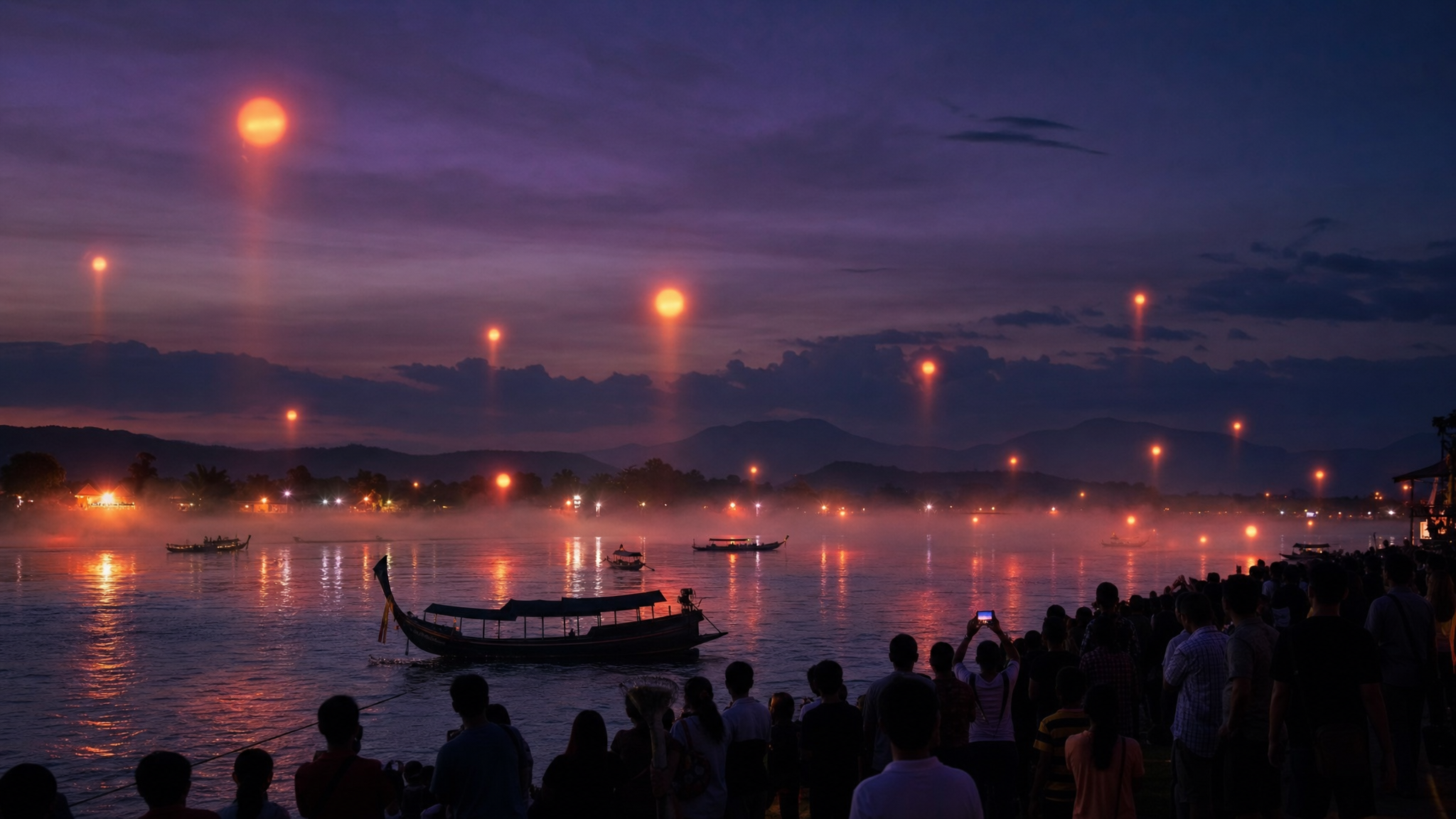
On the night of the full moon in October, along a 250-kilometer stretch of the Mekong River between Thailand and Laos, something extraordinary happens. Glowing red-orange spheres, ranging from the size of eggs to basketballs, rise silently from the water's surface. They ascend vertically at speeds estimated between 20 and 100 meters per second, reaching heights of several hundred meters before vanishing without smoke, sound, or debris.
The phenomenon is called bung fai paya naga—the Naga fireballs—named after the mythical serpent deity said to inhabit the river. Thousands of spectators gather annually to witness what has become both a scientific enigma and a cultural pilgrimage. The Thai government has documented the event. Television crews broadcast it live. Yet no consensus exists on what causes these lights.
I've spent two decades analyzing anomalous phenomena through the lens of intelligence tradecraft: pattern recognition, source validation, and the elimination of noise. The Naga fireballs present a rare case where the phenomenon is repeatable, witnessed by credible observers, and still fundamentally unexplained.
The Historical Record: Not a Modern Invention
References to the fireballs appear in regional folklore dating back centuries, but the first Western documentation came in the early 20th century. French colonial officials stationed along the Mekong reported seeing the lights, dismissing them as local superstition until they witnessed the phenomenon themselves.
The modern scientific interest began in earnest in 1999, when a Thai news crew filmed the fireballs during the annual festival. The footage, broadcast nationally, showed dozens of luminous orbs rising from the river over the course of several hours. The video quality was poor by today's standards, but the objects' behavior was unmistakable: vertical ascent, no lateral movement, no visible propulsion system.
In 2002, a documentary crew from the Thai television program Code Cracking claimed to have "solved" the mystery. They produced footage showing Lao soldiers on the opposite bank firing tracer rounds into the air, suggesting the entire phenomenon was a hoax perpetuated to boost tourism. The backlash was immediate and fierce. Local residents, scientists who had studied the phenomenon, and even Thai military officials denounced the claim. The soldiers in the footage were indeed firing—but during a separate celebration, not at the location or time when the fireballs typically appear.
What the documentary failed to address: the fireballs have been observed for decades before the modern festival existed, at multiple locations along the river, often by witnesses who had no expectation of seeing them.
The Eyewitness Testimony: Quality Over Quantity
In intelligence work, we distinguish between signal and noise. A thousand unreliable witnesses are worth less than one trained observer with no agenda. The Naga fireballs benefit from both: mass sightings and credible individual accounts.
Dr. Manas Kanoksilpa, a physician and researcher from Nong Khai Hospital, has studied the phenomenon since 2000. He conducted field observations over multiple years, documenting conditions, locations, and frequency. His data showed that the fireballs appear most reliably during October, particularly around the full moon of the 11th lunar month, which coincides with the end of Buddhist Lent. However, he also recorded sightings in other months, contradicting the theory that the phenomenon is purely seasonal.
Dr. Manas noted several consistent characteristics:
- The fireballs are predominantly red-orange in color
- They rise from specific locations along the river, not randomly
- They appear in clusters—sometimes dozens within an hour
- They leave no residue, smoke, or sound
- Weather conditions vary; the phenomenon occurs in both clear and cloudy conditions
A 2003 study by a team from the Naresuan University observed the fireballs using calibrated equipment. They confirmed the vertical trajectory and estimated the objects' temperature at approximately 100-300 degrees Celsius based on their luminosity. They could not determine composition or energy source.
Foreign witnesses add an interesting dimension. In 2001, a group of Australian tourists filmed the fireballs from a boat. Their footage, later analyzed by optical specialists, showed no evidence of digital manipulation. The objects exhibited uniform acceleration and disappeared at consistent altitudes, behaviors inconsistent with flares or pyrotechnics.
The Scientific Hypotheses: Natural Explanations Under Scrutiny
The leading natural explanation involves spontaneous ignition of methane or phosphine gas. The theory suggests that organic matter decomposing in the riverbed releases flammable gases that, under specific conditions, ignite upon contact with atmospheric oxygen.
This hypothesis has merit. Methane pockets do exist in rivers with high organic content. Spontaneous ignition of swamp gas has been documented elsewhere. The timing—late October—coincides with the end of the rainy season when water levels drop and pressure changes could release trapped gases.
However, the gas hypothesis struggles with several observations:
Consistency of location: If gas pockets were randomly distributed, the fireballs should appear unpredictably along the entire river system. Instead, they emerge from specific, repeating locations year after year.
Uniformity of behavior: Methane flames typically burn irregularly, flickering and changing color. The Naga fireballs maintain consistent shape, color, and trajectory. They don't behave like burning gas.
Altitude and duration: Methane flames would dissipate quickly as fuel is consumed. The fireballs maintain luminosity for several seconds while ascending hundreds of meters—a trajectory requiring sustained energy.
Absence of ignition source: Methane requires a spark or sufficient heat to ignite. What provides the ignition at the water's surface? Proponents suggest phosphine (which can spontaneously ignite) might serve as the trigger, but phosphine has never been detected in water samples from the Mekong.
In 2006, Dr. Surapol Sudprasert from Khon Kaen University led an expedition to test the gas hypothesis. His team collected water and sediment samples from locations where fireballs were observed. Laboratory analysis found methane concentrations, but at levels far below what would be required to produce visible flames of the observed size and duration.
Alternative Theories: From Plasma to Piezoelectricity
When conventional explanations fail, researchers propose more exotic mechanisms.
Ball lightning: Some scientists have suggested the fireballs are a form of ball lightning, a rare atmospheric electrical phenomenon. Ball lightning typically occurs during thunderstorms and lasts only seconds. The Naga fireballs appear in various weather conditions and follow predictable patterns—characteristics inconsistent with ball lightning's chaotic nature.
Piezoelectric effects: The Mekong River flows over geological formations containing quartz-rich rocks. Under tectonic stress, quartz can generate electrical charges (the piezoelectric effect). Could this charge create plasma balls that rise from the water? It's theoretically possible, but there's no evidence of tectonic activity correlating with fireball appearances. The phenomenon occurs on schedule, not during seismic events.
Bioluminescence: Could the fireballs be swarms of bioluminescent organisms? Certain bacteria and fungi emit light through chemical reactions. However, bioluminescence produces a cool glow, not the intense heat indicated by the fireballs' orange-red color. Additionally, bioluminescent organisms don't spontaneously launch themselves hundreds of meters into the air.
The Intelligence Perspective: Pattern Analysis and Anomaly Detection
During my years at the CIA, I analyzed patterns in terrorism financing—tracking transactions that appeared normal individually but revealed networks when examined collectively. The same methodology applies here.
Consider the temporal pattern: the fireballs appear most frequently during a specific lunar phase in a specific month. This isn't random. It suggests either a natural trigger tied to lunar cycles (tidal effects on gas release, perhaps) or a human-orchestrated event (though we've established the hoax theory doesn't hold).
The spatial pattern is equally significant. The phenomenon concentrates along specific stretches of the river, particularly near Nong Khai and Phon Phisai districts. These locations don't correlate with obvious geographical features that would differentiate them from other parts of the Mekong. What makes these zones special?
One overlooked factor: electromagnetic anomalies. In 2008, a Thai research team measured electromagnetic fields along the river during the October festival. They detected unusual fluctuations at locations where fireballs later appeared. The readings suggested localized areas of higher electromagnetic activity, though the source remained unidentified.
Could the Mekong River system harbor natural electromagnetic generators? Flowing water over certain mineral deposits can create electrical potentials. Combined with dissolved gases and specific atmospheric conditions, might this produce a plasma phenomenon?
This hypothesis remains speculative, but it addresses some of the evidence: the repeatability (consistent geological features), the timing (seasonal water flow changes affecting the electromagnetic system), and the appearance (plasma can produce sustained, spherical luminous objects).
The Cultural Dimension: Why It Matters
The Naga fireballs are inseparable from local culture. The Naga—a serpent deity in Hindu and Buddhist mythology—represents water, fertility, and protection. The fireballs are interpreted as offerings from the Naga to Buddha, marking the end of Buddhist Lent.
Skeptics often dismiss cultural explanations as mere superstition, but that's intellectually lazy. The fact that a phenomenon has cultural significance doesn't make it imaginary. People build belief systems around observable events. The question isn't whether the mythology is literally true—it's what real phenomenon inspired the mythology.
Ancient peoples were keen observers of nature. They lacked our scientific framework, but they noticed patterns. If the fireballs have appeared for centuries (and the folklore suggests they have), then locals would naturally incorporate them into their cosmology. The mythology doesn't explain the phenomenon—it documents it.
The Tourism Problem: When Witnesses Become Participants
The annual Naga Fireball Festival now attracts hundreds of thousands of visitors. Hotels book months in advance. The event generates millions of baht for the local economy. This creates an uncomfortable question: does the commercial incentive compromise the phenomenon's authenticity?
The 2002 hoax allegations, while largely debunked, revealed that some locals have launched fireworks to ensure tourists aren't disappointed if the natural fireballs don't appear. This muddies the water considerably. How do we distinguish genuine phenomena from manufactured ones?
Dr. Manas addressed this in his research by focusing on off-season observations and locations away from tourist areas. He documented fireballs in months other than October, witnessed by only a handful of local fishermen. These sightings lack commercial motive and suggest the core phenomenon is genuine, even if the festival has been supplemented with artificial displays.
The Data Gaps: What We Still Don't Know
Despite decades of observation, critical data remains missing:
- Chemical composition: No one has successfully captured and analyzed a fireball. Attempts to use drones or nets have failed—the objects either dissipate before contact or prove too hot to contain.
- Thermal imaging: While some thermal data exists, comprehensive infrared analysis across multiple events would reveal whether the fireballs are truly hot plasma or something else entirely.
- Subsurface geology: Detailed mapping of the riverbed at fireball emergence points could identify unique geological features—fault lines, mineral deposits, or gas reservoirs.
- Electromagnetic spectrum analysis: Continuous monitoring across radio, microwave, and other frequencies might detect precursor signals before fireball appearances.
These studies require resources and access. The Thai government has shown interest but limited funding. International scientific teams face logistical challenges and political sensitivities. The phenomenon exists in a bureaucratic gray zone—too localized for major research grants, too unusual for conventional academic study.
Comparative Cases: Lights That Rise
The Naga fireballs aren't unique. Similar phenomena appear worldwide:
The Min Min lights of Australia—mysterious lights that follow travelers in the outback. These have been partially explained by atmospheric refraction, but some cases remain puzzling.
The Marfa lights of Texas—dancing orbs near Highway 67. I've covered these previously; they show similar characteristics but lack the predictable timing of the Naga fireballs.
The Hessdalen lights of Norway—sustained luminous phenomena in a Norwegian valley, extensively studied with scientific equipment. Researchers detected unusual electromagnetic signatures but no definitive explanation.
What these cases share: they occur in specific locations, resist simple explanation, and challenge our understanding of natural processes. They suggest that Earth's atmosphere and geology can produce phenomena we don't yet fully comprehend.
My Assessment: The Balance of Evidence
After reviewing the available evidence, I'm left with three possible conclusions:
Possibility One: The Naga fireballs are a natural phenomenon involving gas combustion, but under conditions we haven't fully characterized. The specific geology, hydrology, and atmospheric conditions along certain stretches of the Mekong create a perfect storm for sustained, vertical flames. We simply haven't identified all the variables.
Possibility Two: The fireballs represent an unknown plasma phenomenon, possibly involving electromagnetic effects from the river's geological substrate. This would explain the consistency, the energy, and the repeatability—but it requires accepting that we've overlooked a fundamental natural process.
Possibility Three: We're witnessing multiple phenomena conflated into one. Some sightings are genuine natural events (gas, plasma, or other); some are misidentified conventional objects (flares, fireworks); some are deliberate hoaxes. The challenge is separating them.
My intelligence training tells me that Possibility Three is most likely—but that doesn't diminish the core mystery. Even if we strip away the noise, credible observations remain. Something is happening on the Mekong River that we don't fully understand.
Conclusion: The Questions That Remain
The Naga fireballs represent a rare phenomenon: repeatable, observable, documented—and still unexplained. They occur at the intersection of science, culture, and commerce, which complicates investigation but also makes them fascinating.
What would it take to solve this mystery? A sustained, well-funded scientific study with advanced equipment, positioned at known emergence sites, operating year-round. We need chemical analysis, thermal imaging, electromagnetic monitoring, and subsurface geological surveys—all coordinated and analyzed by experts without preconceptions.
Until that happens, the fireballs will continue to rise every October, watched by thousands, explained by none. They remind us that Earth still holds secrets, that not everything can be dismissed or easily categorized. Some phenomena demand patience, resources, and intellectual humility.
The Naga may not be a serpent deity, but something is stirring in the depths of the Mekong. And every year, it rises to the surface, glowing in the darkness, defying our expectations.
We just don't know what it is yet.