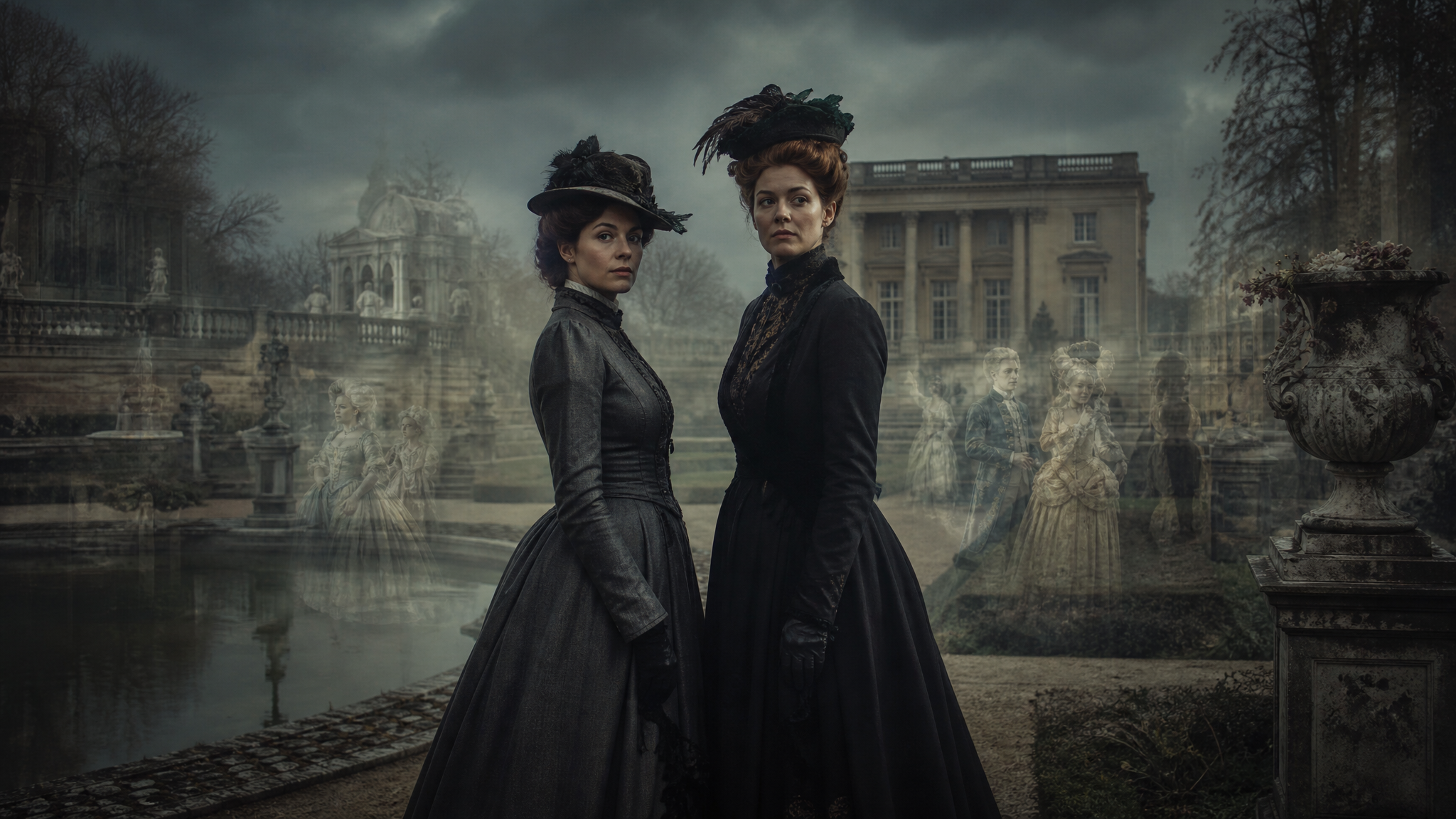
The Moberly–Jourdain Affair: Two Women, One Palace, and the Day Time Seemed to Slip
When a Walk in Versailles Became a Question of Time
Some mysteries begin with a crash, a scream, or a disappearance. The Moberly–Jourdain Affair began with a sightseeing trip.
On August 10, 1901, Charlotte Anne Moberly and Eleanor Jourdain—both educated, disciplined, and not given to theatrical claims—visited the grounds of the Petit Trianon at the Palace of Versailles. What they reported afterward has fascinated investigators for more than a century: an eerie atmosphere, people dressed in old-fashioned clothes, a sense of oppressive unreality, and the strong impression that they had, for a short time, somehow crossed into the past.
If that sounds impossible, it should. But impossible events are often the ones that leave the deepest historical footprint.
Who Were Moberly and Jourdain?
Charlotte Anne Moberly was the daughter of a bishop and later became the first principal of St Hugh’s College, Oxford. Eleanor Jourdain, born in 1863, was also an academic and eventually served as vice-principal of the same college. These were not women seeking attention in the modern sense. They were teachers, administrators, and products of late Victorian intellectual culture—precisely the sort of witnesses that make a strange case harder to dismiss and harder to accept.
Years later, they would publish their account under pseudonyms in a 1911 book titled An Adventure. But the core story dates to 1901, during a trip to France they took together while both were staying near Versailles.
The Day at Versailles
According to their later account, the pair first became uneasy while trying to find their way to the Petit Trianon. They felt strangely disoriented, as though the landscape itself had become unfamiliar. At one point, they described asking directions from men who seemed oddly dressed and behaved in a manner they found unnatural.
They also reported seeing a woman near a cottage, a figure later associated in their minds with Marie Antoinette. In the grounds, they claimed to notice details that felt out of place: a bridge, a rustic setting, and an atmosphere of quiet menace. Jourdain in particular said the mood seemed to thicken around them, as if the air had become heavy and time had lost its ordinary shape.
They later left the area and, after comparing notes, concluded that they had experienced something extraordinary. Not a ghost story in the common sense, but a temporal anomaly—what we would now call a time slip.
What Makes the Case Hard to Ignore
The reason this case persists is not just the claim itself. It is the type of claim and the character of the witnesses. Moberly and Jourdain were educated, articulate, and aware that their story would invite ridicule. They did not publish immediately. Instead, they compared recollections, investigated the grounds, and only later decided to write publicly.
That delay matters. It suggests the account was not a momentary impulse. It also means the story matured over time, which cuts both ways: it adds reflection, but it also opens the door to memory distortion. As an investigator, that is the tension that keeps this file open.
Points often cited by supporters
- The witnesses were independent, intelligent observers.
- Their initial reactions were cautious rather than sensational.
- They claimed the experience was vivid and consistent over time.
- Some details appeared to align, at least loosely, with 18th-century Versailles.
Points often raised by skeptics
- The memories were recorded and shaped years after the event.
- The site was already steeped in historical associations, which can prime expectation.
- Heat, fatigue, and confusion in an unfamiliar setting can distort perception.
- Later research identified ordinary explanations for some of the “anomalous” details.
The Marie Antoinette Connection
One of the most compelling features of the story is its connection to Marie Antoinette. The Petit Trianon was closely associated with her life, and the women believed they had somehow encountered a scene from her era. In their minds, the landscape seemed inhabited by figures from the late 18th century rather than by tourists in 1901.
That association gave the affair its enduring power. It is one thing to say you felt disoriented in a famous garden. It is another to say the garden appeared to transform into a previous century, complete with period clothing and historical atmosphere. The leap is enormous—but it is exactly that leap that made the case legendary.
Alternative Explanations
Modern investigators have proposed several explanations, none of which fully closes the case. The most common is psychological. Versailles is a place saturated with history, symbolism, and expectation. Visitors arrive primed to imagine royalty, revolution, and memory. In such an environment, suggestion can do powerful work.
Another possibility is simple misidentification. People in unusual clothing, an odd route through unfamiliar grounds, and confusion about the map of the estate could have combined into a coherent but false reconstruction after the fact. Human memory is not a recording device; it is an editing room.
There is also the issue of narrative consolidation. Once two witnesses compare notes, their stories can merge. Details become sharper, then cleaner, then more certain. That process does not make the account a fraud, but it does complicate any claim that the experience remained perfectly intact from the start.
Why the Mystery Endures
The Moberly–Jourdain Affair survives because it sits at the intersection of two very different worlds: historical scholarship and paranormal speculation. It is not a sensational ghost tale built on rumor. It is a disciplined, uncomfortable testimony from two women with reputations to protect.
And yet, if one strips away the aura, what remains is still deeply strange. Why did both women feel the same unnatural atmosphere? Why did they return from Versailles convinced they had witnessed something from another time? Did they misread a setting loaded with historical imagery—or did they encounter a phenomenon our language still struggles to classify?
Final Assessment
If I were writing this case file in an intelligence archive, I would mark it as unresolved, with a strong bias toward psychological and environmental explanation but not enough certainty to close it completely. That is the honest answer. The witnesses were credible. The evidence is not.
And that, more than any ghost or time slip, is the real source of the fascination. The Moberly–Jourdain Affair reminds us that mystery does not always arrive with flashing lights. Sometimes it appears in daylight, in a royal garden, on an ordinary summer day in August 1901—quiet, elegant, and impossible to verify.
That is how the best mysteries haunt us. Not by shouting. By leaving just enough room for doubt.