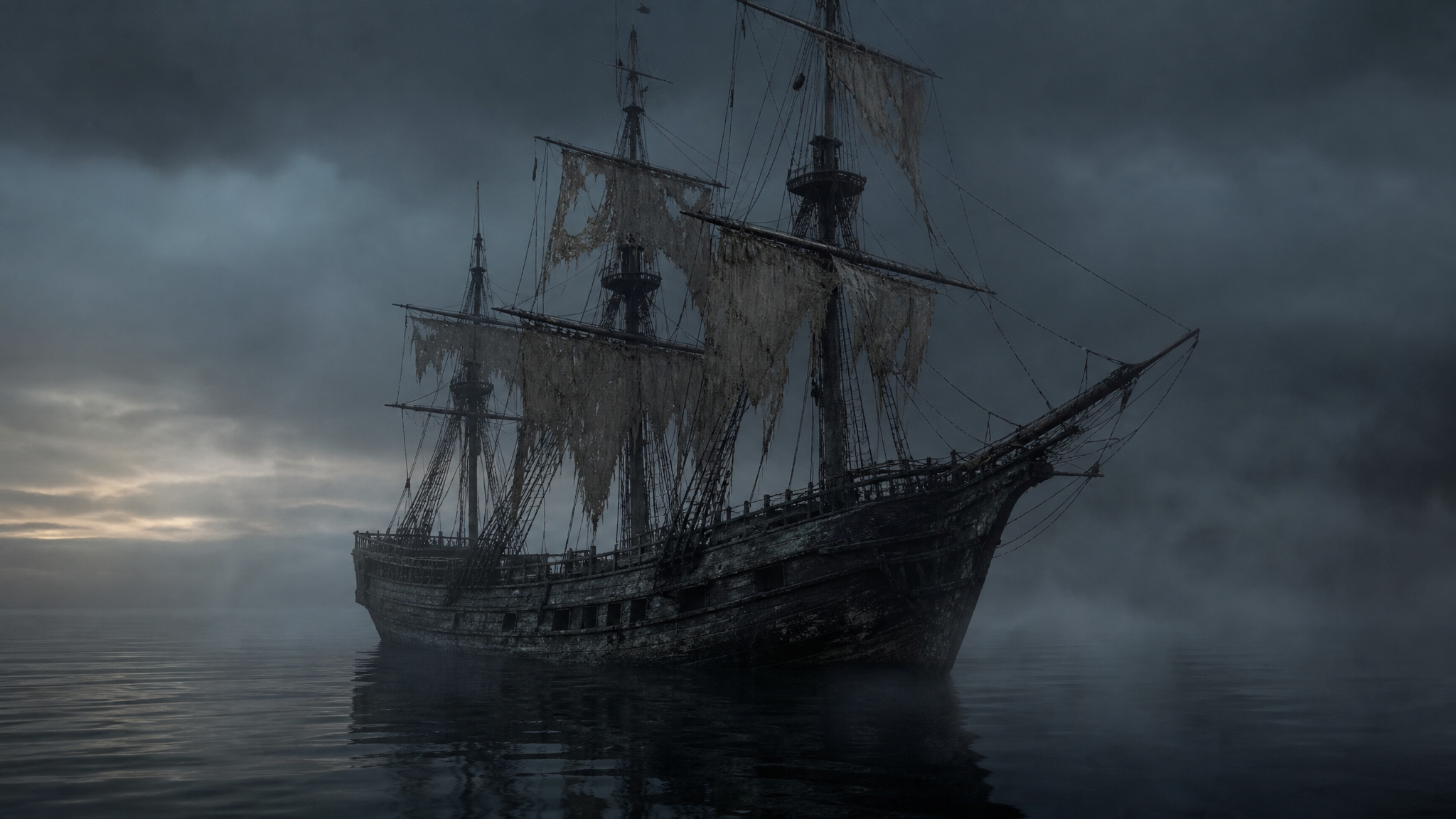
The Mary Celeste: The Ghost Ship Mystery That Still Won't Stay Buried
The Day the Sea Handed Back an Empty Ship
Some mysteries survive because they are wrapped in fog, folklore, and a little too much wishful thinking. Others endure because the facts, even after 150 years, still do not fit neatly into any one explanation. The Mary Celeste belongs to the second category.
On December 4, 1872, the British brigantine Dei Gratia sighted a vessel adrift in the Atlantic near the Azores. The ship was the Mary Celeste, a merchant brig that had departed New York weeks earlier under the command of Captain Benjamin Briggs. When the boarding party stepped aboard, they found a vessel in seaworthy condition, carrying cargo, provisions, and personal belongings. What they did not find was the crew.
No captain. No family. No sailors. No lifeboat. No clear explanation.
That absence has fueled speculation ever since: piracy, mutiny, waterspouts, alcohol fumes, sea monsters, alien abduction if you are feeling particularly uncharitable toward evidence. But when you strip away the mythology, the case becomes more interesting, not less. The Mary Celeste is not a supernatural story. It is a study in uncertainty, maritime risk, and the danger of assuming that silence means something exotic.
What the Evidence Actually Shows
The Mary Celeste was not a legendary ghost ship at the time she left port. She was a routine commercial vessel with a respectable, if uneven, service history. Built in Nova Scotia and later renamed, she had changed hands more than once before her final voyage. In 1872, she was carrying a cargo of denatured alcohol from New York to Genoa.
When the Dei Gratia discovered her, the ship was not in ruins. The hull was sound. The sails were partly set. The cargo was largely undisturbed. Food and water were still on board. The last log entry was dated November 25, roughly nine days before the discovery, and the ship was found some 400 miles east of the Azores. The lifeboat, however, was missing.
That detail matters. If a crew abandons ship, they usually do so because they believe the vessel is about to sink, burn, explode, or become otherwise uninhabitable. Yet the Mary Celeste did not show the typical signs of catastrophic disaster. There was a broken pump, some water in the hold, and a damaged hatch cover. Nothing about the ship said, unmistakably, that everyone must have fled in terror.
The absence of bodies does not mean the absence of danger. It often means the people on board made one very bad decision at exactly the wrong moment.
The Theories: Some Plausible, Some Not
Over the years, investigators and enthusiasts have offered nearly every imaginable explanation. A few deserve serious attention. Most do not.
- Panic over a false threat: This is the leading practical theory. The cargo included alcohol, and some barrels were found leaking. Captain Briggs may have feared an explosion or toxic fumes. If the crew believed the ship was about to blow, they might have launched the lifeboat and intended to reboard later.
- Severe weather or a waterspout: The Atlantic can produce violent, fast-moving events. A sudden storm could have convinced the crew that staying aboard was unsafe. If the lifeboat was tethered to the ship, it might have been lost when the towline snapped, leaving everyone stranded.
- Navigation error or collision fear: The ship had been sailing in open water, but the captain may have misread conditions or feared grounding. A hurried evacuation into a small boat would have been a desperate gamble, especially with a family aboard.
- Piracy or mutiny: Popular in fiction, weak in evidence. There were no signs of violence, no missing valuables, and no credible trace of another vessel's interference.
- Supernatural intervention: The story practically invites it. But the supernatural is usually what we call a case when the documentary record goes thin and the imagination moves in to do the heavy lifting.
When I analyze cases like this, I ask a simple question: what explanation requires the fewest unsupported assumptions? On that score, panic remains the strongest candidate. Not panic as a cinematic scream in the moonlight, but panic as a rational response to uncertain conditions and incomplete information. A captain sees what appears to be imminent danger. He orders an evacuation. The lifeboat is launched. Conditions worsen. The lifeboat is lost. The ship, now empty, continues to drift.
That scenario is not elegant, but history rarely is.
Why the Case Became a Legend
The Mary Celeste did not become famous because it was the most baffling maritime incident in history. It became famous because it was narratively perfect. A ship without a crew is a ready-made ghost story. It has atmosphere, ambiguity, and an ending that refuses to close.
Then came the press. Sensational reporting transformed a puzzling maritime event into a cultural artifact. The empty ship was recast as evidence of madness, murder, and the unknown. Later writers embroidered the case even further, and the ghost ship entered popular mythology as if it had always belonged there.
That is how mysteries survive. They are not merely discovered; they are edited. Details that do not support the myth are ignored. Facts that do are amplified. The result is a story that feels truer than it is.
What Still Doesn't Add Up
Even the best explanation leaves loose ends. Why did the captain order the crew into the lifeboat so far from shore? Why was there no clear evidence of an immediate threat? Why was the vessel abandoned in such haste that the ship remained seaworthy for days after?
Those are real questions. But a real question is not the same thing as a paranormal answer. The ocean is an efficient destroyer of evidence. A missing lifeboat, a broken towline, a sudden squall, a bad judgment call, and the sea can erase a family with almost surgical cleanliness.
One of the dangers in any long-running mystery is that the unknown acquires a personality. We start imagining intention where there may have been only contingency. The sea did not need to be haunted to claim the Mary Celeste. It only needed to be indifferent.
The Most Likely Answer
If you press me for a conclusion, here is mine: the Mary Celeste was probably lost to a combination of fear, misread conditions, and maritime bad luck. The crew most likely abandoned ship expecting to return, and the lifeboat never made it back to safety. That explanation is less dramatic than a curse or a sea-borne enigma, but it fits the evidence better than anything else on the table.
The enduring power of the case lies not in what it proves, but in what it reminds us. History is full of incidents that look supernatural from a distance and mundane under the microscope. The trick is knowing when to let the facts lead and when to resist the temptation to make them perform.
The Mary Celeste was not a vessel stolen by ghosts. It was a vessel abandoned by people who believed, for reasons we can still debate, that the next few minutes mattered more than the life they were leaving behind. That is not a paranormal answer. It is something older and, in its own way, more disturbing: a reminder of how thin the line can be between judgment and tragedy.
And that is why the Mary Celeste still drifts through our imagination. Not because the sea keeps its secrets. Because sometimes the sea simply keeps the evidence.