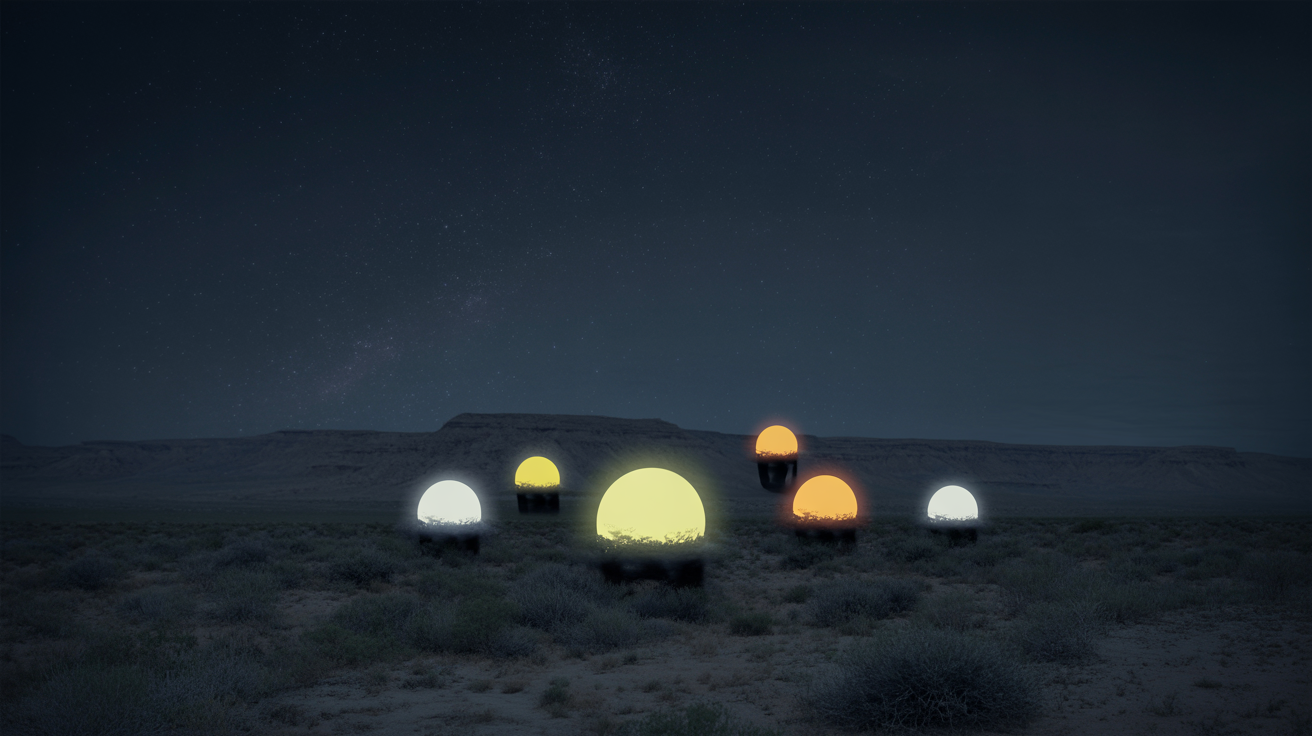
The Marfa Lights: Texas's Century-Old Enigma of Dancing Orbs
In the remote desert landscape of West Texas, nine miles east of the small town of Marfa, a phenomenon has been occurring with remarkable consistency since at least 1883. Locals and visitors alike report seeing mysterious lights—glowing orbs that appear, disappear, split apart, merge together, and move in ways that seem to defy conventional explanation.
The First Documented Sighting
The first recorded observation came from Robert Reed Ellison, a young cowhand who was driving cattle through Paisano Pass in 1883. Ellison reported seeing strange lights in the distance and initially assumed they were Apache campfires. However, when he investigated the area the following day, he found no evidence of any encampment, no ashes, no tracks—nothing to explain what he had witnessed the night before.
What makes Ellison's account particularly significant is that it predates the introduction of automobile headlights, electrical power lines, or aircraft in the region—eliminating the most common skeptical explanations offered for similar phenomena elsewhere.
Characteristics of the Phenomenon
Witnesses consistently describe the Marfa Lights as having several distinctive characteristics:
Size and appearance: The lights are typically described as basketball-sized orbs, though some reports indicate they can appear larger or smaller. They emit colors ranging from white and yellow to red, blue, and green.
Behavior: The lights demonstrate unusual movement patterns. They hover, float, split into multiple orbs, merge back together, and move both horizontally and vertically. Some witnesses report the lights appearing to "dance" or move in coordinated patterns.
Location: The lights consistently appear in the same general area—the Mitchell Flat region east of Marfa, typically viewed from Highway 90 between Marfa and Alpine.
Frequency: Unlike many paranormal phenomena that occur sporadically, the Marfa Lights appear with enough regularity that the Texas Department of Transportation constructed an official viewing area in 2003, complete with parking and informational plaques.
Scientific Investigation
The Marfa Lights have attracted serious scientific scrutiny over the decades. In 2004, a team from the Society of Physics Students at the University of Texas at Dallas conducted a systematic study. They used telescopes, cameras, and spectrum analyzers to observe and document the lights over several nights.
Their conclusion? Some of the lights could be explained as distant car headlights refracted through layers of air at different temperatures—a phenomenon known as a superior mirage or Fata Morgana. However, the researchers acknowledged that this explanation couldn't account for all observations, particularly historical sightings that predated automobiles.
Dr. Karl Stephan, an engineering professor who has studied the phenomenon, noted that while atmospheric refraction can explain some sightings, it doesn't address reports of lights that appear to move independently of any road traffic patterns, or lights that split and merge.
Alternative Theories
Piezoelectric effects: Some researchers have proposed that tectonic stress in the underlying geology could generate electrical charges that manifest as luminous phenomena. The Marfa area sits near the intersection of several geological features, which could theoretically produce such effects.
Swamp gas and phosphorescence: Despite the desert environment, some have suggested that decomposing organic matter could produce phosphorescent gases. However, the arid climate and lack of significant organic deposits make this explanation problematic.
Ball lightning: This rare atmospheric electrical phenomenon has been proposed as an explanation, though ball lightning typically occurs during thunderstorms and lasts only seconds—characteristics that don't match most Marfa Lights observations.
Extraterrestrial activity: Given the lights' unusual behavior and the region's remote location, UFO enthusiasts have long considered the Marfa Lights as potential evidence of alien visitation or surveillance.
The Intelligence Community Perspective
During my years analyzing patterns and anomalies for the Agency, I learned that the most interesting cases are those with multiple credible witnesses, consistent characteristics, and no obvious conventional explanation. The Marfa Lights check all these boxes.
What strikes me most about this phenomenon is its persistence and consistency. We're not dealing with a handful of isolated reports from unreliable witnesses. We have 140+ years of documented observations, an official state viewing area, and sightings that continue to this day with remarkable regularity.
The fact that some sightings can be explained by atmospheric refraction doesn't invalidate the entire phenomenon—it simply means we need to separate the signal from the noise, much like any intelligence analysis operation.
Recent Developments
In recent years, advances in camera technology and the proliferation of smartphones have resulted in numerous videos and photographs of the lights. While many can be debunked as distant vehicles or aircraft, some footage shows behavior that remains difficult to explain through conventional means.
Local residents have reported that the lights seem to appear more frequently during certain times of year, though no definitive pattern has been established. Some witnesses claim the lights respond to flashlights or other signals, though controlled experiments have produced inconsistent results.
The Bottom Line
The Marfa Lights represent one of the most well-documented and persistent unexplained phenomena in North America. While skeptics can point to atmospheric refraction as an explanation for some sightings, this doesn't account for the full range of reported observations—particularly those from the pre-automobile era.
What we're left with is a genuine mystery: a phenomenon that occurs with enough regularity to be reliably observed, yet defies comprehensive scientific explanation. Whether the answer lies in unusual geological activity, rare atmospheric conditions, or something more exotic, the Marfa Lights continue to challenge our understanding and draw investigators to the West Texas desert.
For those willing to make the journey, the official Marfa Lights Viewing Area on Highway 90 offers the best opportunity to witness this phenomenon firsthand. Just remember: not every light you see will be unexplained, but among them might be something that science has yet to fully understand.
💃 Video: Marfa Lights Texas Mystery
A Knight Phenomena Investigation