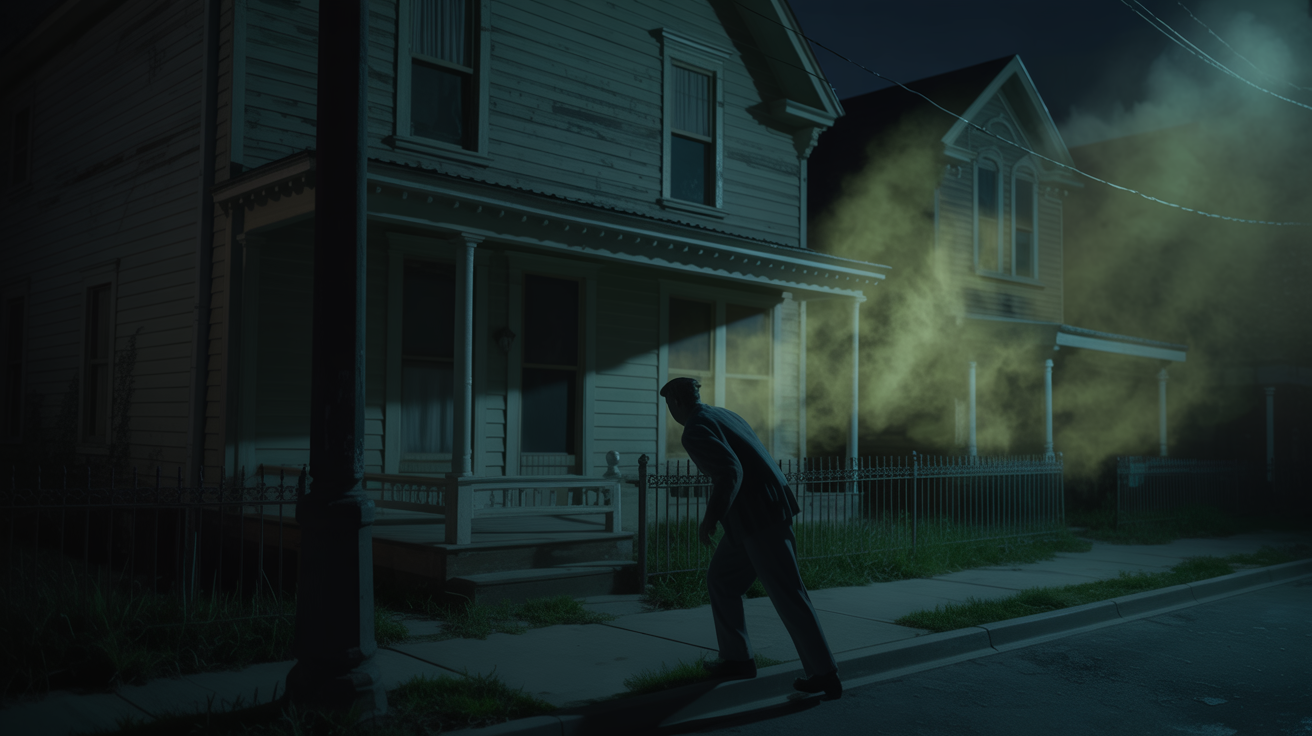
The Mad Gasser of Mattoon: Panic, Poison, and a Phantom in the Night
On a warm night in late summer 1944, Mattoon, Illinois became the kind of place that newspapers love and investigators dread: a small American town suddenly convinced that something unseen was moving through its bedrooms after dark. The reports were unsettling, but also strangely consistent. People said they woke to a sweet, cloying chemical smell. Some could not move. Others felt sick, dizzy, or numb. A few believed they had glimpsed a figure outside a window. Before long, the local press had a name for the intruder: the Mad Gasser.
That name gave shape to fear, but it did not answer the obvious question. Was Mattoon dealing with a genuine attacker using an irritant gas? Or was this one of those moments when anxiety, suggestion, and ordinary misfortune combined into something that felt supernatural? The evidence, as it turns out, is frustratingly thin. That is what makes the case endure.
A Town Wakes Up Afraid
The first widely discussed reports came in late August and early September of 1944. Mattoon was a rail and manufacturing community, the sort of Midwestern town where wartime production, blackouts, and local gossip all existed in close quarters. One woman reportedly awoke to a strong odor in her home and found that her legs would not respond. Another resident described a similar smell and a wave of nausea. In at least some accounts, windows were open or screens were disturbed, fueling the impression that someone had been entering homes or spraying something from outside.
At first glance, the incidents seemed isolated. But newspapers are accelerants, and the local reporting turned scattered complaints into a coherent story. Once residents read that neighbors had experienced the same thing, the mystery acquired momentum. People began to interpret every unexplained smell as evidence. Every shadow outside a window became a suspect. That is often how such cases grow: not from one dramatic event, but from repetition, interpretation, and fear.
What the Police Actually Found
The central challenge in the Mattoon case is that the physical evidence never caught up with the reports. Police investigated homes, questioned residents, and looked for a chemical source. They did not find a clear intruder, a residue that could be tested conclusively, or a reliable pattern that pointed to one offender. In other words, the story generated urgency, but not a case file with a neat solution.
That absence matters. If someone really was moving through Mattoon with a chemical spray or gas canister, they left almost no trace. That is not impossible. It is, however, unusual. A sustained series of home invasions of that sort would normally leave some combination of footprints, tool marks, damaged screens, witnesses, stolen equipment, or repeat targeting of the same area. The record does not give us much of that.
There were, of course, physical symptoms. Some victims complained of weakness, vomiting, or difficulty breathing. Those details make the case feel more concrete, but they also complicate it. Chemical irritation can be real without being sinister. Exhaust fumes, industrial solvents, cleaning products, pesticide exposure, or even a household leak can produce dramatic reactions. In a wartime town with industrial activity nearby, the range of possibilities was broad.
Wartime America Was Already on Edge
To understand why the Mad Gasser story spread so quickly, you have to place it in its moment. In 1944, the United States was living with rationing, civil defense drills, and the constant awareness that modern warfare involved gas, bombs, and invisible threats. The idea of a home being invaded by an odorless or nearly odorless agent was not abstract. It was plausible enough to frighten people without requiring much imagination.
That wartime psychology likely amplified the reports. A strange smell was no longer just a strange smell. It was a possible weapon. The body reacts to fear before the mind catches up: shallow breathing, tingling, nausea, and the sensation of being frozen can all follow a panic response. Once those symptoms enter a community narrative, they spread as quickly as the original rumor.
It is also worth noting that the human memory of an event changes once it becomes public. A person who first noticed a vague odor may later remember it as sharp and deliberate. A moment of weakness may be reconstructed as paralysis. None of this requires dishonesty. Memory under stress is simply not a camera. It is a story engine.
The Competing Explanations
Over the years, the Mattoon case has attracted the usual categories of explanation. One is criminal: a prowler or prankster using some kind of chemical spray. Another is environmental: industrial fumes, household chemicals, or an accidental exposure source that affected multiple homes under similar conditions. A third is psychological: mass suggestion, reinforced by newspaper attention and wartime anxiety.
Of those, the psychological explanation is often treated as the most convincing, but it should not be accepted lazily. Labeling a case as mass hysteria can become a way of dismissing every detail without doing the harder work of matching claims to evidence. Still, the fit is strong here. The reports began as a small number of ambiguous incidents, took shape through press coverage, and then spread into a town-wide fear that outpaced the physical findings.
That does not prove there was no real chemical irritant in at least some homes. It does suggest that the larger legend of a single phantom gas man may have grown beyond what the facts can support. The most cautious reading is this: something happened in Mattoon, but the final version of the story was probably assembled from a mix of genuine discomfort, misinterpretation, rumor, and wartime nerves.
Why the Mystery Still Matters
The Mad Gasser of Mattoon survives because it sits at an uncomfortable intersection. It is creepy enough to feel paranormal, yet mundane enough to resist an easy supernatural explanation. There is no monster revealed at the end, no decisive confession, no laboratory analysis that settles the matter. Instead, there is a town, a series of nighttime complaints, and a public narrative that outran the evidence.
That makes the case useful. It shows how quickly a community can turn uncertainty into certainty, and how a few vivid symptoms can become a legend if they meet the right historical moment. It also reminds us that not every mystery is solved by choosing between ghost and hoax. Sometimes the truth is less theatrical: a blend of fear, physiology, and incomplete records.
If there was a Mad Gasser stalking Mattoon, he remains one of the most elusive figures in American mystery lore. If there was not, then the town briefly discovered something just as strange: how easily a hidden threat can be built from real sensations and collective dread. Either way, the darkness over Mattoon was never just chemical. It was psychological, historical, and very human.
💨 Video: Mad Gasser Of Mattoon
A Knight Phenomena Investigation