The Longyou Caves: China’s Underground Chambers With No Historical Record
In the summer of 1992, a few villagers in Zhejiang Province set out to do something ordinary: drain a pond and see whether it could be used for fish farming. What they found beneath the mud was not a lost well, a buried foundation, or a shallow cavern. It was a chamber so large, so deliberately shaped, and so unlike anything expected in that part of China that the discovery immediately shifted from local curiosity to national mystery.
What emerged became known as the Longyou Caves, a network of immense underground halls carved from solid rock. There is no surviving historical record explaining who built them, why they were made, or how a project of this scale vanished from memory. That absence is the core of the mystery. The caves are real. The explanation is not.
A Discovery That Should Have Left a Paper Trail
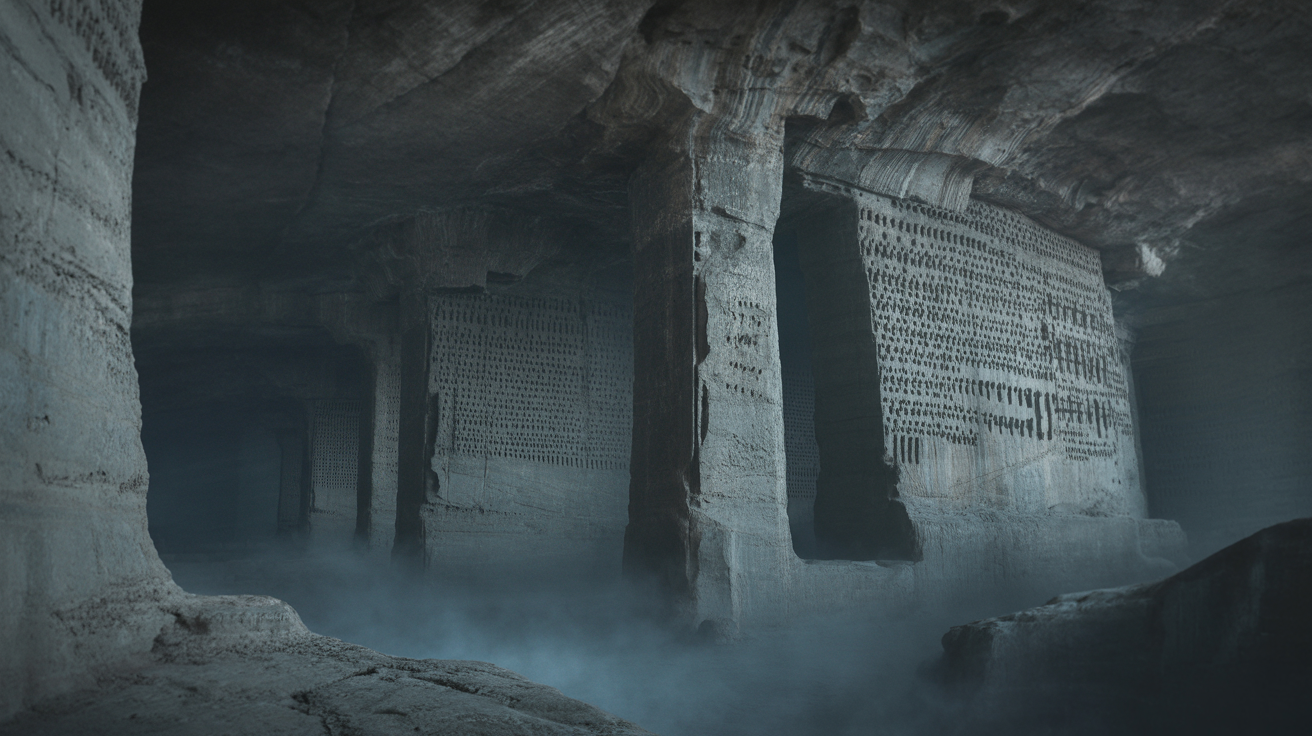
The site sits in Longyou County, in Zhejiang Province, not far from the line between agricultural land and ancient settlement. When the first chamber was drained, the villagers expected an ordinary water feature. Instead, they exposed a broad cavern with angled walls, regular tool marks, and deep parallel grooves that looked intentional rather than natural. More chambers followed, eventually totaling 24 known caverns, all cut into sandstone.
That fact alone would make the site notable. But the dimensions make it extraordinary. These are not small grottoes or shallow storage pits. They are vast halls, some rising several stories high, each with precisely finished walls, columns left standing as structural supports, and a level of symmetry that suggests planning at a civilizational scale.
Chinese archaeologists have dated the caves broadly to antiquity, likely more than 2,000 years old, though the dating is inferential rather than tied to a neatly labeled construction record. There are no inscriptions announcing the project, no dynastic chronicle describing the labor, and no administrative archive that has yet been tied to the work. For a culture known for documentation, that silence is difficult to ignore.
“The mystery is not that the caves exist. The mystery is that a project of this ambition seems to have disappeared from history.”
The Engineering Problem
The first question any investigator asks is simple: could this have been made by accident? The answer appears to be no. The caves show repeated evidence of planned excavation. The walls bear parallel marks that look consistent with chisel use. The ceilings and columns are arranged to prevent collapse. The chambers are not random voids but designed spaces, with surfaces finished in a way that required sustained labor.
Even more striking is the uniformity. These caverns were not hacked out by desperate miners over a few weekends. They reflect a standardized method. Some researchers have noted that the layout implies knowledge of load distribution and structural support. In plain language: whoever made these spaces understood that the mountain would only remain stable if the rock was removed in a controlled way.
That raises a harder question. If the builders possessed the skill to carve such chambers, why are there no clear records of the workforce, the patron, or the purpose? In a civilization with extensive written history, the omission feels almost impossible. Yet history is full of projects that fall through archival cracks, especially if they were local, politically sensitive, or later erased by war, regime change, or simple neglect.
What Were They For?
Every mystery of architecture eventually arrives at the same question: purpose. Storage? Ritual? Military concealment? Water management? Something else entirely?
The most grounded theories are also the least dramatic. Some scholars have proposed that the caves were quarry works, though quarrying usually leaves a very different pattern of extraction and waste. Others suggest underground storage for grain or valuables, but the scale seems excessive for simple warehousing. A ceremonial or religious function is possible, given the care taken in the finish, but no iconography or written dedication has been found to support it.
There is also the possibility that the caves were connected to a broader hydraulic or defensive system now lost to time. Ancient societies often built multiuse spaces: quarries become sanctuaries, shelters become storage, and storage becomes something symbolic in later memory. The problem with Longyou is that every explanation fits only part of the evidence.
If the chambers were intended to hide something, one might expect secret compartments or cached material. None have been convincingly identified. If they were meant as public works, we would expect more traces in local lore or administrative history. If they were purely utilitarian, why the extraordinary finish? The site refuses to settle into one category.
The Silence of the Record
There is a temptation, when faced with a mystery like this, to jump immediately to lost civilizations or impossible technologies. That impulse usually tells us more about our appetite for wonder than the evidence itself. The disciplined approach is harder: stay with what can actually be proven.
What can be proven is this. The caves were carved intentionally into bedrock. They are large enough to require extensive labor and organization. They have coherent engineering features. And yet the historical record, at least so far, does not explain them.
This is the part of the story that matters most. Human history is often assumed to be tidy because we write it down. But archives are selective, and memory is fragile. A project can be major and still leave a thin trace if the records were lost, never centralized, or deliberately destroyed. China’s long history includes dynastic turnovers, regional conflicts, and enormous episodes of administrative loss. It would not be unprecedented for a local monument to survive while its explanation vanished.
Could the Caves Be Younger Than Claimed?
One line of skepticism asks whether the caves are really as old as commonly believed. That is a fair question, and it should be asked. Dating underground rock-cut structures is notoriously difficult unless there is associated organic material, inscriptions, or datable artifacts.
Could they be medieval rather than ancient? Possibly. Could they have been created in a relatively short burst of labor by a local ruler or religious community? Also possible. Those alternatives would not make the site less impressive, only more human. But even a later construction date does not solve the central problem: no direct record has yet surfaced that explains who initiated such an ambitious undertaking and why it was then forgotten.
In cases like this, the danger is not only credulity. It is overconfidence. A mystery becomes more interesting, not less, when we resist the urge to decorate it with unsupported claims. The Longyou Caves do not require aliens, lost empires, or supernatural intervention to remain compelling. They are compelling because they are real and unexplained.
What the Evidence Suggests
So where does that leave us? After stripping away speculation, three conclusions remain reasonable.
- The caves are artificial and carefully engineered.
- They were likely created through sustained labor over a significant period.
- Their original purpose and patron remain unverified.
That is not a satisfying ending, but it is an honest one. In investigation, honesty sometimes means admitting that the evidence leads only to the edge of the map. The Longyou Caves are one of those places. They force us to confront a simple but unsettling reality: civilization does not remember everything it builds.
And perhaps that is why the site continues to fascinate. Not because it proves an impossible theory, but because it reveals a familiar vulnerability. We inherit structures, stories, and institutions that feel permanent until time, war, water, or neglect erases the context around them. What survives is stone. What disappears is explanation.
Longyou is a reminder that history is not only what was recorded. It is also what was made, forgotten, and left behind underground, waiting for a farm pond to be drained and the silence to finally speak.
🕳️ Video: Longyou Caves Underground Chambers
A Knight Phenomena Investigation