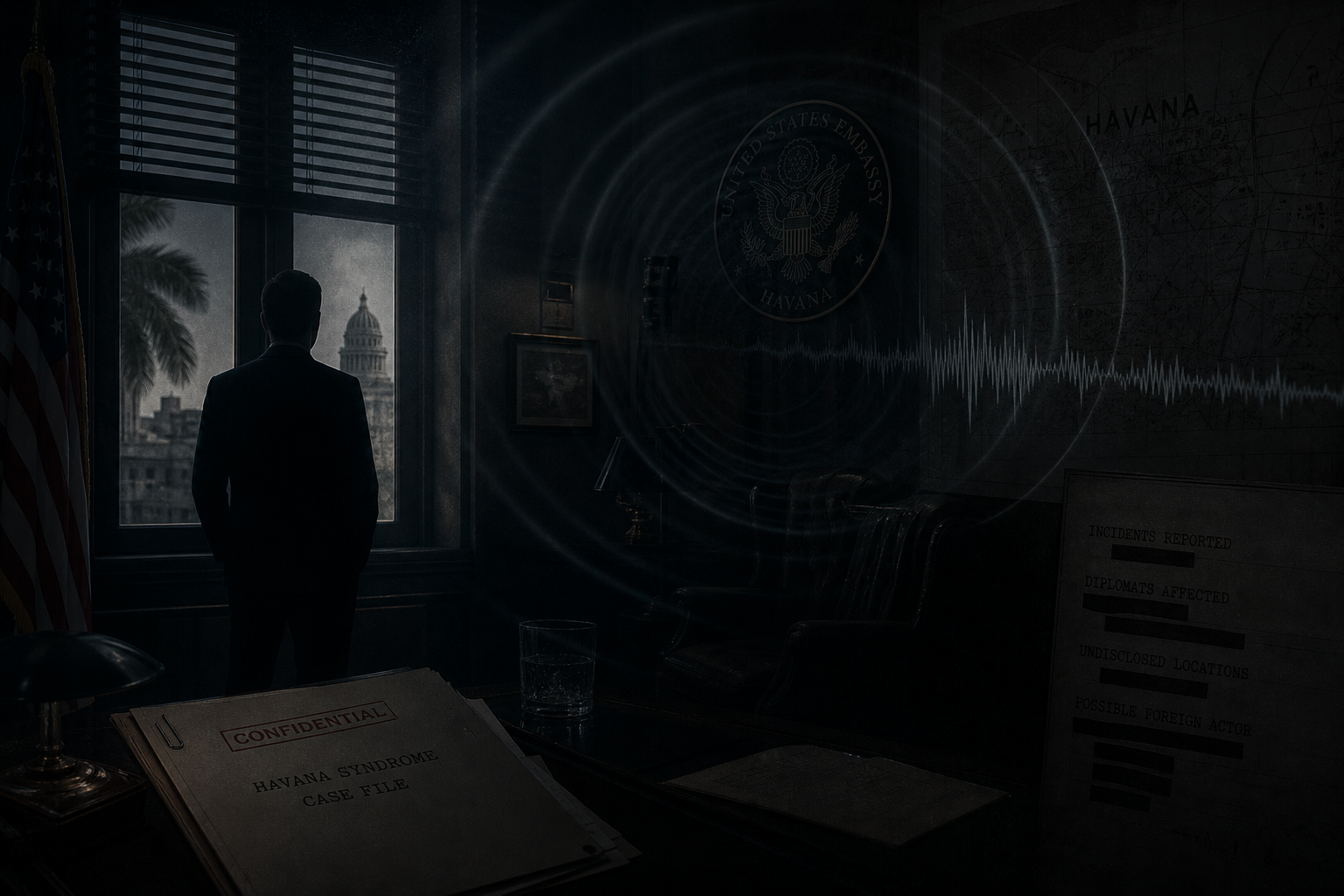
The Havana Syndrome Mystery: Targeted Attack, Stress Response, or Something Stranger?
In intelligence work, ambiguity is often the rule rather than the exception. A report can be true, false, exaggerated, or partially correct in ways that matter more than any clean verdict. The case commonly known as Havana Syndrome sits squarely in that uncomfortable middle ground.
Beginning in late 2016, U.S. personnel in Havana began reporting a cluster of symptoms: a sudden loud or directional sound, pressure in the head, nausea, vertigo, cognitive problems, and in some cases lingering neurological complaints. Soon similar reports emerged from other postings around the world, including China, Europe, and Washington, D.C. What made the story remarkable was not just the symptoms themselves, but the profile of the people reporting them: diplomats, intelligence officers, and other government employees trained to notice anomalies and document them carefully.
That does not automatically make the reports conclusive. It does, however, make them difficult to dismiss.
What Was Actually Reported?
The earliest cases in Havana were described in ways that were consistent in one important respect: many witnesses said the sensation was highly localized. Some heard a piercing tone or a mechanical buzz. Others described a feeling of pressure, as if something was directed at a specific point in space rather than filling an entire room. A number of them then experienced headaches, dizziness, and confusion that persisted well beyond the initial event.
For investigators, that pattern immediately raised two questions:
- Was this an environmental exposure of some kind?
- Or was it a perceptual event amplified by stress, expectation, and shared concern?
Those are not mutually exclusive possibilities. In fact, that is what makes the case so difficult.
The Attack Theory
The most dramatic explanation is also the one that has attracted the most attention: that U.S. personnel were subjected to some kind of directed-energy attack. The phrase sounds like science fiction, but the underlying idea is straightforward. If a weapon or device could emit a focused acoustic, microwave, or other energy beam, it might theoretically induce the reported symptoms without leaving obvious physical evidence.
Supporters of this theory point to several facts:
- the apparent specificity of the effects
- the concentration of cases among government personnel
- reports of similar incidents in multiple locations
- medical findings in some affected individuals that suggested genuine injury
Yet there is a gap between possibility and proof. No device has been recovered. No attack has been conclusively observed. And no public evidence has established a single mechanism that accounts for every case.
The Sound Problem
One of the most important details in the case is the reported sound itself. Some witnesses described a high-pitched noise, others a grinding or screeching sensation, and some insisted they felt the effect without hearing anything at all. That inconsistency matters.
If the cause were purely acoustic, we would expect a more uniform description. If the cause were microwave or another non-audible energy source, we would need to explain why many people perceived a sound at all. Researchers have proposed that certain frequencies or pulsed energy could produce a sensation of sound inside the head, but that remains an area of ongoing dispute.
In other words: the sound is one of the central clues, but it is also one of the least reliable pieces of the puzzle.
The Medical Evidence
Some clinicians and researchers have argued that at least a portion of the reported injuries are consistent with brain trauma or vestibular disturbance. Others have countered that the symptoms are broad, nonspecific, and compatible with stress, anxiety, migraine disorders, or preexisting conditions.
From an intelligence analyst's perspective, this is where the case becomes especially tricky. Human symptoms are real even when their cause is uncertain. The existence of genuine suffering does not, by itself, identify the mechanism behind it. A patient can be telling the truth and still be mistaken about what happened.
That distinction matters because public debate often collapses two separate questions into one:
- Did these people experience something medically significant?
- Was that something caused by an external hostile act?
The first question may be easier to answer than the second.
The Stress and Contagion Hypothesis
Another explanation is far less cinematic but cannot be ignored. Intelligence and diplomatic personnel operate under chronic stress. Sleep disruption, surveillance anxiety, political tension, and fear of hostile intelligence activity can all heighten sensitivity to unusual sensations. In such environments, a real but minor event can become magnified. In some cases, symptoms may spread through suggestion, shared concern, or heightened vigilance.
This is not a dismissive theory. History shows that groups under pressure can develop powerful collective interpretations of ambiguous events. That does not mean the experiences are fabricated. It means the brain is not a passive recording device. It interprets, amplifies, and sometimes invents patterns under strain.
Still, the stress hypothesis does not easily explain every detail, especially the persistence of symptoms in some individuals and the seriousness of several medical evaluations.
Why the Case Endures
Havana Syndrome persists because it sits at the intersection of three difficult realities:
- there are credible witnesses
- there are documented medical concerns
- there is no publicly accepted mechanism
That combination creates fertile ground for speculation. It also creates a problem for institutions. Intelligence agencies are trained to assess intent, capability, and attribution. But when the available evidence is partial, contested, or classified, those same agencies can end up presenting conclusions that sound firmer than the underlying data.
Over time, the public version of the story has become a battlefield of competing claims: espionage, exotic weaponry, environmental exposure, mass psychogenic illness, and bureaucratic self-protection. Each theory has adherents. Each has weaknesses.
My Assessment
Measured skepticism is not the same as cynicism. The most responsible position is to acknowledge that something happened to at least some of the affected individuals, while also admitting that the evidence for a coordinated hostile campaign is incomplete in public view.
If I were to frame the mystery as an intelligence problem, I would put it this way: the reported incidents are real enough to merit serious investigation, but the leap from unexplained injury to deliberate attack has never been publicly demonstrated with the kind of clean evidence that would end the argument.
That leaves us with a familiar pattern. A cluster of events. Strong emotions. Fragmented data. Confident narratives built on uncertain foundations. And a lingering possibility that the truth is less dramatic than the rumor, or more disturbing than any of the official explanations.
For now, Havana Syndrome remains what many modern mysteries become: a case where the facts are sufficient to alarm us, but not sufficient to settle the matter.
And that, in intelligence terms, is exactly where the trouble begins.