The Göbekli Tepe Paradox: When Civilization's Timeline Collapsed
During my years analyzing intelligence patterns, I learned that the most significant discoveries are often the ones that contradict our fundamental assumptions. Göbekli Tepe is exactly that kind of discovery—a archaeological site so anomalous that it has forced the scientific community to rewrite the entire timeline of human civilization.
The site sits atop a limestone ridge in southeastern Turkey, near the Syrian border. What makes it extraordinary isn't just its age, but what that age implies about human capability, organization, and motivation at a time when we supposedly hadn't yet invented agriculture, writing, or permanent settlements.
The Discovery That Changed Everything
In 1963, a University of Chicago survey team noted the site but dismissed it as a medieval cemetery. The tell-tale limestone slabs protruding from the earth seemed unremarkable. It wasn't until 1994 that German archaeologist Klaus Schmidt recognized what he was looking at: not gravestones, but the tops of massive T-shaped pillars buried beneath centuries of sediment.
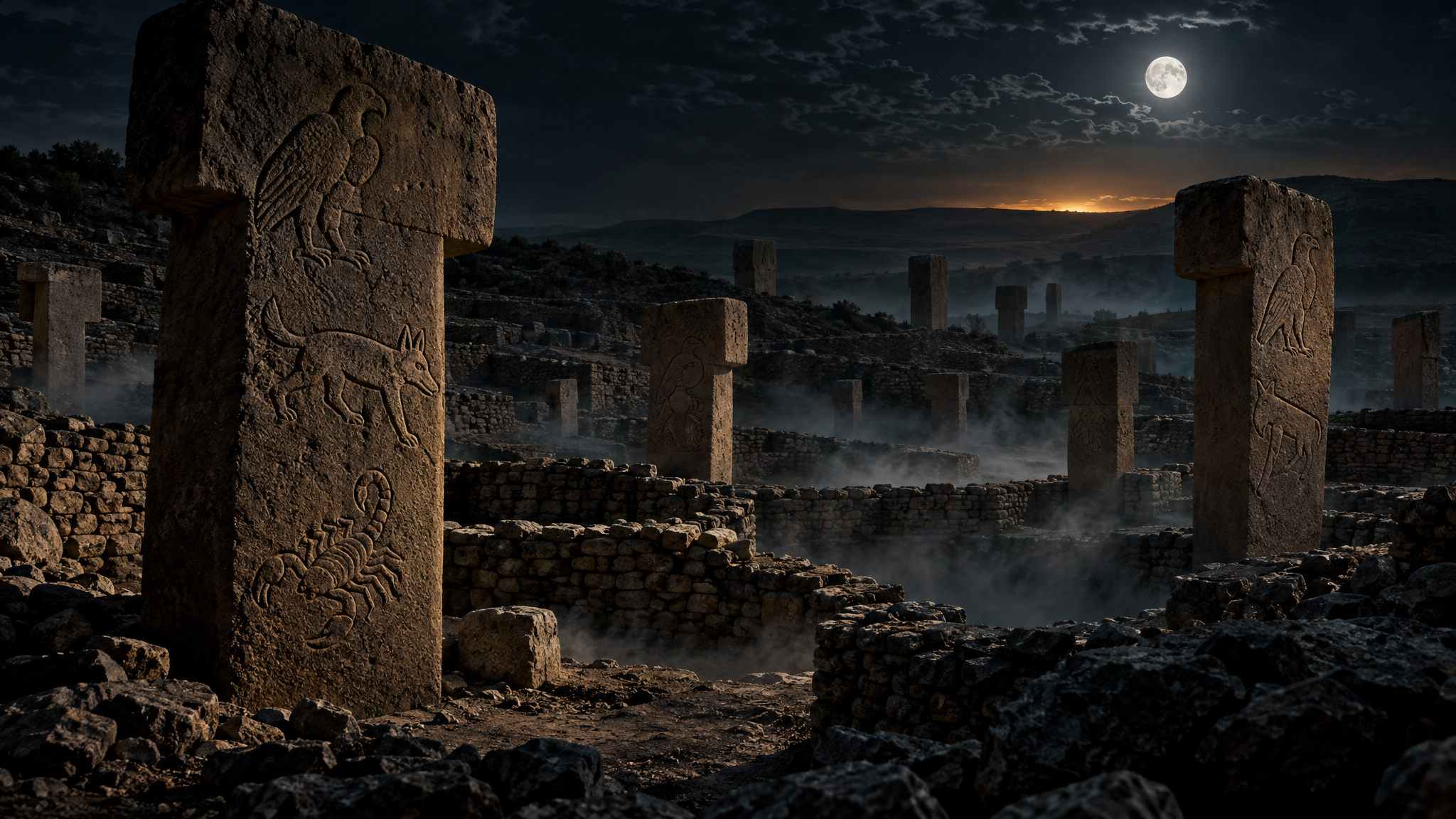
What Schmidt's team uncovered over the next two decades defied archaeological orthodoxy. The site consists of at least twenty circular and oval structures, ranging from 10 to 30 meters in diameter. Each contains massive T-shaped limestone pillars, some weighing up to 20 tons, arranged in rings and decorated with intricate carvings of animals—foxes, lions, scorpions, vultures, snakes, and wild boars.
The radiocarbon dating was unambiguous: 9500 BCE, making Göbekli Tepe approximately 11,500 years old. To put this in perspective, this temple complex was built 6,000 years before Stonehenge and 7,000 years before the Egyptian pyramids. It predates pottery, metallurgy, the wheel, and written language.
The Hunter-Gatherer Problem
Here's where the intelligence analyst in me sees the pattern break. According to conventional archaeological theory, the development of civilization followed a clear sequence: first came agriculture, which created food surpluses, which allowed for permanent settlements, which enabled specialization of labor, which eventually led to monumental architecture and organized religion.
Göbekli Tepe inverts this entire model.
The people who built this complex were hunter-gatherers. We know this because excavations have found no evidence of domesticated plants or animals, no permanent dwellings, no signs of agriculture. The thousands of animal bones discovered at the site are all from wild species—gazelles, wild asses, wild pigs. Yet somehow, these supposedly primitive people organized labor forces large enough to quarry, transport, and erect 20-ton pillars, then carved them with sophisticated artistic representations.
The engineering alone presents questions. The pillars were quarried from bedrock using stone tools, transported up to a quarter-mile, then erected and precisely positioned. Some estimates suggest that moving a single pillar would have required 500 people. The site contains dozens of them.
Evidence of Sophisticated Planning
What strikes me most about Göbekli Tepe—and what my intelligence training tells me is significant—is the evidence of deliberate, long-term planning. This wasn't a spontaneous project. The structures show architectural consistency across different building phases. The pillars are positioned with geometric precision. The iconography follows recognizable patterns and themes.
Moreover, the site appears to have been a regional center. Smaller sites with similar T-shaped pillars have been discovered throughout the surrounding area, suggesting Göbekli Tepe was the hub of a broader cultural network. This implies not just organization, but sustained cultural transmission across generations.
Perhaps most puzzling: around 8000 BCE, the entire complex was deliberately buried. Not destroyed, not abandoned—carefully filled in with debris. The effort required to bury the site would have been nearly as massive as building it. Someone wanted to preserve it.
Competing Theories
The archaeological community has proposed several explanations, none entirely satisfactory:
The Religion-First Hypothesis: Klaus Schmidt argued that Göbekli Tepe proves religion preceded agriculture. The need to gather for ritual purposes at this temple complex may have actually driven the development of agriculture, as feeding large groups of pilgrims required more reliable food sources. This inverts the traditional model entirely.
The Astronomical Observatory Theory: Some researchers note alignments between certain pillars and celestial events. The site's elevated position and careful orientation suggest possible astronomical purposes, though this remains speculative.
The Social Gathering Place: Others propose Göbekli Tepe served as a neutral meeting ground for different hunter-gatherer bands, a place to trade, share information, and arrange marriages. The monumental architecture served to mark its importance and permanence.
What the Evidence Actually Tells Us
Setting aside speculation, here's what we can confirm: A pre-agricultural society possessed the organizational capacity, technical skill, and sustained motivation to create monumental architecture on a scale that wouldn't be seen again for thousands of years. They did this without metal tools, without domesticated animals for transport, without written language for planning and coordination.
This suggests several possibilities, all of them significant:
First, we've dramatically underestimated the cognitive and organizational capabilities of Neolithic hunter-gatherers. The assumption that agriculture was necessary for complex society may be fundamentally wrong.
Second, there may have been earlier, more sophisticated cultures than we've yet discovered. Göbekli Tepe might not be the beginning—it might be a remnant of something older that we haven't found yet.
Third, the development of civilization may not follow a linear path. Perhaps complex social organization, monumental architecture, and sophisticated belief systems emerged, disappeared, and re-emerged multiple times in human prehistory.
The Intelligence Assessment
In intelligence work, we're trained to follow the evidence even when it contradicts our assumptions. Göbekli Tepe is a clear case where the physical evidence demands we revise our models.
The site is only 5% excavated. Schmidt's team deliberately left most of it untouched for future archaeologists with better technology. Ground-penetrating radar suggests at least sixteen additional structures remain buried. What we've seen so far may be just the beginning.
What we can say with certainty is this: 11,500 years ago, people we classified as 'primitive' built something that still confounds us today. They possessed knowledge, skills, and organizational systems sophisticated enough to create one of the world's oldest and most enigmatic monuments. And then, for reasons we still don't understand, they buried it all and walked away.
The question isn't just what Göbekli Tepe was. It's what else we've missed about our own history—and what other assumptions about human civilization are waiting to be overturned by the next discovery.