The Gef the Talking Mongoose: A Case Study in Voice, Witness, and the Machinery of Belief
The House on Cashen’s Gap
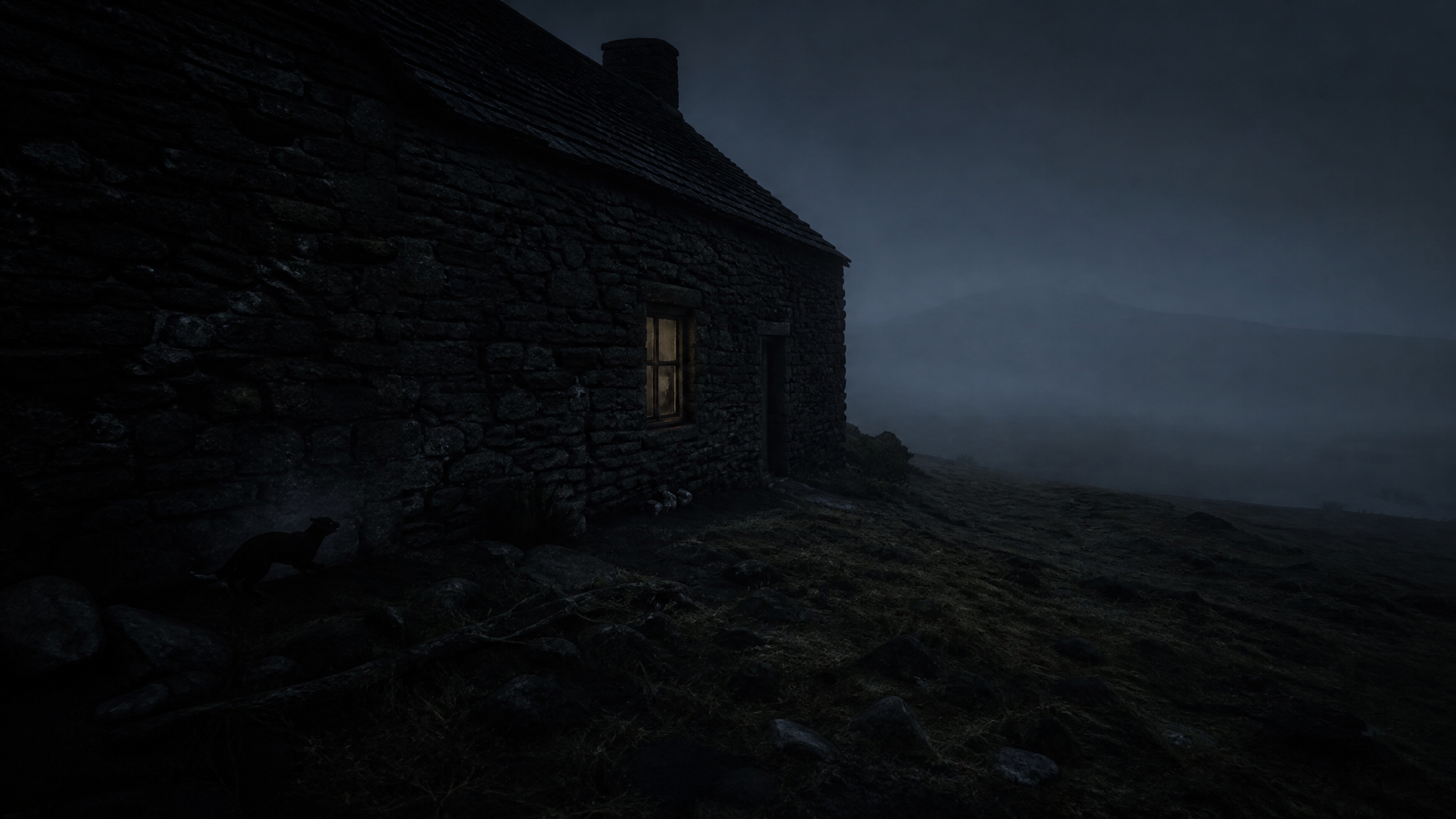
Every mystery has a geography, and Gef’s begins at a specific place: a remote farmhouse called Cashen’s Gap, near Dalby on the Isle of Man, in the early 1930s. The Irving family—James, Margaret, and their daughter Voirrey—lived there with a reputation that would outlast the walls of the house itself. They reported an intelligent, invisible creature in the walls and ceilings: a mongoose-sized being that could speak, imitate voices, and announce, with unsettling confidence, that it was “a freak, a ghost in human form, a spirit and a devil.”
That quote survives because the story survives, and because the story is so strange that it invites the investigator’s oldest temptation: to treat the impossible as if it were a coded message. But before we do that, we need to do what good analysts always do—separate the incident from the narrative built around it.
There are no audio recordings of Gef. There are no verified physical specimens. What remains is a layered record of testimony, newspaper coverage, and later retellings that grew larger each time they were passed along. That doesn’t make the case meaningless. It makes it fascinating in a different way.
What the Witnesses Claimed
The Irving family’s description of Gef was remarkably detailed. It was said to be small, furry, yellow-haired, and mongoose-like, though not exactly a mongoose. It allegedly made noises from the walls, hissed, laughed, and sang. It supposedly knew things it should not have known and could mimic voices with disturbing precision. In some accounts it protected the family; in others it harassed them. In all versions, it refused to fit comfortably into any category.
Gef’s alleged behavior follows a familiar pattern in anomalous cases: first, a sound; then a voice; then an identity; then a personality. Once a phenomenon acquires personality, it becomes much harder to contain. A knock in the wall can be measured. A voice can be argued over. But when the voice starts answering back with wit, timing, and apparent intent, witnesses begin to interpret. The event becomes a relationship.
That is important. Many hauntings and cryptid cases are not built on one dramatic visual sighting. They are built on repeated interaction, usually in emotionally charged conditions, where uncertainty itself becomes part of the experience.
The Newspaper Problem
Gef entered wider public consciousness through the press, and that is where the case becomes both richer and more difficult. Journalists reported the story with a mix of curiosity, amusement, and sensational flair. Once a case hits newspapers, it stops being a local claim and becomes a public artifact. The wording hardens. The contradictions multiply. The most colorful details survive because they are the most memorable, not because they are the most reliable.
That doesn’t mean the press invented the entire story. It means the newspaper record must be handled carefully. Reporters in that era often relied on dramatic quotation, limited verification, and secondhand recollection. In a case like Gef, where the core evidence is already testimonial, every layer of retelling adds distortion. The result is a file that looks dense but is actually fragile.
In anomalous cases, the question is rarely “Did something happen?” It is “What exactly was observed, by whom, under what conditions, and how much of the final story was assembled afterward?”
Could It Have Been a Hoax?
A skeptical reading of Gef begins with the most obvious possibility: fabrication. The case may have been a prank that escalated, a family story that attracted attention, or a deliberate theatrical performance. The lack of hard evidence makes this a reasonable line of inquiry. A speaking mongoose is not the kind of claim that survives scrutiny by default.
Several features of the case support the hoax hypothesis. The reported creature appeared in a dramatic, highly verbal form. It offered jokes, commentary, and theatrical threats—exactly the sort of material that translates well into newspaper copy. The story also unfolded in a remote setting, where informal social pressure and limited outside observation can let a narrative solidify before outsiders can test it.
And yet a clean hoax explanation runs into its own problem: longevity. Hoaxes usually leave behind a clearer center of gravity. Someone confesses, or the mechanism becomes obvious, or the story collapses under the weight of internal contradiction. Gef never quite did that. Instead, it remained suspended between mockery and belief, partly because the witnesses themselves did not all present as simple opportunists.
The Role of Isolation and Suggestion
There is another possibility, and in my experience it is often the one ignored by people who want their mysteries neat: a genuine perceptual experience shaped by isolation, stress, and suggestion. Remote households can become ecosystems of their own. Sounds travel strangely. Animals move in walls. Pipes creak. Wind finds openings. A family already primed to notice irregularities can start connecting them into a single intelligence.
From there, the jump to personality is small. Human beings are pattern-recognition machines. We assign motives to noises, faces to shadows, and agency to coincidence. This does not mean the experience is fake. It means the mind may be participating in the construction of the event in real time.
In Gef’s case, the phenomenon’s human qualities may be the most revealing clue of all. The more a supposed entity speaks, the more it resembles the expectations of the people reporting it. That is not proof of fraud. It is evidence that the witness environment matters as much as the alleged entity.
Why Gef Still Matters
Gef has endured because the story sits at the intersection of folklore, psychology, and paranormal rumor. Unlike many famous mysteries, it is not anchored to a single photograph, object, or traceable physical event. Its power comes from language. It is a mystery about a voice.
That makes it especially useful for investigators. If a case survives mostly as narrative, then the narrative itself becomes the evidence. We ask different questions: Who first told the story? How did the details change? Which portions were repeated because they were true, and which because they were entertaining? What did the local culture already believe about spirits, animals, and uncanny voices?
Those questions don’t “solve” Gef, but they do something perhaps more valuable: they expose the architecture of the legend. And once you see that architecture, you begin to understand why some mysteries refuse to die. They are not sustained by proof alone. They are sustained by pattern, personality, and the deep human need to believe that something unseen is trying to communicate.
My Assessment
If I had to place Gef on the spectrum of unexplained phenomena, I would not put it in the category of objective paranormal evidence. There is simply too little hard corroboration. No recording. No specimen. No independent documentation strong enough to anchor the extraordinary claims.
But I would not dismiss it as mere nonsense either. The case almost certainly contains a real human core: some combination of misperception, storytelling, family dynamics, and media amplification. That core may be more interesting than a literal talking mongoose. It tells us how a household can become the stage on which belief acquires a voice.
In the end, Gef may not be a creature at all. It may be a template—a shape the mind gives to uncertainty when uncertainty starts speaking back. And that, in its own way, is a phenomenon worth investigating.
- Primary case records are incomplete and heavily filtered through later retellings.
- The lack of physical evidence keeps the case in the testimonial category.
- The story’s durability suggests a powerful blend of folklore, media attention, and family narrative.
- Whether hoax, misperception, or something stranger, Gef remains a useful study in how mysteries are made.
For analysts, that is the real lesson. Sometimes the apparition is less important than the conditions that allow it to appear. Gef may have lived in the walls of Cashen’s Gap, but the legend lives in the human need to turn a sound into a voice—and a voice into a story that can outlast the house itself.