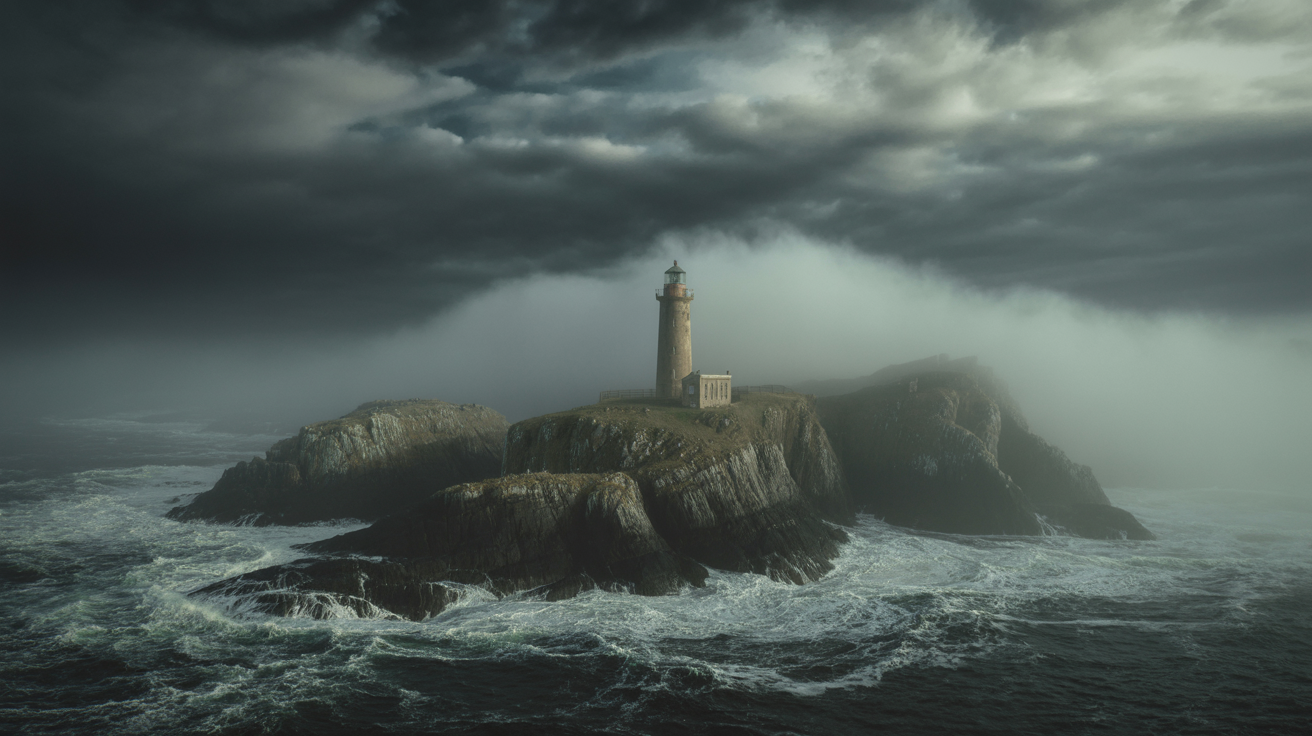
The Flannan Isles Lighthouse Mystery: Three Keepers Vanish Without a Trace
On December 26, 1900, the steamship Hesperus approached the Flannan Isles, a cluster of uninhabited rocks twenty miles west of the Outer Hebrides. Captain James Harvey had come to investigate why the lighthouse—commissioned just one year earlier—had gone dark for over a week. What he found would become one of the most enduring mysteries in maritime history.
The Discovery
When the relief keeper, Joseph Moore, climbed the steep path to the lighthouse compound, he immediately sensed something wrong. The entrance gate and main door stood open, swinging in the Atlantic wind. Inside, the scene was stranger still: two of the three oilskin coats hung on their pegs, the kitchen clock had stopped, and an overturned chair lay on the floor. The lighthouse keepers—James Ducat, Thomas Marshall, and Donald MacArthur—had vanished.
The logbook told a fragmentary story. The last entry, dated December 15, described a severe storm "the likes of which I have never seen." But here's where the facts become troubling: meteorological records from nearby stations recorded no unusual weather on December 15. The storm the keeper described simply didn't exist—at least not according to official records.
The Evidence That Doesn't Add Up
During my years analyzing intelligence patterns at the Agency, I learned that the most revealing details are often the ones that don't fit the narrative. The Flannan Isles case is full of them.
First, the missing oilskin. Two coats remained in the lighthouse, meaning at least one keeper went outside without weather protection—unthinkable for experienced men in December on an exposed Atlantic island. Second, the overturned chair suggested a sudden departure, yet the lighthouse was otherwise orderly. The lamps had been cleaned and refilled, routine maintenance completed.
Most puzzling: damage to the western landing platform, located 110 feet above sea level. Iron railings had been bent, a toolbox weighing over a hundredweight had been displaced, and ropes were scattered across the rocks. Whatever force caused this damage would have required a wave of extraordinary, almost impossible magnitude.
The Official Explanation
The Northern Lighthouse Board's investigation concluded that the keepers had been swept away by a freak wave while attempting to secure equipment at the western landing. Superintendent Robert Muirhead theorized that Ducat and Marshall went out first, were caught by the wave, and MacArthur—seeing the disaster—rushed out without his coat in a failed rescue attempt.
It's a tidy explanation. Perhaps too tidy.
The Problems With the Wave Theory
Lighthouse keepers were not reckless men. They were selected for their caution, their adherence to protocol. The regulations were explicit: never should all three keepers leave the light unattended. Yet the official theory requires us to believe that all three violated this cardinal rule simultaneously.
Moreover, the western landing was not the primary access point—it was used only in calm conditions. In rough weather, keepers used the eastern landing. Why would experienced men choose the more dangerous location during a storm severe enough to generate waves reaching 110 feet above sea level?
And then there's the phantom storm itself. The logbook entries describing increasingly violent weather in the days before December 15 don't match any recorded meteorological data. Either the keeper was documenting a localized phenomenon invisible to nearby weather stations, or something else was happening on that island.
Alternative Theories
Over the decades, theories have multiplied. Some point to the psychological strain of isolation—three men confined to a 75-foot tower for weeks at a time. Could paranoia or conflict have led to violence? The orderly state of the lighthouse argues against it, but human behavior under extreme stress can be unpredictable.
Others have suggested foreign agents or smugglers, though the Flannan Isles offered nothing of strategic value and were far from any shipping lanes. The supernatural explanations—sea spirits, dimensional portals, alien abduction—say more about our need for answers than about the evidence itself.
What the Silence Tells Us
In intelligence work, we have a saying: absence of evidence is not evidence of absence, but it is evidence of something. The complete disappearance of three men, the contradictory weather records, the violation of safety protocols—each absence points to a gap in our understanding.
The Flannan Isles lighthouse operated for another seventy years before automation. Keepers who served there afterward reported nothing unusual, no recurring phenomena, no explanation for what happened in December 1900. The island kept its secrets.
The Unanswered Questions
More than a century later, we're left with the same questions that haunted the original investigation. Why did the logbook describe a storm that apparently didn't happen? What could generate the force necessary to damage equipment 110 feet above sea level? Why would three experienced keepers simultaneously abandon their post and violate the most fundamental safety rule of their profession?
The official explanation requires us to accept a series of improbable decisions and an extraordinarily rare natural event occurring at precisely the same moment. The alternative is to admit we simply don't know—and may never know—what happened on the Flannan Isles in those dark December days of 1900.
Sometimes the most honest answer is the hardest one to accept: the evidence is incomplete, the witnesses are gone, and the truth died with three men whose names are now carved on a memorial plaque, their fate as mysterious as the dark Atlantic waters that surround their final posting.
🏠 Video: Flannan Isles Lighthouse Mystery
A Knight Phenomena Investigation