The Enfield Poltergeist: England's Haunting Under the Microscope
It began, as so many modern hauntings do, not with a ghostly figure in a hallway, but with a complaint from a neighbor. In August 1977, a mother in Enfield, North London, called police after hearing banging noises from the council house next door. What she could not know was that the modest brick home at 284 Green Street would soon become one of the most documented paranormal cases in Britain.
Over the next 18 months, the Hodgson family reported knocking sounds, objects moving on their own, beds shaking, and a gravelly male voice speaking through 11-year-old Janet Hodgson. The case drew journalists, police officers, psychologists, and two investigators from the Society for Psychical Research: Maurice Grosse and Guy Lyon Playfair. By the time the case faded from headlines, it had generated interviews, photographs, audio recordings, and a public argument that has never really ended.
The Facts on the Ground
The Hodgson family was not wealthy, and their home was not a gothic mansion with hidden passages and candlelit corridors. It was a plain working-class house. That detail matters, because the Enfield case unfolded in an ordinary environment, under ordinary conditions, with neighbors close enough to hear, see, and complain.
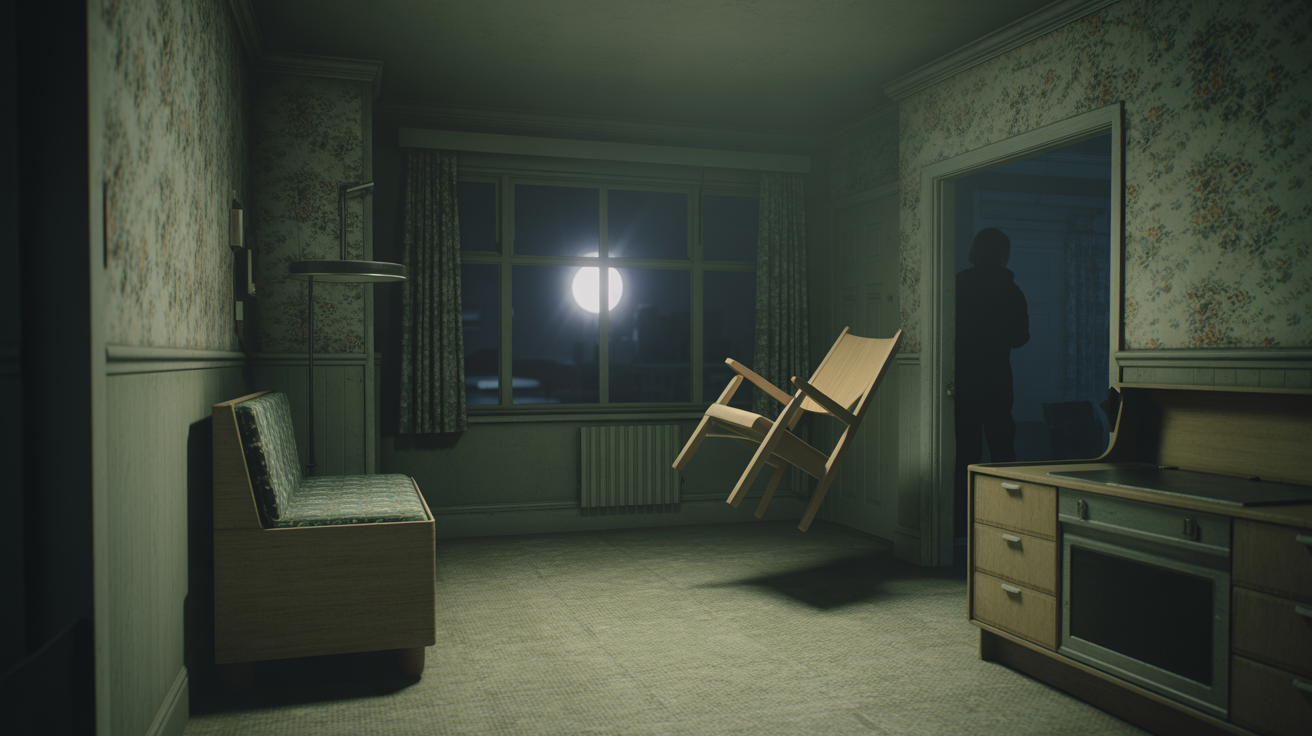
The initial reports centered on loud bangs and furniture disturbances, but the phenomena escalated. Toys reportedly flew across the room. A chair rocked by itself. Janet and her younger sister Margaret said they saw drawers opening and closing without contact. The most sensational episodes involved Janet appearing to speak in a rough, elderly male voice that seemed very different from her own. Some recordings survive, and they are unsettling in the same way many anomalous audio records are unsettling: not because they prove the extraordinary, but because they refuse to fit neatly into the ordinary.
Police officers visited the house. Reporters came. Investigators from the SPR, already experienced in hauntings and mediumship claims, tried to document events as they occurred rather than rely on memory after the fact. Grosse in particular appears to have believed that something unusual was happening, though not every incident was equally persuasive to him. That distinction is important. Serious investigators rarely accept every claim in a case package wholesale. They sort, they doubt, they return to the evidence.
Why Enfield Became a Landmark Case
Haunting stories are common. Haunting stories with contemporaneous documentation are much less common. Enfield mattered because it produced a paper trail. There were witness statements, investigator notes, press coverage, and audio material. In other words, the case did not exist only in the afterglow of recollection. It was argued in real time.
The case also arrived at a moment when Britain was increasingly fascinated by the paranormal. Television documentaries, tabloid features, and spiritualist interest all helped amplify the story. By the late 1970s, the public was ready for a haunting that felt modern rather than medieval, urban rather than rural, and psychodramatic rather than theatrical. Enfield fit the mood perfectly.
That popularity, however, created a problem: the more famous the case became, the more incentives existed for exaggeration, contamination, and performance. Once a family is being filmed, interviewed, and monitored by curious adults, the line between spontaneous event and dramatic reinforcement can blur very quickly.
The Skeptical Case
The strongest skeptical argument is also the simplest: the Enfield haunting shows many signs of classic poltergeist activity driven by stress, attention, and opportunism. Janet and Margaret were children living through family strain. Their parents were separated. The household was under pressure. In paranormal history, that profile appears repeatedly in alleged poltergeist cases.
Skeptics have long argued that some events were staged. Several investigators believed the sisters could fake certain disturbances, such as throwing objects from concealed positions or producing noises on demand. The famous voice, while extraordinary, has also been interpreted as a form of vocal trickery or learned performance. Janet herself later admitted to faking some incidents, though she maintained that not everything was fraudulent. That admission complicates the case enormously. It does not automatically explain away every episode, but it does undermine confidence in the entire body of testimony.
There is also the problem of observer expectation. Once adults arrive hoping to witness a haunting, they may interpret ambiguous sounds and movements as confirmation. In any contested paranormal case, enthusiasm can act like a solvent, dissolving the edge between observation and belief.
The Argument for Something Unexplained
And yet, Enfield is not easily reduced to a simple hoax. Multiple witnesses reported disturbances over an extended period. Some events allegedly occurred when the children were under observation. Recorded speech attributed to Janet remains difficult to dismiss as mere stage magic, even if skepticism is warranted. For believers, the endurance of the case is precisely the point: a prank usually withers when pressure mounts, but this one seemed to persist.
Parapsychologists have offered a different framework. In their view, the case may have involved a genuine poltergeist phenomenon centered on Janet, with emotional strain acting as a trigger rather than a cover story. This theory has deep roots in paranormal literature. Poltergeist cases often cluster around adolescents, especially in households under stress. If one accepts that framework, Enfield becomes less a story about a ghostly intruder and more a story about human psychology producing effects that are, at least initially, misread as external.
That explanation is not glamorous, but it has the advantage of being testable in a way “a spirit did it” is not.
The Historical Context of Haunted London
Britain has a long tradition of hauntings tied to houses, estates, and urban buildings. What sets Enfield apart is not the idea of a haunted home, but the modernity of the evidence. By the late 20th century, cameras, tape recorders, and television crews had entered the ghost story. The result was a new kind of paranormal case: one where belief and skepticism could be debated using the language of documentation, not just folklore.
That matters because Enfield sits at the intersection of old and new. It has the emotional architecture of a traditional haunting, but the media ecology of a modern scandal. Once the case was televised and dramatized, it became a cultural artifact as much as a paranormal claim. Later films and documentaries would revive interest, often choosing atmosphere over nuance. But the underlying record remains messy, inconsistent, and therefore interesting.
So What Actually Happened?
If we strip away the sensationalism, three possibilities remain. First: the entire case was deliberate fabrication, built on juvenile mischief and sustained by attention. Second: some events were faked, while others may have reflected genuine but misunderstood phenomena, psychological distress, or unconscious behavior. Third: something genuinely anomalous occurred, and the best witnesses were simply unable to explain it in conventional terms.
Only the first theory is fully satisfying in a forensic sense, but it does not explain every reported detail. Only the third satisfies the paranormal imagination, but it demands more trust than the record comfortably allows. The second theory may be the least dramatic, yet it is the one most consistent with the evidence as it exists: a volatile mix of family stress, youthful performance, investigator expectation, and perhaps one or two events that resisted easy explanation.
In other words, Enfield may not be a case of either pure hoax or pure haunting. It may be a case where the human mind, under pressure and attention, produces a situation so strange that even the participants cannot fully control the story once it starts.
My Assessment
After reviewing the record, I do not think Enfield stands as proof of a classic ghost story. Too much of the evidence is contaminated by admitted fraud, inconsistent testimony, and the natural tendency of a famous case to grow larger than its source. But I also do not think it can be waved away as a simple childhood prank. The persistence of reports, the involvement of experienced investigators, and the surviving recordings leave behind a residue of uncertainty that deserves respect.
My assessment is this: Enfield was likely a mixed case, part deception, part distress, part unexplained residue that never received a clean answer. That may be disappointing to people who want either a ghost or a hoax. But disappointment is often the price of honest investigation. The Enfield Poltergeist remains compelling not because it proves the supernatural, but because it reminds us how quickly human fear, belief, and performance can merge into something that looks, for a time, like the impossible.
👻 Video: Enfield Poltergeist Englands Haunting
A Knight Phenomena Investigation