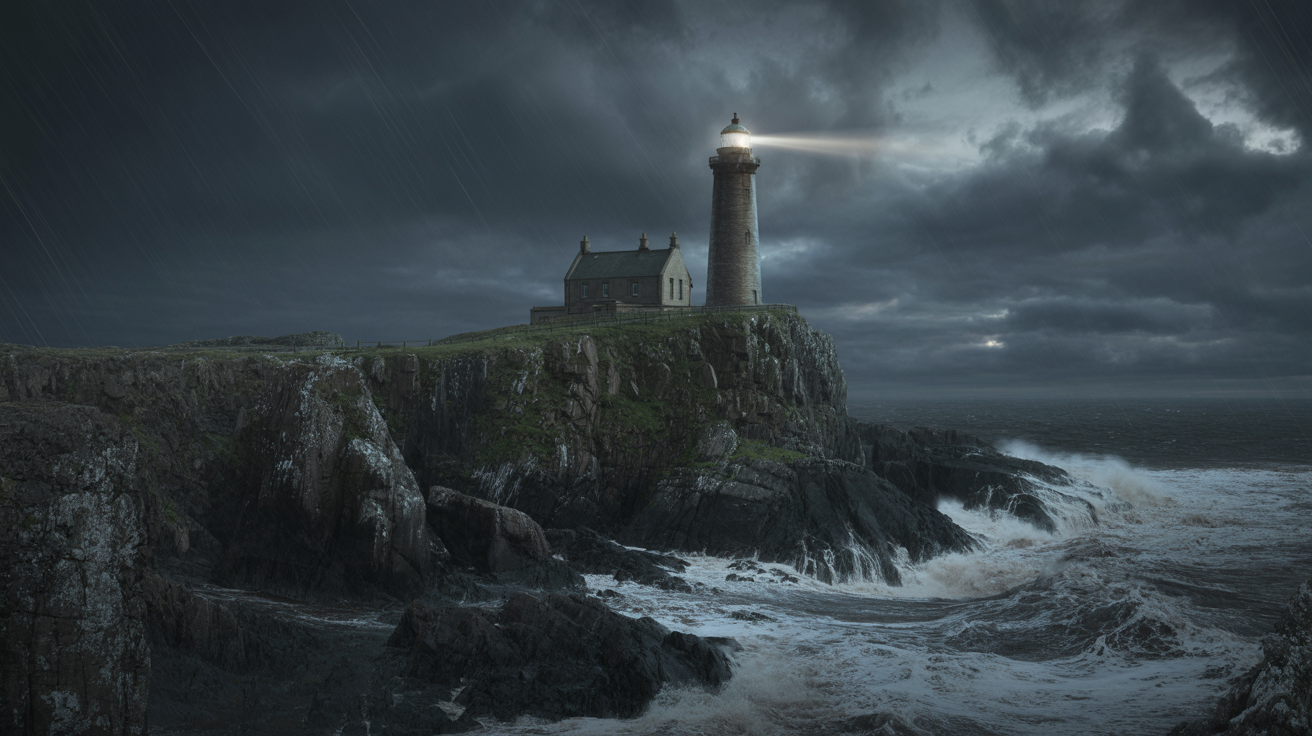
The Eilean Mor Mystery: Three Lighthouse Keepers Erased from History
On December 26, 1900, the relief vessel Hesperus approached the Flannan Isles lighthouse on Eilean Mor, a desolate rock in the Outer Hebrides of Scotland. Captain James Harvey expected a routine crew rotation. What he found instead would become one of maritime history's most enduring mysteries.
The Discovery
When the relief keeper, Joseph Moore, climbed the steep path to the lighthouse, he was met with an eerie silence. The entrance gate and main door stood open. Inside, the lighthouse was immaculate—beds made, dishes washed, clocks stopped. But the three keepers—James Ducat, Thomas Marshall, and Donald MacArthur—were gone.
The only signs of disturbance were subtle but deeply unsettling: two of the three oilskin coats were missing from their hooks, meaning one man had ventured into what must have been severe weather without protection. An overturned chair lay on the kitchen floor. And most disturbing of all, the lighthouse log contained entries that made no meteorological sense.
The Impossible Log Entries
As a former intelligence analyst, I've learned that anomalies in documentation often point to the truth. The Eilean Mor log is a masterclass in anomaly. The final entries, allegedly written by Thomas Marshall, describe a storm of unprecedented ferocity:
December 12: "Severe winds the likes of which I have never seen in twenty years. Ducat very quiet. MacArthur crying."
December 13: "Storm still raging, wind steady. Stormbound. Cannot go out. Ship passing sounding foghorn. Could see lights of cabins. Ducat irritable."
December 15: "Storm ended, sea calm. God is over all."
Here's the problem: meteorological records from surrounding areas show no evidence of any storm during this period. Weather stations on nearby islands, ships at sea, and coastal observers all reported calm conditions. So what was Marshall describing?
The Physical Evidence
The investigation revealed additional peculiarities. At the west landing, a storage box containing ropes had been torn from its concrete moorings and swept away. Iron railings were bent. A rock weighing over a ton had been displaced. Yet this landing sat 110 feet above sea level—it would require a wave of extraordinary, almost impossible magnitude to cause such damage.
The east landing, by contrast, showed no damage whatsoever. The lighthouse itself was in perfect working order. The lamps had been cleaned and refilled. The last entry in the official log was routine, dated December 15 at 9 AM, noting nothing unusual.
Theories and Analysis
The Rogue Wave Theory: The official explanation suggests a massive wave swept the men away while they were securing equipment at the west landing. But this raises questions: Why would all three men be outside simultaneously, violating standard lighthouse protocol? Why would one man go without his oilskin? And why does the damage pattern suggest the wave came from an impossible angle?
The Psychological Break Theory: Some researchers point to Marshall's log entries describing MacArthur "crying" and Ducat being "irritable" as evidence of mounting psychological pressure. Isolation, the relentless winter darkness, and the psychological weight of maintaining a light that stood between ships and death could break even experienced men. But this doesn't explain the physical evidence or the synchronized disappearance.
The Foreign Vessel Theory: During my time analyzing maritime intelligence, I learned that the waters around Scotland were heavily trafficked by foreign vessels, some engaged in activities they preferred to keep quiet. Could the keepers have witnessed something they shouldn't have? The mention of a "ship passing" in the log is tantalizing, but no vessel reported being in the area.
The Supernatural Hypothesis: Local folklore speaks of the Flannan Isles as a place of "phantom birds" and strange occurrences. The islands were considered cursed by some fishermen, who refused to land there. While I approach such claims with analytical skepticism, the pattern of inexplicable disappearances in isolated locations often correlates with areas of intense local superstition. Correlation, however, is not causation.
The Intelligence Analysis Approach
In intelligence work, we construct timelines and look for gaps. The gap here is significant: the last confirmed sighting of the keepers alive was December 15. The relief vessel wasn't due until December 20, but was delayed by weather until December 26. That's an 11-day window where anything could have happened.
The log entries describing the "storm" are dated December 12-15, but the official log shows routine entries through December 15. This suggests either the storm log was fabricated (but by whom and why?), or Marshall was describing something other than a meteorological event. In intelligence analysis, when a source uses familiar terminology to describe an unfamiliar phenomenon, it often indicates they lack the vocabulary for what they're actually experiencing.
Unanswered Questions
Why was the chair overturned in an otherwise pristine lighthouse? Why did the clocks stop? Why would experienced keepers, who knew the sea's dangers intimately, all venture outside together? And perhaps most haunting: what could make a grown man cry and another fall into irritable silence in the face of a storm that apparently never happened?
Conclusion
The Eilean Mor mystery remains unsolved after more than 120 years. The official explanation—a rogue wave—is plausible but incomplete. It doesn't account for the psychological distress documented in the log, the phantom storm, or the violation of safety protocols that would have been second nature to these men.
What I can say with certainty is this: something happened on that remote island in December 1900 that was significant enough to cause three experienced men to abandon their post, their protocols, and ultimately their lives. Whether that something was a natural phenomenon we don't yet understand, a human intervention that was covered up, or something else entirely, we may never know.
The lighthouse still stands on Eilean Mor, automated now, requiring no human keepers. The islands remain as desolate and mysterious as they were that winter day when three men walked into history and never returned. Their fate is a reminder that even in our modern age of surveillance and documentation, some mysteries resist all attempts at resolution.
And perhaps that's exactly as it should be.
🏠 Video: Eilean Mor Mystery Lighthouse
A Knight Phenomena Investigation