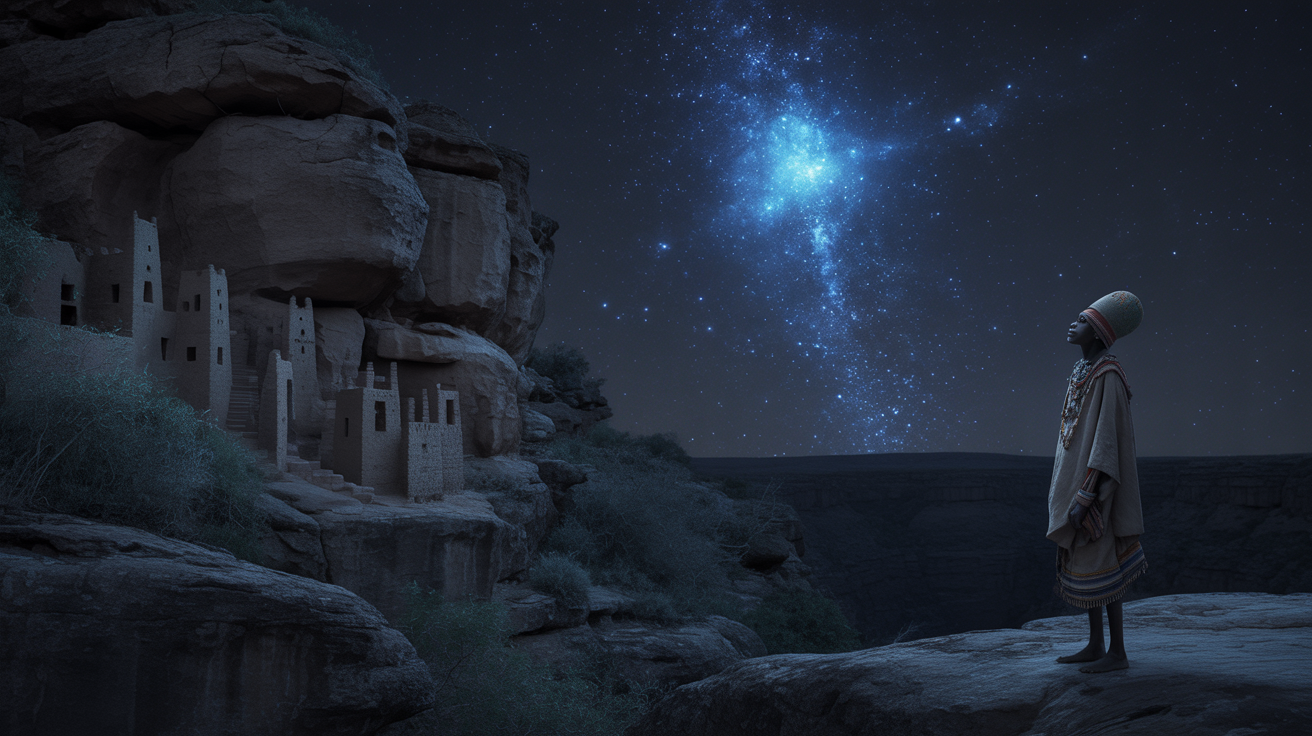
The Dogon and Sirius: An African Tribe's Impossible Knowledge of the Stars
In my years at the CIA, I learned to be suspicious of coincidences. When a piece of intelligence seemed too perfectly placed, too conveniently timed, you didn't celebrate the find — you questioned the source. That discipline has served me well in this work, too. Because sometimes, the most extraordinary claims don't come from fringe corners of the internet. Sometimes they come from peer-reviewed anthropological fieldwork, published by respected academics, and they still don't have a clean explanation.
The Dogon people of Mali are one of those cases. And after years of sitting with the evidence, I still don't have a comfortable answer.
The Cliffs of Bandiagara
The Dogon are an ethnic group of roughly 400,000 to 800,000 people living primarily in the Mopti region of Mali, West Africa, concentrated along the dramatic sandstone escarpment known as the Bandiagara Cliffs. Their culture is ancient, their oral traditions rich, and their cosmology — by any reasonable measure — is extraordinary.
Between 1931 and 1956, two French anthropologists, Marcel Griaule and Germaine Dieterlen, conducted extensive fieldwork among the Dogon. What they documented in their 1950 paper "A Sudanese Sirius System" — and later expanded in Griaule's 1965 book Le Renard Pâle — sent quiet shockwaves through academic circles that have never fully subsided.
The Dogon, Griaule reported, possessed detailed knowledge of the Sirius star system. Not just that Sirius was bright. Not just that it rose at a particular time of year. They knew things that, by all conventional understanding, they should not have known.
What the Dogon Claimed to Know
According to Griaule and Dieterlen's documentation, Dogon cosmological tradition held that Sirius — the brightest star in the night sky, visible to the naked eye — was accompanied by a small, dense, invisible companion star. They called it Digitaria, or po tolo. They described it as the smallest and heaviest of all stars, made of a metal stronger than iron. They said it orbited Sirius in an elliptical path, completing one revolution every 50 years.
Here is why that matters: Sirius B, the white dwarf companion to Sirius A, was first photographically confirmed in 1862 by American astronomer Alvan Graham Clark — and even then, its extreme density wasn't understood until the early 20th century. The 50-year orbital period of Sirius B around Sirius A was calculated by Western astronomers at approximately 50.1 years. The Dogon's figure was, by any measure, remarkably close.
Sirius B is invisible to the naked eye. It requires a telescope of significant power to observe. The Dogon had no telescopes.
Griaule and Dieterlen also documented Dogon knowledge of a third star in the system — emme ya tolo — which they described as larger than Digitaria and following a longer orbital path. Intriguingly, some astronomers have periodically proposed the existence of a hypothetical Sirius C, though its existence remains unconfirmed and contested to this day.
The Robert Temple Controversy
In 1976, British author Robert K.G. Temple published The Sirius Mystery, a book that took Griaule's anthropological findings and ran hard in a particular direction: the Dogon's knowledge, Temple argued, came from direct contact with extraterrestrial beings from the Sirius system in antiquity. He connected the Dogon traditions to ancient Egyptian mythology, to the amphibious god Nommo, and constructed an elaborate framework suggesting that alien visitors had seeded astronomical knowledge across ancient civilizations.
Temple's book became a sensation. It also became a lightning rod.
The scientific and anthropological communities pushed back — hard. And some of their objections are legitimate and worth taking seriously. Carl Sagan and astronomer Ian Ridpath were among the most prominent critics. Their core argument: Griaule and Dieterlen had spent decades living among the Dogon, and it was entirely possible — even likely — that the anthropologists themselves had inadvertently introduced Western astronomical knowledge into the community through their conversations and questions. This phenomenon, known as "contamination" or "diffusion," is a recognized hazard in long-term ethnographic fieldwork.
In 1991, anthropologist Walter van Beek conducted his own independent fieldwork among the Dogon. His findings were striking: the Dogon he interviewed showed little to no knowledge of Sirius B or the specific astronomical details Griaule had documented. Van Beek concluded that Griaule had likely over-interpreted — or been misled by — a small group of initiated elders who may have been telling him what he wanted to hear, or who had absorbed information from outside sources.
Weighing the Evidence
This is where my intelligence background kicks in. When two credible sources produce contradictory findings, you don't simply pick the one you prefer. You examine the methodology, the access, the incentives, and the gaps.
Griaule's critics raise valid points. He was not a neutral observer — he was deeply invested in Dogon culture, spent decades embedded with specific informants, and his primary source for the most sensitive cosmological knowledge was a single elder named Ogotemmêli, who granted him 33 days of intensive interviews in 1946. That's a narrow evidentiary base for extraordinary claims.
But van Beek's counter-findings have their own complications. Dogon cosmological knowledge is explicitly esoteric — it is tiered, with deeper knowledge reserved for initiated members of specific societies. The fact that ordinary Dogon villagers in the 1990s couldn't confirm Griaule's findings doesn't necessarily mean those findings were fabricated. It may simply mean van Beek didn't have access to the same initiated sources.
There is also the uncomfortable question of prior knowledge. When did Western astronomy's understanding of Sirius B become widely available enough to contaminate Dogon oral tradition? Sirius B's density and orbital characteristics were being discussed in scientific literature by the 1920s. Griaule began his fieldwork in 1931. The window for contamination exists — but it is narrower than critics sometimes imply, and it requires assuming a fairly specific chain of transmission into a remote cliff-dwelling community in French Sudan.
The Question That Remains
I want to be precise about what I'm not saying. I am not saying the Dogon were visited by aliens. Temple's extraterrestrial hypothesis is a significant leap that the evidence does not compel. Ancient contact with a technologically advanced but entirely human civilization — Egyptians, Greeks, Arab traders — is a far more parsimonious explanation if outside transmission is required at all.
What I am saying is this: the contamination hypothesis, while plausible, is not proven. The dismissal of Griaule's work has sometimes been as ideologically motivated as its promotion. And the core astronomical correlations — the invisible companion star, the density, the orbital period — remain genuinely difficult to explain away with complete comfort.
The Dogon case sits in a category I've come to recognize well: evidence that is too specific to ignore and too ambiguous to resolve. It doesn't fit neatly into "ancient aliens" or "simple folklore." It lives in the uncomfortable middle ground where honest investigators have to resist the pull of both sensationalism and reflexive debunking.
The Bandiagara Cliffs have been inhabited for thousands of years. The Dogon have watched the same sky for all of them. Whatever they saw — or were told — they encoded it carefully enough that two French anthropologists found it remarkable in the 20th century.
That, at minimum, deserves more than a dismissive footnote.
— Steven Knight, Knight Phenomena
⭐ Video: Dogon Tribe Sirius Impossible
A Knight Phenomena Investigation