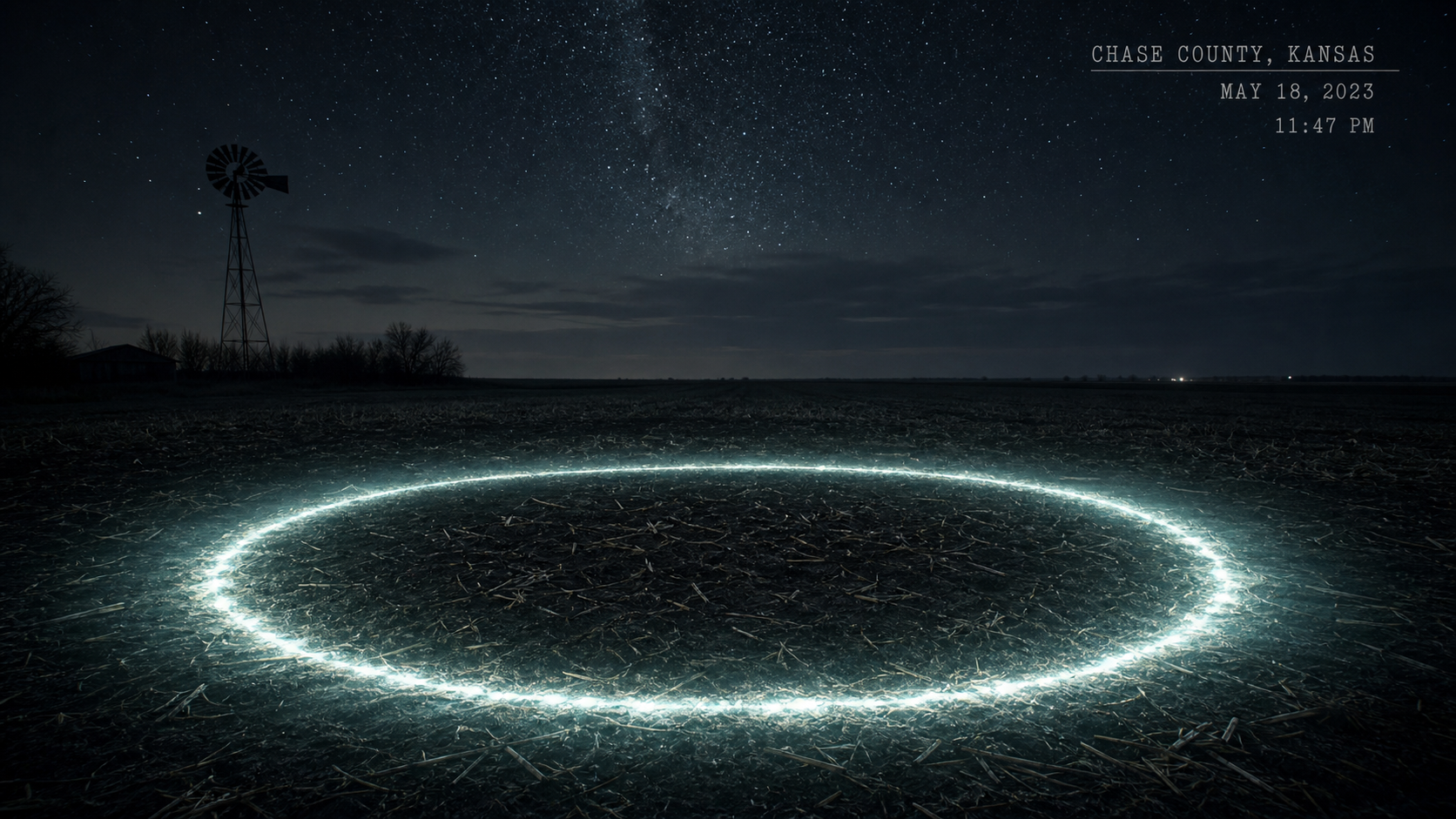
The Delphos Ring: Kansas's Most Compelling Physical Trace Case
In my years analyzing intelligence data, I learned that physical evidence changes everything. Witness testimony can be unreliable, photographs can be faked, but soil samples, chemical analysis, and measurable environmental changes—those are harder to dismiss. That's why the Delphos Ring case, despite occurring over fifty years ago in rural Kansas, still commands attention from serious researchers.
On November 2, 1971, something happened on the Johnson family farm outside Delphos, Kansas that left behind evidence you could touch, photograph, and analyze in a laboratory. Whether that evidence points to extraterrestrial visitation or a more terrestrial explanation remains the question.
The Night of November 2, 1971
Sixteen-year-old Ronald Johnson was tending sheep in a wooded area near his family's farmhouse around 7:00 PM when he noticed an object hovering approximately two feet above the ground, about 75 feet away. He would later describe it as mushroom-shaped, roughly nine feet in diameter, with multicolored lights covering its surface. The object emitted a sound he compared to "an old washing machine which vibrates."
According to Ronald's account, he watched the object for several minutes, during which time he experienced temporary blindness and a numbing sensation. When the object suddenly ascended with a bright flash, he ran to get his parents, Durel and Erma Johnson. All three witnesses then observed the object in the sky before it disappeared.
What they found on the ground is where this case diverges from typical UFO reports.
The Physical Evidence
At the location where Ronald claimed the object had hovered, the family discovered a glowing ring on the ground. The ring measured approximately eight feet in diameter and glowed with what witnesses described as a grayish-white luminescence visible in the darkness. When Erma Johnson touched the ring's soil, she reported that her fingers went numb and remained so for several weeks.
The ring itself consisted of a band of soil roughly one foot wide that appeared crystallized or encrusted. The soil within this ring was dry to a significant depth, despite recent rain that had left surrounding areas muddy. Trees near the ring showed unusual damage to their lower bark, with a whitish discoloration extending up the trunks.
The luminescence was photographed that night by the local newspaper editor and reportedly remained visible for several days. The ring itself persisted for months, with the affected soil remaining noticeably different from surrounding earth well into the following year.
Scientific Analysis
Soil samples from the ring were collected and analyzed by multiple parties, including Dr. Erol Faruk, a physical chemist, and later by French researcher Jacques Vallée. The findings were unusual, though their interpretation remains contested.
The soil showed a high concentration of white fibrous material identified as an actinomycete organism—a type of fungus. The soil's hydrophobic properties were remarkable; it actively repelled water, which could explain the dry condition despite surrounding moisture. Chemical analysis revealed elevated levels of calcium, potassium, and other elements compared to control samples.
Dr. Faruk noted that the soil's crystalline structure appeared altered, though he stopped short of declaring the changes impossible through natural means. The fibrous fungal material could theoretically produce some of the observed effects, including bioluminescence, though the concentration and distribution pattern remained difficult to explain through conventional mycological processes.
The Intelligence Analysis Approach
When I approach a case like Delphos, I apply the same methodology I used analyzing intelligence reports: assess the witnesses, examine the chain of evidence, look for corroboration, and identify alternative explanations.
The Johnson family had no apparent motive for fabrication. They were private individuals who gained no financial benefit from their report and, by most accounts, found the attention unwelcome. Ronald Johnson's account remained consistent across multiple interviews over decades. The physical evidence was documented by multiple independent parties within hours of the alleged event.
The luminescence was witnessed and photographed by parties beyond the family. The soil anomalies were confirmed by laboratory analysis. The ring's persistence—visible for months—was documented by investigators who visited the site at various intervals.
These factors distinguish Delphos from cases relying solely on testimony.
Alternative Explanations
Skeptical researchers have proposed several conventional explanations. The most common involves fairy ring fungi—naturally occurring circular fungal growths that can create ring patterns in soil and grass. Certain fungi can indeed produce bioluminescence and create hydrophobic soil conditions.
However, fairy rings typically develop over extended periods, not instantaneously. The reported luminescence intensity and the soil's extreme water-repellent properties exceed what's commonly observed in natural fairy rings. The correlation with the witnessed aerial object and the immediate appearance of the ring present timing problems for the fungal hypothesis.
Other theories have included ball lightning, though this phenomenon doesn't typically leave lasting ground traces. Chemical contamination has been suggested, but no source for such contamination was identified, and the specific chemical profile doesn't match common agricultural or industrial substances.
The Enduring Questions
What makes the Delphos Ring significant isn't that it proves extraterrestrial visitation—it doesn't. What makes it significant is that it represents physical evidence that resists easy dismissal. The case has been studied by both believers and skeptics, and while interpretations differ, the basic facts remain undisputed: something created an unusual ring in that Kansas field, and that ring exhibited properties not readily explained by common natural processes.
In intelligence work, we often dealt with incomplete information. You rarely get the full picture. What matters is the quality of the information you do have and whether it's sufficient to support action or further investigation.
The Delphos Ring provides higher-quality data than most UFO cases. It offers physical samples, multiple witnesses, photographic documentation, and scientific analysis. Whether those elements point to something extraordinary or merely unusual remains open to interpretation.
The ring is gone now, long since returned to normal soil. But the samples remain, stored in research archives, available for re-analysis as technology improves. The photographs still exist. The witnesses' accounts are preserved in multiple interviews and documents.
In the end, the Delphos Ring doesn't answer the UFO question. But it asks it in a way that's harder to ignore—with evidence you can hold in your hand and measure in a laboratory. And sometimes, in the world of unexplained phenomena, that's the most we can hope for: not answers, but better questions backed by tangible data.