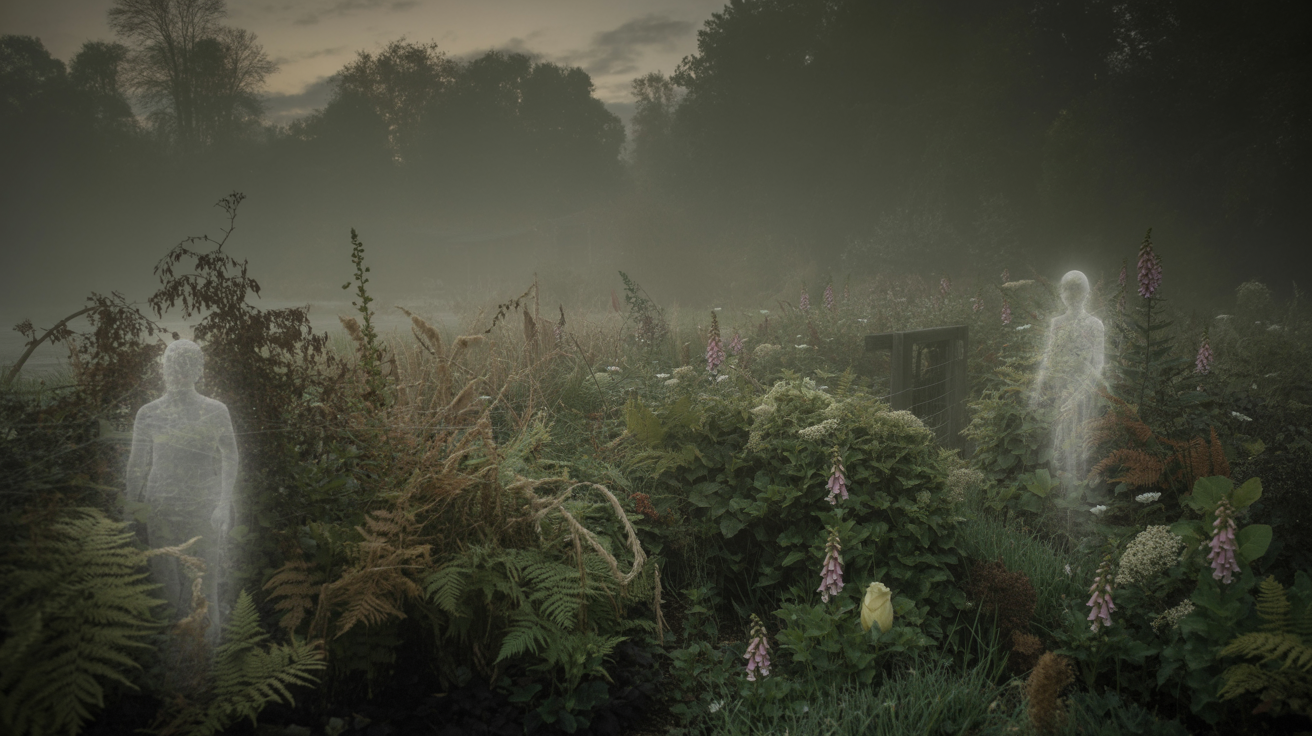
The Cottingley Fairies: How Two Girls Turned Cardboard Into a National Mystery
In intelligence work, the most durable deceptions are often the simplest. They do not depend on exotic technology or elaborate conspiracies. They depend on human beings doing what they have always done: seeing what they want to see, trusting authority, and mistaking confidence for evidence.
The Cottingley Fairies case, which emerged from a small English village during the First World War, is one of the clearest examples I know. Two young cousins, Frances Griffiths and Elsie Wright, produced photographs that appeared to show fairies in a stream-side glade. The images were sharp enough to impress the public and strange enough to survive the usual filters of skepticism. For a time, they did more than entertain. They became evidence.
A Photograph in the Wrong Century
The story begins in Cottingley, near Bradford, in 1917. Frances and Elsie were not career hoaxers or occultists. They were children, living in a world shaped by war, rationing, and the narrow boundaries of village life. One day they returned with photographs that seemed to capture tiny winged figures in motion. In the era of glass plates and long exposures, the images looked, to many eyes, unusually convincing.
Today it is easy to underestimate that credibility. We live in a world saturated with images, deepfakes, filters, and instant verification. In 1917, a photograph carried a different weight. It had an aura of mechanism and truth. People trusted what the camera saw, even when the human eye had not seen it directly. That is the first lesson of Cottingley: the technology of proof can become the technology of belief.
What the girls likely used was far less mysterious than the final product suggested. The fairies appear flat, posed, and oddly similar to illustrations one might cut from a book. In other words, the images were exactly the sort of thing a clever child could assemble with patience, paper, and a camera. That does not make the hoax trivial. It makes it instructive. The best deceptions rarely require brilliance. They require timing.
The Man Who Wanted to Believe
The case might have remained a local curiosity if not for Sir Arthur Conan Doyle. By then, Doyle was not just the creator of Sherlock Holmes; he was one of the most famous public advocates of spiritualism in Britain. He had already accepted phenomena that many others dismissed. When he encountered the Cottingley photographs, he did not approach them as a hardened skeptic. He approached them as a man looking for confirmation that the unseen world was real.
That distinction matters. In analysis, predisposition is one of the most important variables in any case file. A witness does not simply observe. He interprets. A believer and a skeptic can examine the same image and leave with opposite conclusions, each convinced the other is blind. Doyle had intellectual prestige, but prestige is not immunity. In this case, it may have made the deception more powerful, because his endorsement carried the force of reputation.
He wrote and spoke about the photographs as if they were a significant breakthrough. Newspapers took notice. The public followed. A private village oddity became a national debate about fairies, photography, and the reliability of modern evidence. It is difficult to overstate how unusual that was. The story crossed from folklore into mainstream culture precisely because it was framed as proof.
What made the Cottingley photographs dangerous was not that they showed fairies. It was that they gave respectable people permission to lower the burden of proof.
Why the Hoax Worked
There is a temptation to treat the Cottingley case as a simple embarrassment, a quaint relic of a more gullible age. I think that is too easy. The episode worked because it sat at the intersection of several powerful forces: wartime grief, fascination with the occult, trust in photography, and the authority of respected voices. When those factors align, evidence can become flexible.
It also helped that the fairies were not grotesque. They were delicate, charming, almost storybook in appearance. That aesthetic matters. People are more willing to accept a phenomenon when it flatters their imagination. The Cottongley figures did not demand fear. They offered wonder. And wonder, unlike fear, lowers resistance.
Over time, the explanation became clearer. The girls eventually acknowledged that the photographs were staged, and the broader historical record supports that conclusion. The images were likely crafted from paper cutouts, arranged with a practical understanding of angles and camera distance. In other words, the solution is not supernatural at all. It is artisanal.
Yet the case persists because it asks a question larger than whether fairies exist. It asks why intelligent people accept implausible claims when those claims satisfy an emotional need. Doyle wanted a universe alive with spirit. The public wanted a mystery in a grim age. The girls, perhaps, wanted attention, fun, or simply to see whether the adults around them could be fooled. Each motive is ordinary. Together, they produced something extraordinary.
The Intelligence Lesson Hidden in the Glade
Cases like Cottingley are useful because they strip the mystery down to its mechanics. No alien craft. No impossible physics. No lost civilization. Just a camera, a willing audience, and a story strong enough to survive scrutiny longer than it should have. If that sounds less dramatic than a classic haunting, it is only because the mechanics of deception are often mundane.
From an investigative standpoint, the lesson is clear. Do not begin with the conclusion. Examine the medium. Ask who benefits, who believes, and what assumptions are doing the real work. In the Cottingley case, the evidence was not strong enough to prove fairies. But it was strong enough to prove something else: that people will often grant reality to whatever makes the world feel a little less empty.
That is why the photographs endure. Not because they capture a hidden race of woodland beings, but because they capture a timeless human vulnerability. We want mystery to be true. Sometimes, that desire is stronger than the facts in front of us. And in Cottingley, two children understood that instinct well enough to turn cardboard into legend.
🧚 Video: Cottingley Fairies Cardboard National
A Knight Phenomena Investigation