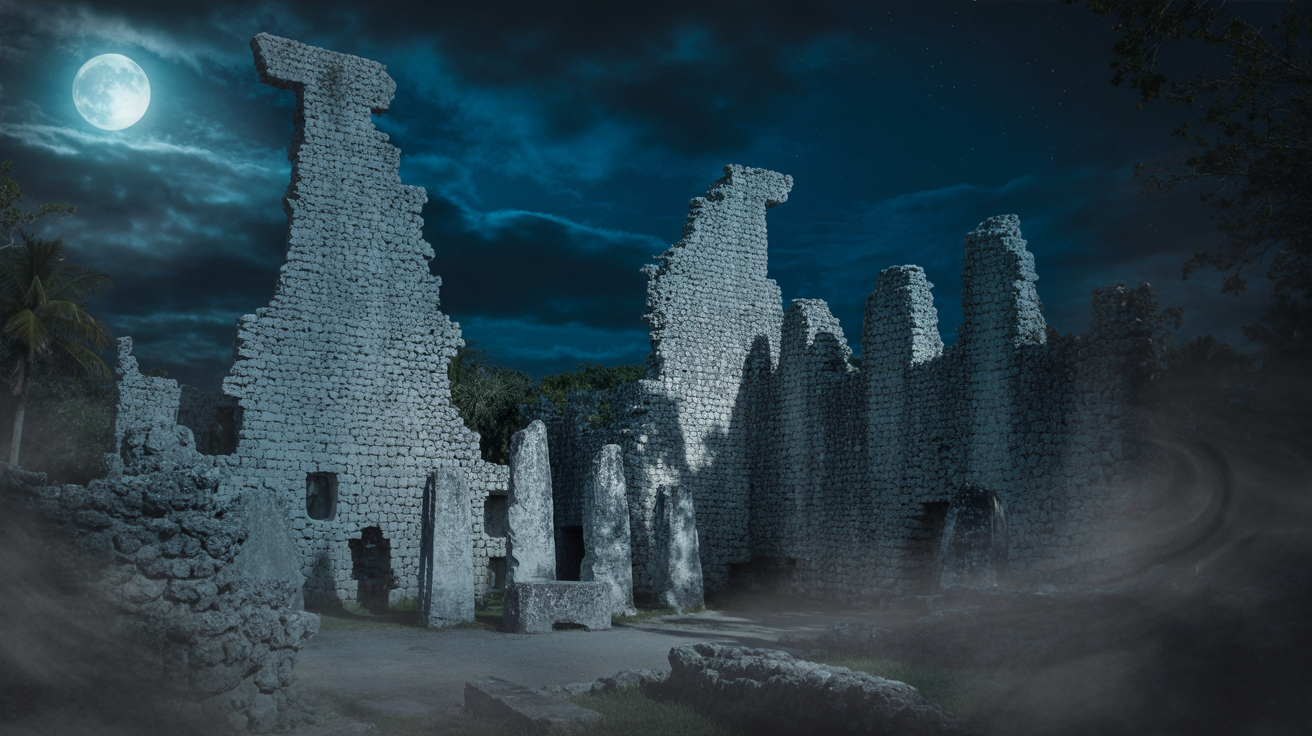
Coral Castle: The Florida Monument Built in Solitude and Legend
Case File: A Monument in the Florida Heat
On the surface, Coral Castle looks like the kind of roadside curiosity that should be explainable in a paragraph. A self-taught Latvian immigrant named Edward Leedskalnin spent years carving and moving massive blocks of oolite limestone in Homestead, Florida, creating walls, chairs, tables, a sundial, a heart-shaped table, and a nine-ton gate that once turned with a finger’s pressure. The problem is not that the object exists. The problem is that the story around it has grown larger than the stone itself.
Any case like this deserves a disciplined approach. Begin with the known facts, separate them from family legend, and then test the remaining claims against engineering, historical record, and human behavior. Coral Castle survives because it sits at the intersection of three powerful ingredients: one man’s grief, a community’s fascination, and a pile of limestone heavy enough to invite disbelief.
The Man Behind the Walls
Edward Leedskalnin was born in 1887 in Latvia, then part of the Russian Empire. He emigrated to North America and, after a series of moves and jobs, settled in Florida in the 1920s. What is not in dispute is that he worked alone, maintained a private life, and spoke publicly in a way that encouraged mystery. He published pamphlets about magnetism and often hinted that he understood forces others did not.
Those pamphlets matter because they reveal the mindset of the man at the center of the legend. Leedskalnin was not a conventional builder, and he was not trying to appear conventional. He was a lone inventor, a self-promoter, and by some accounts a man still nursing the pain of a broken engagement to a much younger woman he referred to as his “Sweet Sixteen.” The heartbreak story has become inseparable from Coral Castle, but it is best treated as biography, not proof. Grief can motivate obsession. It does not automatically explain method.
What Was Actually Built
The site includes more than the iconic gate. There are walls composed of large blocks, some weighing several tons; a crescent-shaped seating area; a well; an obelisk; a rocking chair; and a number of decorative and functional stone pieces. The construction appears deliberate, not random. Alignment, balance, and placement all suggest a builder who understood leverage and patience. If there was a “secret,” it likely began there.
Visitors in the mid-20th century often came away convinced that something supernatural or lost-to-history had occurred. Leedskalnin, working in solitude and often at night, did little to discourage them. He frequently refused to explain his methods, or he offered vague statements about magnets, polarity, and the behavior of matter. That evasiveness created a vacuum, and legend rushed in to fill it.
“The question is not whether the blocks moved. The question is how a single man managed the labor, logistics, and precision required to move them at all.”
The Nine-Ton Gate: The Details That Matter
The most famous element at Coral Castle is the rotating gate. For years, observers treated it as evidence that Leedskalnin had discovered some extraordinary scientific principle. In truth, the gate’s later reputation may owe as much to maintenance and mythmaking as to original design. The original mechanism reportedly used a truck axle as a pivot. Over time, wear, corrosion, and repairs complicated the story. At one point, the gate stopped turning smoothly, and later restoration work helped reintroduce the “miracle” effect for tourists.
That does not make the gate ordinary. It makes it instructive. A properly balanced heavy object can move with surprising ease if the pivot is well engineered and friction is minimized. Modern engineers can reproduce the effect without invoking antigravity. The deeper question is not whether it is possible. It is how Leedskalnin, without modern equipment, achieved enough precision to make it look impossible to the casual observer.
Possible Methods, Not Miracle Claims
The available evidence points toward a combination of simple machines and ruthless persistence. Leedskalnin is believed to have used tripods, pulleys, chain hoists, blocks and tackles, homemade tools, and leverage. There is also the strong possibility that he relied on a truck or trailer for some transport, especially in later phases. Photos and eyewitness accounts suggest he had access to practical mechanical aid, though not the kind of heavy machinery people often imagine when they hear about the site.
One of the most persistent myths is that he worked in total secrecy and never received assistance. That is probably too absolute. Solitary labor does not mean zero outside help. It means the main labor, planning, and execution came from one person. A man can recruit occasional assistance, hire a truck, or use a machine for a few minutes and still remain the primary builder. That distinction matters, because legends often depend on a false binary: either impossible solo genius or hoax. Reality usually lives in the middle.
- Leverage can move enormous weight with relatively little force.
- Tripods and pulleys can lift blocks vertically without cranes.
- Careful balancing can make large doors and slabs seem weightless.
- Time is itself an engineering tool when the builder is patient enough.
Why the Legend Persisted
Coral Castle became famous not because the public had exhausted the explanation, but because the explanation never felt emotionally satisfying. A lonely immigrant with hand tools is less cinematic than a man who discovered secret geomagnetic principles. Human beings prefer a hidden key when faced with an astonishing result. We want a forbidden formula, a lost civilization, an alien visitor, or at least a document that ties everything together.
Leedskalnin’s own behavior encouraged that impulse. He guarded the site, charged admission, and cultivated the aura of a private inventor. He also wrote about magnetic current in a way that bordered on the mystical. Yet nothing in the surviving record proves he controlled gravity, manipulated unknown fields, or possessed a vanished science from antiquity. Those claims remain unsupported. Interesting, yes. Confirmed, no.
This is where skepticism does its best work. It does not diminish the achievement. It sharpens it. The engineering explanation is not a disappointment; it is the achievement. If one man, with limited means, moved and shaped these stones through ingenuity, patience, and practical mechanics, that is extraordinary enough. The fact that it is less theatrical than the legend should not be confused with inadequacy.
The Heartbreak Narrative: Useful, But Not Sufficient
Leedskalnin’s broken engagement is an appealing origin story because it gives Coral Castle emotional gravity. A spurned man builds a monument in isolation, perhaps as tribute, perhaps as therapy, perhaps as defiance. It fits the American myth of the obsessive genius and the wounded outsider. But investigators should be wary of narrative convenience. Stories that explain too much often explain too little.
The evidence for the romance is real enough to mention, but it does not tell us how limestone blocks were lifted, cut, or balanced. Love may have set the project in motion, but mechanics completed it. In a case file, those are different lines of inquiry. One addresses motive. The other addresses means.
“Mystery often survives not because the facts are absent, but because the facts are less dramatic than the public expects.”
What We Can Say With Confidence
After decades of speculation, the most defensible conclusion is straightforward. Coral Castle was built by Edward Leedskalnin over many years using practical construction methods, persistence, and likely some improvisation beyond what the average observer would imagine. The site remains remarkable because the scale of the work is real, not because paranormal claims are needed to support it.
There are still unresolved questions. Exactly how much assistance did he receive? Which tools were used at which stages? How much of the lore was self-generated, and how much was added later by promoters, visitors, and storytellers? Those are legitimate questions. They are also the kinds of questions that keep a historical mystery alive without requiring a supernatural conclusion.
Final Assessment
Coral Castle is not a haunted monument, and there is no credible evidence that it proves anti-gravity, lost Atlantean machinery, or occult engineering. But it is still a mystery in the most human sense: a record of obsession, labor, and secrecy that outlived its maker. Leedskalnin left behind stone shapes, unanswered questions, and a reputation that expanded far beyond the available facts.
From an investigative standpoint, that is enough. The real story is not that a man bent the laws of physics. It is that he bent perception. He took ordinary tools, an isolated life, and a stubborn will, then built something that still makes people stop, stare, and wonder whether they are missing a hidden explanation. In most cases, that feeling is the beginning of a mystery. Here, it is also the end of one.
🏰 Video: Coral Castle The Florida
A Knight Phenomena Investigation