Cicada 3301: The Internet's Most Elusive Recruitment Puzzle
Some mysteries begin with a body, a crash, or a flash of light in the sky. Cicada 3301 began with a quiet image posted to the internet and a sentence that sounded almost bureaucratic in its precision: We are looking for highly intelligent individuals. No theatrics. No manifesto. No immediate claim of ownership. Just a puzzle, placed in public, and left there to see who would notice.
That is what made it dangerous in a different sense. In intelligence work, the most effective operations often do not announce themselves. They blend into the noise. Cicada 3301 did exactly that. The first puzzle appeared in January 2012 on 4chan, a place where anonymity is both feature and camouflage. It included an image, a phone number, and an invitation that seemed equal parts game, recruitment test, and provocation. The people who engaged it quickly discovered that the surface challenge was only the beginning.
What the clues actually looked like
The early steps were not mystical. They were technical, layered, and deliberately obscure. Solvers found that images contained hidden data. Text concealed through steganography led to websites, coordinate points, and literary references. One clue pointed to a book. Another required understanding cryptography. Others demanded knowledge of computer systems, medieval poetry, and numerical patterns. This was not random complexity. It was structured difficulty, the kind designed to filter not just for intelligence, but for patience, curiosity, and the ability to work across disciplines.
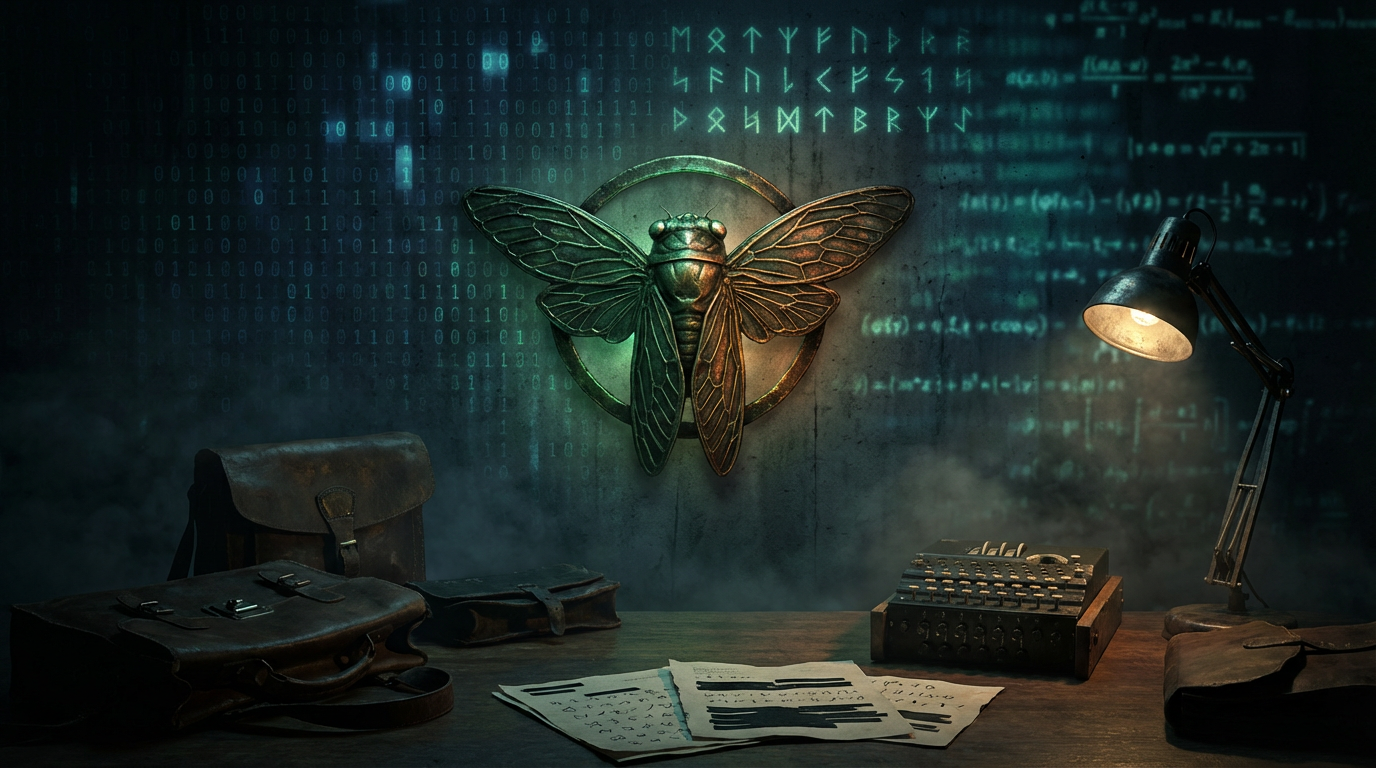
Then came the physical world. In a move that separated Cicada 3301 from ordinary internet puzzles, clues pointed to real-world locations in cities around the globe. Posters appeared in places such as Seattle, Paris, Warsaw, and elsewhere, each bearing the same cryptic symbol: a stylized cicada. That detail matters. Most online hoaxes remain online. Cicada 3301 crossed the boundary into physical space, where posters can be photographed, traced, and removed. Whoever was behind it either accepted the risk or wanted to be found.
The obvious theories, and their limits
Over the years, the explanations have multiplied. Some argue Cicada 3301 was an elaborate recruitment mechanism for intelligence services, cyber-security groups, or some private network of cryptographers and researchers. Others insist it was performance art, a digital scavenger hunt, or a social experiment designed to measure how people respond to mystery. A smaller faction treats it as a kind of secret society initiation, which tends to happen when an unexplained pattern remains unsolved long enough to attract myth.
From an analytical standpoint, the recruitment theory has the most practical weight. The puzzles screened for exactly the qualities valuable to intelligence, security, and advanced research environments: discretion, persistence, pattern recognition, and the ability to collaborate without ego overwhelming the task. The instructions also seemed to penalize people who talked too much. That, too, is a useful filter. A genuine selection process often rewards those who can solve quietly and move on.
Still, there is a difference between plausibility and proof. No verified organization has publicly claimed ownership of Cicada 3301. No recruiting officer has stepped forward with documentation. No court record, leaked memo, or authenticated internal archive has closed the case. In the absence of evidence, people fill the gap with imagination. That is not irrational; it is human. But the burden remains on the theory, not the rumor.
Why the mystery endured
Cicada 3301 persisted because it understood something about modern attention. Most internet phenomena are designed to be consumed quickly and discarded. This one moved in the opposite direction. It rewarded slow thinking. It asked solvers to invest time without promise of certainty. In a digital environment built for speed, that alone made it feel unusual, even subversive.
It also appeared at the right historical moment. In the early 2010s, public anxiety about surveillance, encryption, and online anonymity was rising. Movements around privacy and state power were becoming more visible. Whether intentional or not, Cicada 3301 fit neatly into that atmosphere. It looked like a test built for people who understood both the power of information and the need to keep some of it hidden.
There is another reason the case lingered: the participants themselves became part of the myth. Online forums filled with accounts of solvers who believed they had advanced to another stage, then vanished from public view. Some claimed the process led to a private network or interview. Others said nothing at all, which is often how real-world confidentiality looks. But silence can be interpreted in any direction, and in a mystery like this, interpretation becomes fuel.
The strongest skeptical reading
The most disciplined conclusion is also the least dramatic: Cicada 3301 was probably a sophisticated selection exercise, or at minimum a challenge created by people with serious technical literacy and an appreciation for operational secrecy. That does not make it ordinary. It makes it legible. The puzzles were too carefully constructed, too multi-layered, and too targeted to be the work of random pranksters. But the absence of a confirmed sponsor prevents us from calling it anything more than that.
Could it have been one person? Possibly, in the early stages. Could it have been multiple people collaborating across years? More likely. Could it have served purposes beyond recruitment, including reputation-building or community creation? Certainly. Good operations often accomplish more than one objective. A puzzle can be a filter, a message, and a brand all at once.
What Cicada 3301 is not, despite the mythology, is evidence of the paranormal. There is no reason to invoke hidden dimensions, ancient orders, or nonhuman intelligence to explain it. The real story is more interesting than that. A group of unknown creators built one of the most sophisticated public puzzles of the internet era, then allowed the world to argue over its meaning while never fully surrendering their own.
That kind of mystery survives because it resists the usual endpoints. No confession. No body. No official file released for easy closure. Just a sequence of clues, a trail of resolved and unresolved questions, and the unsettling possibility that somewhere, someone was watching the solvers as closely as the solvers were watching the clues.
As an analyst, I have always been suspicious of mysteries that promise too much and reveal too little. Cicada 3301 does the opposite. It offers substance without explanation. That is why it still matters. Not because it proves something impossible, but because it demonstrates how much can be hidden in plain sight when the people behind the curtain understand the value of discipline, ambiguity, and timing.
In the end, the question is not whether Cicada 3301 was real. It was. The better question is what it was for. On that point, the public still does not have a verified answer. And until it does, Cicada 3301 remains one of the rare modern mysteries that feels less like folklore than tradecraft.
🧩 Video: Cicada 3301 The Internets
A Knight Phenomena Investigation