The Cash-Landrum Incident: When the U.S. Government May Have Burned Its Own Citizens
The Night on Farm Road 1485
I want to start with something that separates this case from the vast majority of UFO reports I've examined over the years: the victims sued the United States federal government. Not in a fringe newsletter. Not in a conspiracy forum. In a federal district court, with attorneys, with medical records, with documented evidence of radiation exposure. That fact alone demands serious attention from anyone willing to approach this subject with intellectual honesty.
It was December 29, 1980. Betty Cash, 51, was driving her Oldsmobile Cutlass along Farm Road 1485 near Huffman, Texas — a rural stretch northeast of Houston. With her were Vickie Landrum, 57, and Vickie's seven-year-old grandson, Colby. The time was approximately 9:00 PM. The night was clear and cold.
What they reported seeing next would consume the remaining years of their lives.
The Encounter: A Clinical Description
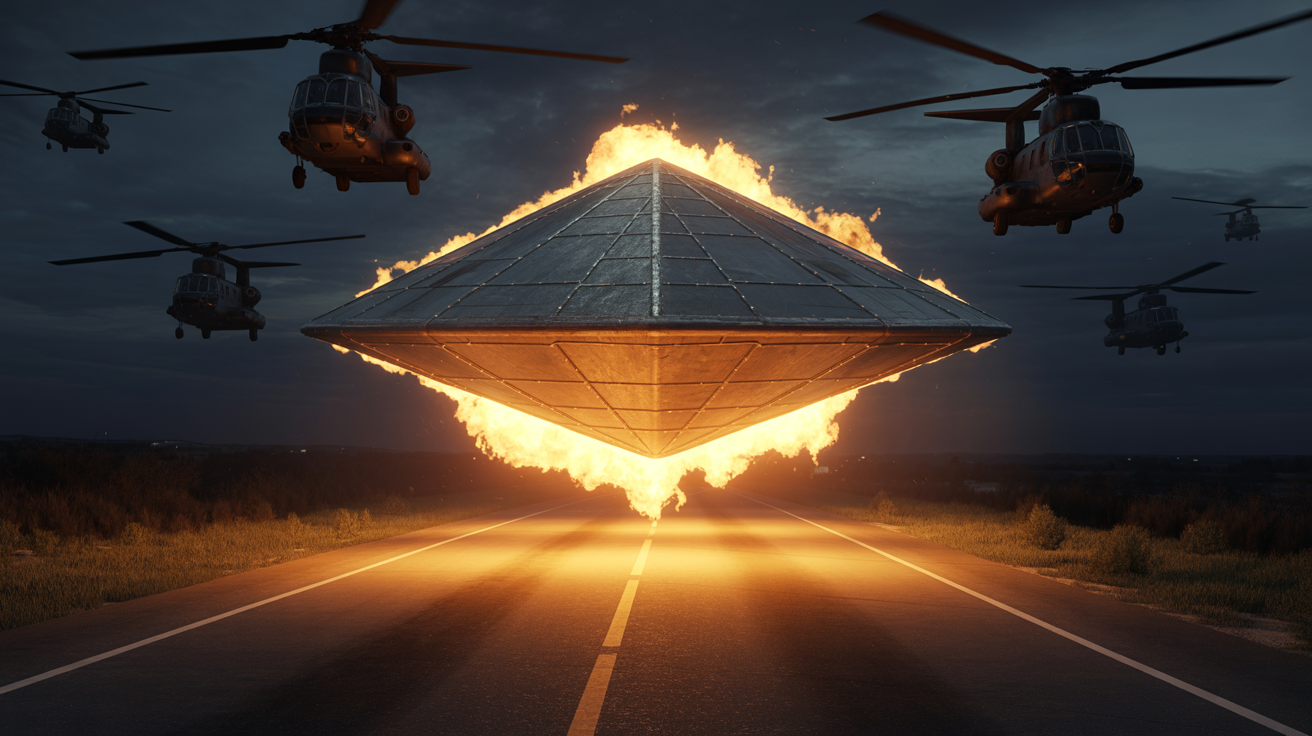
According to all three witnesses — whose accounts remained consistent across years of interviews, legal depositions, and independent investigations — a massive, diamond-shaped object appeared above the tree line ahead of them on the road. It was emitting intense light and periodic bursts of flame from its underside, forcing Cash to stop the vehicle. The object hovered at low altitude, and the heat radiating from it was described as intense enough to make the car's metal surfaces painful to touch.
Betty Cash exited the vehicle to observe the object more closely. Vickie Landrum remained inside with Colby, who was terrified. By multiple accounts, Cash stood outside for several minutes before returning to the car. The object eventually moved away, and as it did, the witnesses reported seeing a large formation of helicopters — later estimated at somewhere between 23 and 26 aircraft — surrounding or following the object. Several of these were identified by witnesses and later investigators as CH-47 Chinook helicopters, a military twin-rotor design with a very distinctive silhouette not easily confused with civilian aircraft.
The drive home was uneventful. What came next was not.
The Medical Evidence: This Is Where It Gets Serious
Within hours of returning home, all three witnesses began exhibiting symptoms. Betty Cash, who had spent the most time outside the vehicle in closest proximity to the object, suffered the most severely. Her symptoms included:
- Large, fluid-filled blisters forming on her skin
- Severe nausea and vomiting
- Diarrhea
- Significant hair loss in the days following the incident
- Inflammation and damage to her eyes
- A dramatic drop in white blood cell count
Vickie Landrum and Colby experienced similar but less severe symptoms — nausea, eye inflammation, skin irritation, and hair loss. Betty Cash was hospitalized multiple times in the weeks and months following the incident. Her health never fully recovered. She would be hospitalized more than two dozen times in the years ahead, and she died in 1998 — on the 18th anniversary of the encounter, a coincidence that does nothing to resolve the underlying questions but everything to underscore the tragedy.
Dr. Bryan McClelland, a physician who examined Cash, and later Dr. Peter Rank, a specialist in radiation injuries, both concluded that the symptoms were consistent with exposure to ionizing radiation. This was not a diagnosis of hysteria or mass psychogenic illness. These were measurable, documentable physiological changes consistent with a known category of injury.
The Helicopters: The Thread That Pulls Everything Apart
Here is the element of this case that I find most analytically significant, and the one that most mainstream dismissals conveniently underweight: the helicopters.
UFO sightings are, by their nature, difficult to corroborate. But helicopters are not UFOs. Helicopters are registered, maintained, crewed, fueled, and logged. If 23 to 26 military helicopters were operating in the airspace northeast of Houston on the night of December 29, 1980, there is a paper trail. Flight logs exist. Fuel records exist. Crew manifests exist.
The witnesses were not alone in seeing the helicopters. Other motorists in the area that night independently reported seeing both the unusual object and the military aircraft accompanying it. This is not a single-witness account subject to the usual credibility debates.
When investigators — including civilian UFO researchers and eventually the witnesses' own legal team — began querying military installations in the region, including Fort Hood, Ellington Field, and Bergstrom Air Force Base, every installation denied any knowledge of helicopter operations in that area on that night. The Army, the Navy, the Air Force — all denied it. The official position was, and remains, that no U.S. military aircraft were involved.
I spent years working in an environment where official denials are a standard tool of information management. I am not saying every denial is a lie. I am saying that a denial, by itself, is not evidence of absence. It is evidence of a position.
The Lawsuit: United States District Court, Southern District of Texas
In 1981, Betty Cash and Vickie Landrum filed suit against the United States government under the Federal Tort Claims Act, seeking $20 million in damages for the injuries they sustained. Their claim was straightforward: a U.S. government craft, or a craft being escorted by U.S. military assets, had caused them serious physical harm.
The case was assigned to U.S. District Judge Ross Sterling. The government's defense was equally straightforward: we have no such craft, we had no aircraft in the area, and therefore we cannot be liable. In 1986, Judge Sterling dismissed the case — not because the injuries were disputed, not because the witnesses were found to be lying, but because the plaintiffs could not prove the object was owned and operated by the U.S. government. Without establishing that threshold fact, the Federal Tort Claims Act provided no avenue for relief.
It is a legally coherent outcome. It is not a satisfying one.
The dismissal did not mean the government was innocent. It meant the plaintiffs couldn't prove it in court with the evidence available to them — evidence that, if it existed in classified form, was entirely beyond their reach.
What Was It? The Competing Hypotheses
I'll lay out the serious candidates as I see them, without editorializing beyond what the evidence supports.
Hypothesis One: An experimental U.S. military or government craft experiencing difficulties. The presence of military helicopters is the cornerstone of this theory. The Chinook is not a combat aircraft — it's a heavy-lift transport. Its presence in numbers around an aerial object suggests a shepherding or recovery operation, not an intercept. If a classified propulsion test vehicle was malfunctioning and venting radiation, a rapid response escort to guide it to a safe landing area would be operationally logical. The government's blanket denial of any aircraft in the area, if false, would be consistent with protecting a classified program.
Hypothesis Two: A jointly operated or foreign craft under U.S. military observation. This is a more speculative extension of Hypothesis One, and I include it only because the 1980 timeframe coincides with a period of significant classified aerospace development by multiple nations. The evidence does not strongly support this over Hypothesis One.
Hypothesis Three: A genuinely unidentified phenomenon, with the military helicopters responding to it independently. This hypothesis requires accepting that military assets were scrambled to observe or follow something they did not control — and that the subsequent denial of their presence was to avoid acknowledging the scramble itself, not the nature of the object. This is plausible from an institutional behavior standpoint.
Hypothesis Four: Misidentification and psychosomatic illness. I include this for completeness, but I find it the least defensible given the physical evidence. Radiation-consistent injuries do not arise from misidentification. The multiple independent witnesses to the helicopters undermine the misidentification framework for that element of the case.
What the Record Actually Shows
Let me be precise about what we can state with reasonable confidence, stripped of speculation:
- Three individuals were present on Farm Road 1485 on December 29, 1980, and all three subsequently exhibited symptoms consistent with radiation exposure, as documented by medical professionals.
- Multiple witnesses, not just the three primary victims, reported seeing both an unusual aerial object and military helicopters in the same area on the same night.
- Every military installation queried denied any operational activity in the area that night.
- A federal lawsuit was filed, heard, and dismissed on procedural grounds — not because the injuries were fabricated or the witnesses were discredited.
- Betty Cash died in 1998 after years of health complications that she and her physicians attributed to the incident.
What we cannot state with confidence is what the object was, who operated it, and whether the government's denials reflect genuine ignorance or deliberate concealment. Those questions remain open.
A Final Note on Institutional Behavior
In my former professional life, I learned something that has stayed with me: institutions do not lie uniformly. They compartmentalize. The Air Force public affairs officer who told investigators there were no helicopters in the area may have been telling the truth as he understood it — because the operation, if it existed, would have been classified above his access level. The absence of a smoking gun document does not mean the gun was never fired. It may mean the filing system is very well organized.
The Cash-Landrum incident deserves to be remembered not as a curiosity but as a case study in what happens when ordinary people encounter something extraordinary and then spend the rest of their lives trying to get answers from institutions that have every structural incentive to provide none. Betty Cash, Vickie Landrum, and young Colby Landrum were not investigators. They were not enthusiasts. They were driving home on a Tuesday night in Texas.
Whatever burned them, it was real. The medical records say so. The court record says so. And the silence from the government, maintained now for over four decades, says something too — even if we're still debating exactly what.
— Steven Knight
🛸 Video: Cash Landrum Incident 1980
A Knight Phenomena Investigation