The Brown Lady of Raynham Hall: England's Most Famous Ghost Photograph Under the Microscope
When I first studied the Brown Lady of Raynham Hall, I was struck by how little it resembles a modern ghost story. There are no infrared cameras, no grainy cellphone clips, no social-media frenzy. Instead, there is a stately English manor, a family legend, a staircase, and one photograph that has outlived nearly every explanation offered for it.
That is the kind of case I respect. Not because it proves the paranormal, but because it forces us to work with what can actually be documented: names, dates, published accounts, and physical images that can be examined, doubted, and reinterpreted. Raynham Hall, in Norfolk, gives us all of that. Whether it gives us a ghost is another matter.
Who Was the Brown Lady?
The haunting is tied to Lady Dorothy Walpole, sister of Sir Robert Walpole, often described as Britain’s first prime minister. She married Charles Townshend, 2nd Viscount Townshend, in the early 18th century. Over time, the story hardened into a familiar shape: a woman of high birth, a troubled marriage, rumors of infidelity, confinement, and an early death in 1726.
Here is where I start separating history from legend. Dorothy Walpole was real. Her marriage was real. Her burial at Raynham is real. But the dramatic claim that she was locked away by a jealous husband is less secure than many later writers imply. That detail may contain truth, exaggeration, or a mixture of both. In cases like this, a legend often grows in the gaps left by the record.
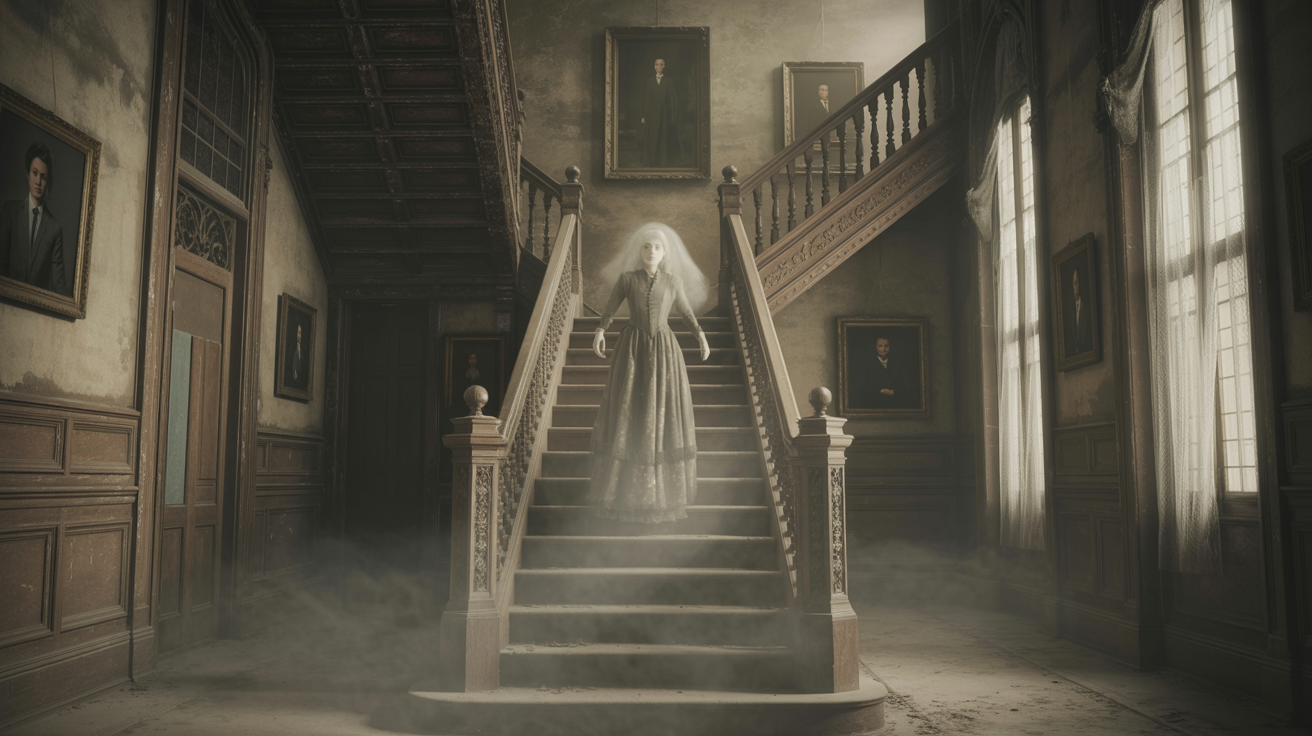
What matters is that by the 19th century, Raynham Hall already had a ghost attached to it. The apparition was said to be a woman in brown, gliding down the great staircase. The color of the dress gave the haunting its name, and the staircase gave it its stage.
The Witnesses Before the Camera
The most cited early sighting came in the 1830s, when Colonel Loftus and several companions were staying at Raynham Hall. According to the account, they saw a woman in brown moving on the staircase, carrying a light. One witness reportedly described her as appearing solid enough to be human, yet strangely detached from the room around her. The figure vanished before anyone could approach.
A second famous account is attributed to Captain Frederick Marryat, the naval officer and novelist. He reportedly encountered the Brown Lady on the same staircase in the 1830s and later wrote that the apparition had a particularly unsettling feature: eyes that glowed red. In the more theatrical versions of the story, Marryat jokingly fired a pistol at the figure, only to watch it dissolve. Whether every detail of that scene can be verified is beside the point. The important thing is that the story was established well before the 20th century photograph made Raynham famous.
That sequence matters to an investigator. A photograph of a ghost is easier to dismiss if it arrives in a vacuum. A photograph attached to decades of prior testimony is harder to wave away, because it becomes part of a longer chain of claims. Still, a chain is only as strong as its weakest link.
The 1936 Photograph That Changed Everything
In September 1936, a photographic team from Country Life was at Raynham Hall on assignment. They were working on architectural images of the house when, according to the published account, they made the exposure that would become legendary. On the staircase, the negative appeared to show a translucent female figure descending the steps, dress billowing, features obscured, body seeming to occupy the space between visibility and absence.
The image was printed in Country Life and then reproduced elsewhere, where it became one of the most discussed ghost photographs ever published. It has the qualities that make a haunting endure: it is suggestive rather than explicit, detailed enough to invite interpretation and vague enough to resist it. You can look at it and see a person, a blur, or a trick of light depending on what you bring to the image.
That ambiguity is not a flaw. It is the engine of the story.
What the Skeptic Has to Ask
If I put on my analyst’s hat, the first question is simple: what else could it be?
The most obvious explanation is a photographic artifact. Early cameras, especially in the 1930s, could produce motion blur, double exposure, or odd tonal effects. A person moving through the frame during a long exposure can appear ghostlike. A figure wearing light-colored fabric, or a curtain catching movement, can take on an eerily human shape. And because the image is old, later reproductions may have degraded the details that would help settle the issue.
There is also the problem of context. People on a haunted-property assignment are not neutral observers. They know the legend. They may even hope for a result. That does not mean they fabricated the image. It means the environment was primed for interpretation. Human beings are excellent at pattern recognition and equally excellent at turning uncertainty into narrative.
Then there is the weakness of memory. The earlier sightings at Raynham were recorded long after the events they describe. Some versions were published, retold, embellished, and folded into a ghost story that became more coherent with time. This is not the same as saying the witnesses lied. It is saying that testimony, especially in paranormal cases, is vulnerable to the pressure of expectation and the gravity of folklore.
Why This Case Still Matters
And yet, the Brown Lady persists.
That persistence is itself worth studying. Some ghost stories fade because they are built entirely on rumor. Others survive because they attach themselves to a place with enough historical weight to absorb them. Raynham Hall has both: a real family, a real house, and a legend that has been repeated often enough to become part of the property’s identity.
I do not think the Brown Lady photograph is enough, on its own, to prove the existence of an intelligent apparition. The evidence does not rise to that standard. But I also do not think the case can be dismissed as a simple hoax without a closer look at provenance, original negatives, and the sequence of witness reports that preceded the image.
In my line of work, the most dangerous mistake is to decide too early. That applies to espionage, crime, and mystery alike. If you dismiss a case because the answer seems obvious, you miss the details that make it interesting. If you accept the supernatural too quickly, you stop asking the questions that might expose an elaborate illusion.
My Conclusion
The Brown Lady of Raynham Hall remains compelling because it lives in the narrow space between folklore and evidence. There is enough history to keep the story grounded, enough testimony to make it persistent, and enough photographic ambiguity to keep skeptics busy for generations.
So what was captured on that staircase in 1936? A ghost, a trick of light, a moving figure, or a perfectly ordinary camera accident that history turned into something else? I cannot prove the answer from a distance, and neither can anyone else. What I can say is that Raynham Hall gives us a rare kind of mystery: one that does not ask us to choose immediately between belief and disbelief, only to keep looking.
That, in my experience, is where the real story usually begins.
👻 Video: Brown Lady Raynham Hall
A Knight Phenomena Investigation