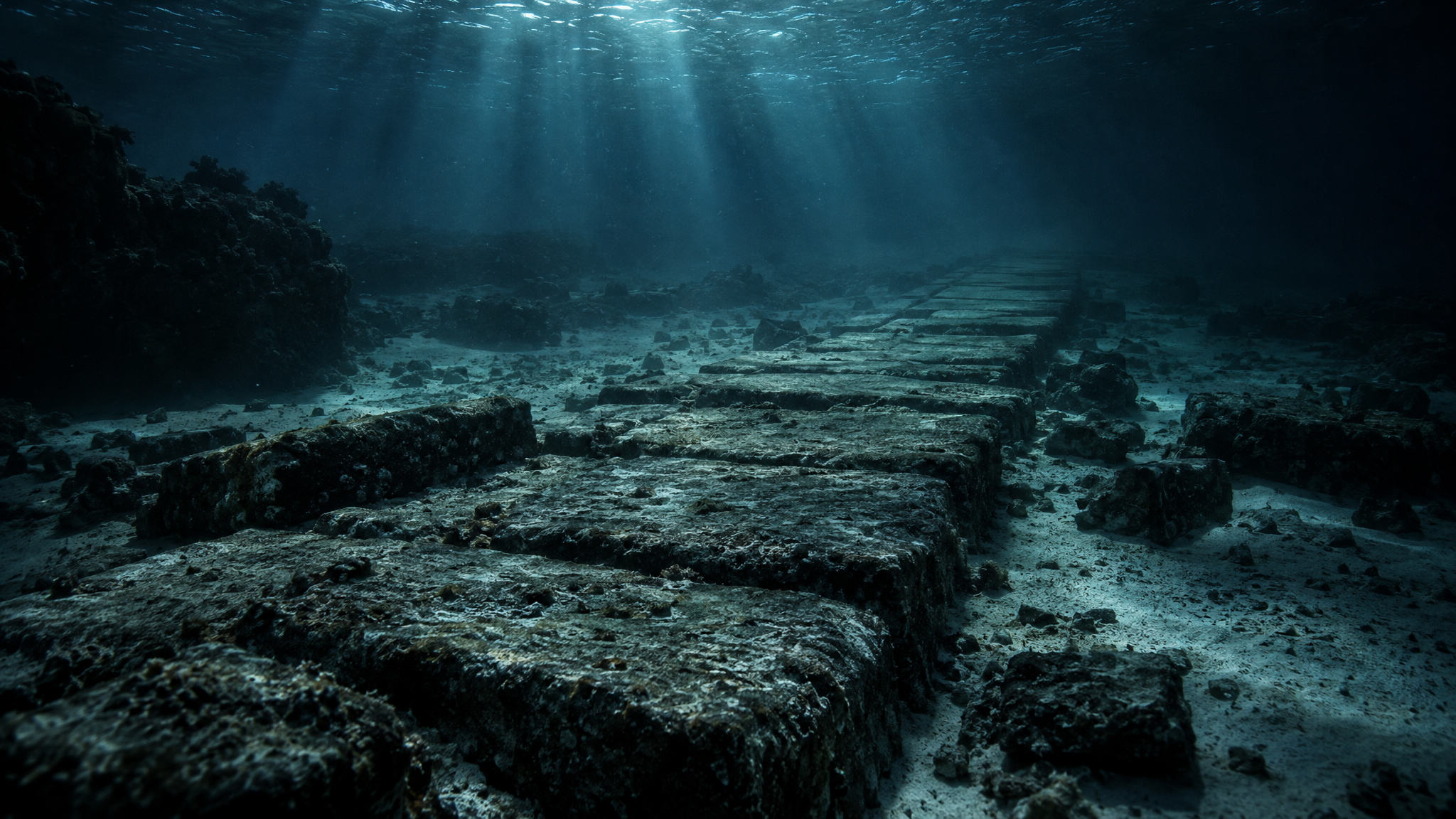
The Bimini Road: Submerged Stone, Sunken Civilization, or Something In Between?
There is a particular kind of discovery that intelligence analysts are trained to treat with maximum caution: the one that appears to confirm exactly what someone already believed. Confirmation bias is the enemy of accurate assessment. It is also, as it turns out, the central problem with nearly every serious investigation of the Bimini Road.
Let me give you the facts first, before the theories crowd them out.
What Was Found, and When
In September 1968, Dr. J. Manson Valentine — a zoologist, archaeologist, and honorary curator at the Miami Museum of Science — was diving with local guide Bonefish Sam Rolle in the shallow waters off Paradise Point, North Bimini. What Valentine observed on the seafloor was a linear arrangement of large, flat limestone blocks, many of them rectangular, some weighing an estimated 25 tons, laid out in a curved northeast-to-southwest alignment approximately 800 meters in length. The blocks were mostly submerged under three to six meters of water. Some appeared to be stacked in double or triple layers at certain points. The formation had right angles. It had consistent spacing. It looked, to Valentine's trained eye, deliberate.
Valentine published his findings and the scientific community took notice — though not always in the way he hoped. The formation was quickly dubbed the "Bimini Road" or "Bimini Wall," and within months it had attracted marine geologists, archaeologists, and a category of researcher that tends to complicate any serious investigation: true believers with a predetermined conclusion.
That conclusion was Atlantis. And the reason it arrived so quickly is worth examining carefully.
The Cayce Prediction Problem
In 1940, American psychic Edgar Cayce — known as the "Sleeping Prophet" — delivered a reading in which he stated that evidence of Atlantis would rise near Bimini "in '68 or '69." When Valentine's discovery was announced in 1968, Cayce's followers treated it as vindication. Several of the early diving expeditions to the site were funded or organized by the Association for Research and Enlightenment, the organization built around Cayce's legacy.
I want to be precise about why this matters analytically. The Cayce prediction did not cause the formation to exist. But it did shape the interpretive framework that surrounded the discovery from its earliest days, and it attracted a research community that was, structurally, motivated to find evidence of a lost civilization rather than to evaluate the evidence neutrally. That is a contaminated investigative environment. It doesn't mean the formation is natural. It means the early research record has to be read with that bias explicitly accounted for.
The Geological Case Against
The mainstream scientific position, established most rigorously by geologist Eugene Shinn of the U.S. Geological Survey, is that the Bimini Road is a natural formation called beachrock. Beachrock forms when carbonate sediment — sand, shell fragments, biological material — is cemented together by calcium carbonate in the intertidal zone. It forms in layers parallel to the shoreline, and as it erodes, it can fracture along natural joint lines into rectangular or polygonal blocks. Shinn and his colleagues collected core samples from the Bimini blocks in the 1970s and found that the internal structure of the rock was consistent with beachrock formation. Radiocarbon dating placed the formation at approximately 2,000 to 4,000 years old — geologically recent, and inconsistent with the timeline of any proposed Atlantean civilization.
Shinn also noted that similar beachrock formations exist throughout the Caribbean and are not considered anomalous. The apparent regularity of the Bimini blocks, he argued, is a product of natural fracturing patterns rather than human shaping.
This is a serious scientific argument. It is not, however, the end of the conversation.
The Counterarguments That Deserve Attention
Several researchers, including Dr. Greg Little and Dr. Lora Little, conducted extensive underwater surveys of the Bimini formation between 2005 and 2011 and documented features that they argue are difficult to explain through natural beachrock formation alone. Among their findings: blocks that appear to have been moved from their original positions, stones with what appear to be tool marks or worked surfaces, and a second, deeper formation discovered approximately a mile offshore that had not been part of the original 1968 survey.
More technically significant is the argument raised by geologist Robert Schoch — the same researcher who controversially re-dated the Egyptian Sphinx based on water erosion patterns. Schoch has pointed out that some of the Bimini blocks appear to rest on top of a layer of micrite, a fine-grained limestone that would not support the weight of the overlying stones if they had formed in place. This, he argues, suggests the blocks were transported and placed rather than formed where they now sit.
Shinn's team disputes this interpretation. The debate has not been resolved to the satisfaction of either side.
What the Evidence Actually Supports
Here is my analytical assessment, stripped of the mythology on both ends.
The beachrock hypothesis is the most parsimonious explanation for the Bimini formation. It requires no extraordinary assumptions, it is consistent with the geological context of the region, and it has been supported by physical sampling. In intelligence analysis, we call this the baseline explanation — the one you need compelling evidence to move away from.
The evidence for human construction is suggestive in places but not conclusive. The apparent regularity of the blocks, the possible tool marks, the questions about the micrite substrate — these are genuine anomalies that deserve rigorous investigation. They do not, individually or collectively, constitute proof of a pre-Columbian civilization, let alone Atlantis. What they constitute is a list of questions that have not been fully answered.
The Atlantis hypothesis is not supported by the evidence. I want to be direct about this. Even if the Bimini formation were proven to be artificial — which it has not been — it would represent a construction of modest scale in shallow Caribbean waters. It would not, by itself, constitute evidence of a continent-spanning civilization. The leap from "possibly worked stone" to "Plato's Atlantis" is not an analytical step. It is a narrative choice.
Why This Case Stays Open
What keeps the Bimini Road from being a closed file is not the Atlantis theory. It is the incomplete state of the physical investigation. The formation has never been subjected to the kind of systematic, peer-reviewed archaeological survey that a comparable terrestrial site would receive as a matter of course. Underwater archaeology is expensive, logistically difficult, and chronically underfunded when the site in question carries the stigma of fringe association.
That stigma is itself a problem worth naming. The Cayce connection and the Atlantis enthusiasts have made serious researchers reluctant to engage with Bimini publicly, for fear of professional association with pseudoscience. The result is that a genuinely ambiguous geological and potentially archaeological site has been left largely to investigators who are not disinterested. That is not how you get accurate answers.
The Bimini Road sits in clear, shallow, accessible water. The technology to conduct a definitive survey exists. The will to conduct one, free of both institutional dismissal and true-believer contamination, has not yet materialized.
Until it does, the formation remains what it has been since Valentine first looked down through forty feet of Atlantic water in 1968: a genuine anomaly, imperfectly understood, and more interesting than either side of the argument is willing to admit.
— Steven Knight writes about intelligence, anomalous phenomena, and the methodology of investigation at knightphenomena.com. He is a former CIA analyst and U.S. Army Intelligence officer.