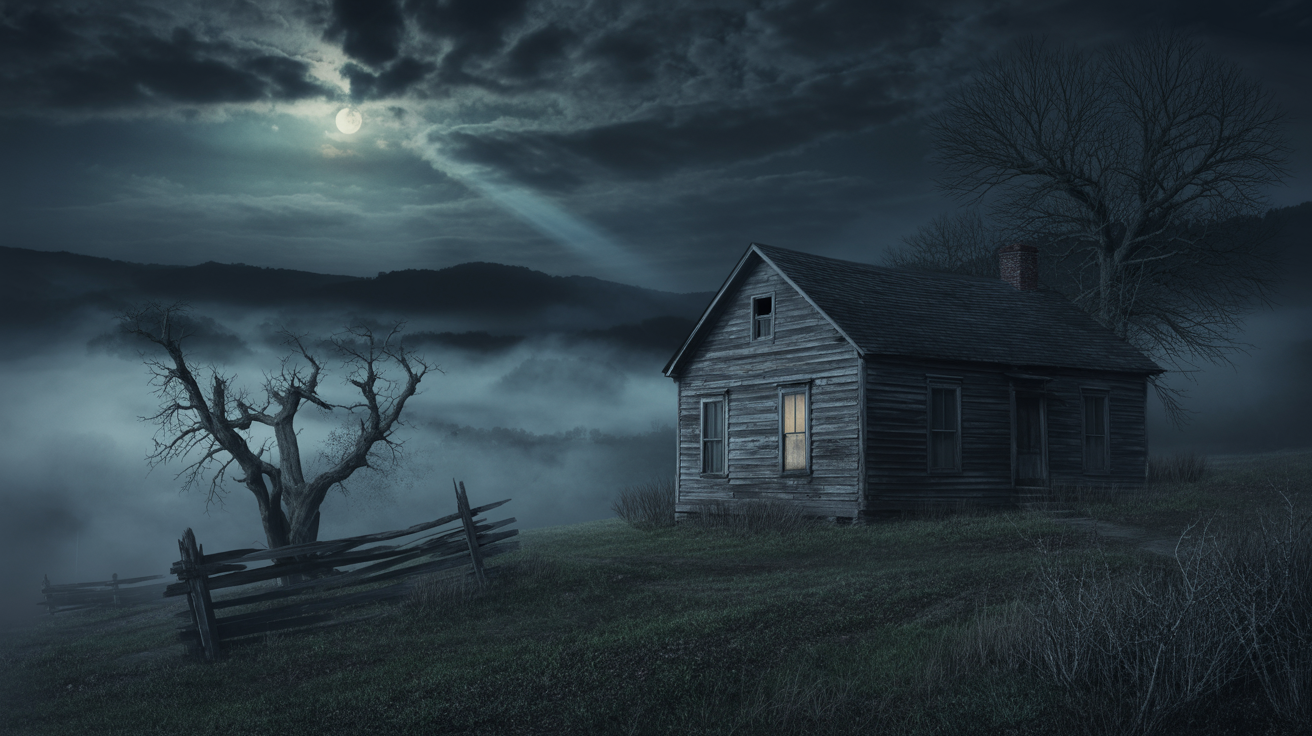
The Bell Witch of Tennessee: A Haunting Built on Memory, Fear, and Maybe More
A Haunting on the Tennessee Frontier
Every mystery has two histories: the event itself, and the story that survives it. The Bell Witch belongs to the second category, but the first is where the real work begins. In the early 1800s, on a farm near what is now Adams, Tennessee, the Bell family reported a series of disturbances that escalated from odd noises to what they believed was a sustained supernatural assault. Doors opened on their own. Beds were struck in the night. A voice, described as sharp and intelligent, argued, mocked, and sometimes sang. The target, according to the later accounts, was John Bell, his wife Lucy, and especially their daughter Betsy.
If this sounds like a familiar haunting, there is a reason the Bell Witch story has endured for more than two centuries: it contains all the elements that make paranormal lore sticky. A recognizable family. A rural setting. A community that hears about the problem before it understands it. And, most important, a narrative of escalation. The disturbance is not merely strange; it is personal. It watches, it comments, it humiliates.
That is also where skepticism has to enter the room. Stories like this are rarely transmitted as simple reports. They are layered through retelling, shaped by local pride, religious belief, and the human appetite for a good fright. By the time a case becomes famous, the facts have usually been mixed with decades of embellishment. The Bell Witch is no exception.
What the Record Actually Shows
The Bell Witch legend is usually dated to around 1817, when the Bell family is said to have begun hearing tapping sounds and witnessing objects moving without explanation. According to tradition, the entity eventually became vocal, identifying itself as a witch or spirit and tormenting the household. One version of the story says it especially hated John Bell and Betsy Bell. Another claims it was more playful with some family members and openly abusive to others. The voice was allegedly capable of mimicking people, reciting scripture, and holding extended conversations.
There is also the famous Andrew Jackson angle. In the folklore, the future president supposedly visited the Bell farm, encountered the entity, and left in alarm after hearing it or seeing signs of its power. It is a terrific story. It is also almost certainly late embellishment. The Jackson connection appears in retellings long after the alleged events and is not supported by firm contemporary documentation. In investigations, this is the point where the eyebrows go up. When a story gets linked to a major historical figure without strong primary evidence, the burden of proof gets heavier, not lighter.
The same caution applies to many other parts of the Bell Witch tradition. The best-known source is An Authenticated History of the Bell Witch, published in 1894 by M. V. Ingram, long after the events were said to have taken place. Ingram’s account is colorful, detailed, and clearly influential. But it is not a contemporaneous record. That matters. Memory is not a filing cabinet. It is an editor, and it is often a reckless one.
So what can be said with confidence? That a Bell family lived in a period and place where religious revival, folk belief, and fear of witchcraft were still part of the cultural landscape. That the family later became the center of a local legend involving unexplained disturbances. And that the story was preserved and expanded by oral tradition before being fixed in print decades later. Beyond that, the ground gets softer.
The Most Likely Explanations
From an analytical standpoint, there are several possibilities, and none requires us to swallow the entire legend whole. The first is straightforward fraud or exaggeration. A prankster, family member, or neighbor could have used concealed means to create noises, movements, and voice effects. That sounds unsatisfying until you remember how little technology is required to convince people in the dark. A hidden human source can mimic a lot of the supernatural if the audience is already primed to believe.
The second is social contagion. Once a family believes it is under attack, every sound becomes evidence. Anxiety spreads. Ordinary incidents become charged. A creaking floorboard is no longer a creaking floorboard; it is a message. In a tight-knit community, especially one influenced by religious explanation and local rumor, that can snowball fast. I spent years around threat reporting, and the lesson is the same in every era: people do not merely observe events. They interpret them through expectation.
The third possibility is that something genuinely unusual occurred, but not something paranormal. There are historical cases where sleep paralysis, stress, illness, and suggestibility have combined to produce experiences that feel utterly real. That does not make the witnesses liars. It makes them human. A household under strain can become a laboratory for misperception.
And then there is the smallest category, the one enthusiasts prefer: that the Bell Witch was a real anomalous intelligence, not yet explained by current science. I cannot rule out what no one can fully recover from the historical record. But the standard of evidence has to remain high. A remarkable claim requires more than a remarkable tale. It requires contemporaneous documentation, independent corroboration, and the kind of source chain that can survive scrutiny. The Bell Witch case does not give us much of that.
Why the Story Refuses to Die
Still, dismissing the Bell Witch outright would miss the larger point. Folklore is not preserved for nothing. Some stories endure because they meet a cultural need. In the Bell Witch narrative, there is the fear of invasion into the home, the terror of an unseen intelligence, and the idea that the ordinary world is thinner than we like to think. Those themes never go out of fashion.
There is also a grim historical dimension. Early frontier life was difficult. Medical understanding was limited. Death, hardship, and superstition lived close together. In that environment, a strange family disturbance could become a communal explanation for larger anxieties. A haunted house was not just entertainment. It was a way to give shape to fear.
That may be why the Bell Witch survives not as a single verified event, but as a durable cultural artifact. The details keep shifting, but the core remains stable: a family in distress, a voice from the dark, and a community that never quite stopped telling the story. If you are looking for a clean case file, you will be disappointed. If you are looking for a lesson in how legends are built, this is one of the best in America.
My view is simple. The Bell Witch is not well supported as a literal supernatural case, but it is very well supported as a historical mystery of perception, rumor, and memory. That combination is often more interesting than a simple ghost story. It tells us something about the people who saw it, the people who repeated it, and the human tendency to turn uncertainty into narrative.
And that, in the end, is the real haunting.
👻 Video: Bell Witch Tennessee Haunting
A Knight Phenomena Investigation