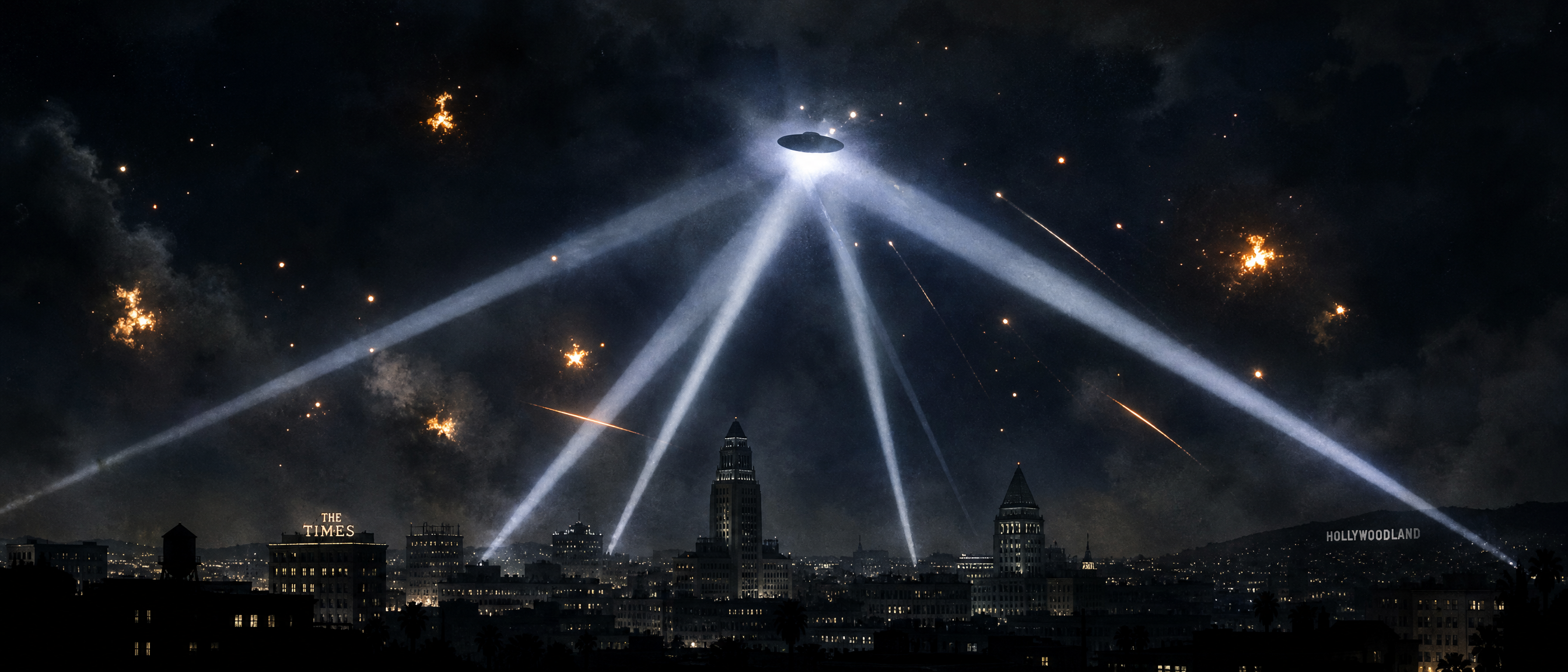
The Battle of Los Angeles: The Night the Searchlights Caught Something Impossible
February 1942: A City on Edge
Los Angeles was already a nervous place in early 1942. Pearl Harbor had happened only two months earlier, the West Coast feared a Japanese attack, and civilian intelligence was strained by rumor, blackout drills, and the blunt reality of war. In that atmosphere, even a minor incident could become a major event. On the night of February 24 into the early hours of February 25, the city got something much larger: a skyward panic that would later be remembered as the Battle of Los Angeles.
What happened that night is preserved in photographs, newspaper accounts, military records, and a tangle of contradictory testimony. Searchlights swept the darkness. Anti-aircraft batteries opened fire. Sirens wailed. Thousands of residents looked up and saw, or thought they saw, something moving through the sky over the city. By dawn, the official explanation was that nerves had been triggered by a false alarm. But if you read the record carefully, the case is not that simple.
What the Witnesses Said They Saw
The core problem in any aerial mystery is the same one intelligence officers learn to respect: eyewitnesses are useful, but they are not instruments. People in Los Angeles that night reported a range of observations. Some saw a single object. Others described several. Some said the craft was reddish-orange. Others said it was invisible except when caught in the beams of the searchlights. A few claimed it moved slowly and deliberately. Others saw erratic motion, as if the object were hovering, drifting, or even resisting artillery fire.
There were also the unmistakable sounds of war. More than 1,400 anti-aircraft shells were reportedly fired into the sky. Searchlights from across the basin converged on the same patch of air. In the newspaper photographs, the beams create the impression of a focused hunt, a technological net cast over something just out of reach. Whether that something was physical, atmospheric, or psychological is the central question.
"The object was over Santa Monica," one widely circulated account suggested at the time, while others insisted it was never near the coast at all. That geographic uncertainty matters. In intelligence work, when a target's position shifts from witness to witness, the first thing you do is ask whether the target existed as a single object at all.
The Documentary Trail
The Battle of Los Angeles is not a purely folkloric story. It was reported in major newspapers, discussed by military authorities, and later dissected in books, documentaries, and Freedom of Information Act releases. The Los Angeles Times printed headlines about a possible raid. The Army issued statements. Civilians wrote letters and gave interviews. The result is a mixed archive that looks, at first glance, like a classic wartime overreaction.
Among the key pieces of evidence are:
- Newspaper reports from February 25, 1942, describing heavy anti-aircraft fire over the city.
- Photographs showing multiple searchlights converging on an apparent target.
- Military statements acknowledging that an unidentified object or objects were tracked by radar and visually observed.
- Later testimony from witnesses who insisted the object was not a balloon, aircraft, or conventional weather phenomenon.
- The official wartime climate of fear, which made misidentification more likely but does not automatically explain every observation.
For analysts, the most interesting aspect is not the headline claim. It is the structure of the event. The incident escalated across multiple layers: rumor, observation, command response, public perception, and retrospective explanation. That layered response is exactly how real-world anomalies become historical legends.
Official Explanation: War Nervousness and a Weather Balloon
The U.S. Army eventually leaned toward the conclusion that the entire affair had been a false alarm. In later years, the most common official-sounding explanation was that a weather balloon or a misidentified object prompted the barrage, and that the rest was stress amplified by wartime conditions. That explanation has a certain common-sense appeal. Cities under threat do strange things. Soldiers under pressure see patterns where none exist. A small trigger can create a large reaction.
There is also evidence that a meteorological balloon may have been involved in the confusion. The Army’s own communications, combined with the difficulty of coordinating air defense in the blackout conditions, support the idea that one or more innocuous objects could have set off the chain of events. In the intelligence world, this is the kind of explanation we test first because it is usually right more often than the exotic theory.
And yet the weather-balloon theory does not fully solve the case. It explains how the alarm may have started, but not necessarily why so many witnesses independently described a large object, nor why anti-aircraft batteries engaged for so long, nor why the official story shifted over time. When a case grows from an immediate incident into a historical narrative, inconsistencies become part of the evidence, not an excuse to ignore it.
The Anomalies That Keep the Case Open
The strongest anomalies in the Battle of Los Angeles are not the dramatic claims; they are the subtle contradictions.
- First, the duration. A brief misidentification should have been resolved quickly. Instead, the response continued long enough to become a citywide event.
- Second, the number of independent witnesses. Even allowing for wartime nerves, the convergence of accounts suggests that something unusual was in the sky.
- Third, the searchlight photograph itself. It does not prove a craft, but it does prove a coordinated visual fixation on a target that officials believed was there.
- Fourth, the post-event narrative. As explanations changed, confidence in the official version weakened. That pattern is familiar in classified environments: when agencies disagree on the facts, the public usually gets the least precise version.
There is also the issue of radar. Reports from the period indicate that radar may have played some role in tracking the object or objects. Radar in 1942 was useful, but not perfect. It could be fooled by atmospheric conditions, clutter, or operator error. Still, if the system was picking up something and the crews saw lights in the same sector, that convergence deserves attention. In analysis, correlated errors happen. But correlated errors across multiple independent systems are less comfortable to dismiss.
The Human Factor: Fear, Memory, and Wartime Pressure
No serious investigator should ignore the psychological dimension. Southern California in early 1942 was primed for fear. Civil defense notices were everywhere. Blackouts changed the look of the night sky. Rumors of enemy aircraft spread faster than verification. People were exhausted, jumpy, and ready to interpret an unusual light as hostile action.
Memory also changes with repetition. A witness who initially sees a strange glow may, after hearing neighbors describe a cigar-shaped craft, begin to remember the same shape. That does not make the witness dishonest. It makes the witness human. As a former intelligence analyst, I have seen this phenomenon in interrogations, debriefings, and incident reviews. The mind wants coherence. When facts are incomplete, it supplies it.
But psychology cuts both ways. Wartime fear can inflate an ordinary event into a mass panic, yet fear alone does not create anti-aircraft fire aimed at a specific sector of sky, nor does it explain why the event remained part of military and public memory for decades. The truth may sit in the uncomfortable middle: an ordinary trigger, an extraordinary reaction, and at least one unresolved visual anomaly.
What I Think Happened
If I had to file this case as an intelligence assessment, I would not classify it as proof of an extraterrestrial visitation. There is not enough hard evidence for that. I would also not close the file as "simple confusion" and walk away. That would ignore too many mismatched details.
My best judgment is this: a legitimate but mundane aerial object, likely a balloon or related atmospheric target, initiated the alarm. Wartime nerves, poor communication, and a highly charged defensive environment transformed the incident into a prolonged engagement. Yet within that chaos, at least some witnesses may have observed additional phenomena: reflections, flares, smoke, searchlight artifacts, or even a second unidentified object. That layered reality could easily produce a case that is half misidentification and half genuine anomaly.
In other words, the Battle of Los Angeles may not be a clean mystery with one answer. It may be a case where the official explanation solves the central cause but leaves the peripheral facts untouched. Those peripheral facts are what keep researchers coming back.
Why This Case Still Matters
Many mysteries endure because they are dramatic. This one endures because it exposes something more important: how institutions behave under stress. The military made a call, the press amplified it, witnesses interpreted it through fear, and historians have been arguing ever since. That process is not unique to 1942. It is the template for how unexplained events are born in real time.
Whether you approach the Battle of Los Angeles as a UFO case, a wartime panic, or a historical oddity, the lesson is the same. The truth is rarely delivered in one neat package. It arrives in fragments, contradictions, and after-the-fact explanations that never quite fit all the evidence.
That is why this case refuses to die. Not because it proves the impossible, but because it reminds us how fragile certainty becomes when fear, technology, and human perception collide in the dark.