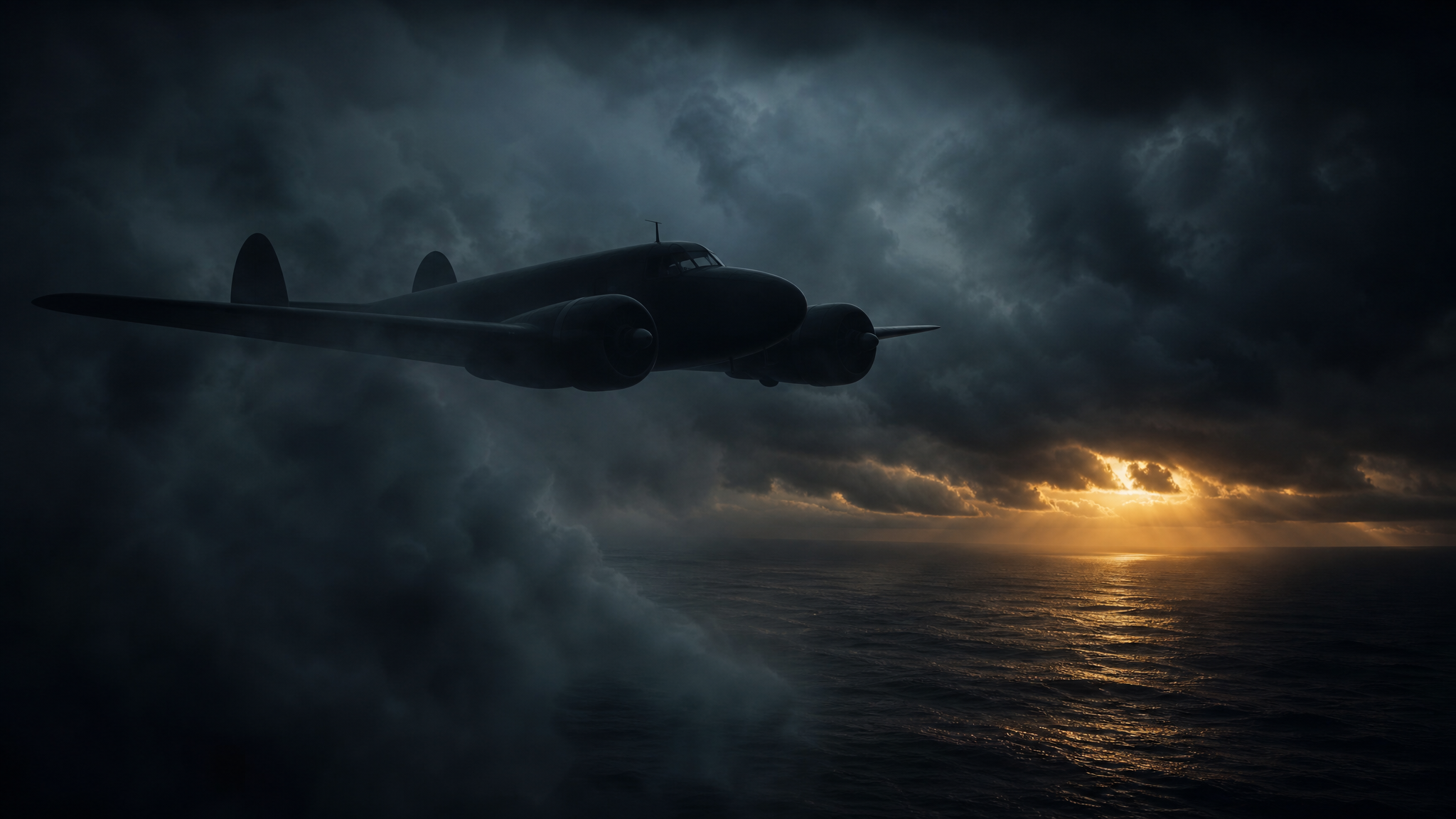
Amelia Earhart: What the Paper Trail Still Says About the Vanishing Over the Pacific
The day a legend disappeared
Few disappearances in modern history have generated as much speculation as the vanishing of Amelia Earhart and navigator Fred Noonan in July 1937. Earhart was not merely a pilot; she was a public symbol of endurance, modernity, and technical confidence in an age that still treated aviation as a frontier. When her Lockheed Electra failed to arrive at Howland Island during an around-the-world flight, the missing aircraft immediately became something larger than an accident. It became a vacuum, and into that vacuum poured radio intercepts, eyewitness claims, government intrigue, secret imprisonment theories, and the enduring hope that somewhere, some trace of the flight still remains.
In investigative work, the first temptation is to treat a famous mystery as if it must be extraordinary simply because it is famous. That is a mistake. Most disappearances are not exotic. They are cumulative failures: weather, fuel, navigation, communications, and human judgment all collapsing in sequence. Earhart’s case deserves skepticism not because the mystery is unimportant, but because it is important enough to demand discipline.
What follows is not a search for romance. It is a review of what can be said with confidence, what remains uncertain, and why the most durable theories survive not because they are proven, but because the evidence was always incomplete.
The flight that turned into a test of systems
Earhart’s world flight in 1937 was an ambitious undertaking, and the final leg from Lae, New Guinea, to Howland Island was among the most demanding. The Electra, a twin-engine aircraft, had to cover a long ocean stretch with limited margin for error. Howland itself was tiny, low-lying, and difficult to spot. In an era before satellite navigation and reliable long-range homing systems, even a minor error in position could turn a planned arrival into a search problem measured in hundreds of miles.
The essential facts are straightforward. Earhart and Noonan departed Lae on July 2, 1937, intending to reach Howland, refuel, and continue westward. Radio communications deteriorated. The U.S. Coast Guard cutter Itasca, stationed near Howland, reported hearing transmissions from Earhart but not getting the directional signals they expected. The last confirmed contact placed the aircraft in the vicinity of the island, low on fuel and struggling to establish a fix. After that, the trail goes cold.
That last point matters. The mystery does not require a crashed conspiracy to explain the disappearance. A long overwater flight, imperfect radio coordination, possible navigational error, and fuel exhaustion can account for the aircraft vanishing without trace. The burden of proof lies with every theory that tries to add anything beyond that sequence.
The strongest theory: fuel exhaustion and a forced landing at sea
The most conservative explanation is also the one most supported by the practical realities of the flight. Earhart likely reached the vicinity of Howland with no reliable visual fix, failed to locate the island, and exhausted her fuel reserves. In that scenario, the Electra either ditched in the ocean or came down hard enough to break apart and sink rapidly. The Pacific is efficient at erasing evidence. Deep water, corrosive salt, shifting currents, and time all work together to turn wreckage into absence.
This theory is not dramatic, but it is durable because it fits the known constraints. Aircraft of that era were not equipped with the redundancy we expect today. A dead reckoning navigation error of even a modest size could prove fatal over open water. Radio direction finding was useful, but not perfect. If the aircraft was south or west of its intended track by enough distance, the island might never have entered visual range before the fuel ran out.
The challenge with the ditching theory is not whether it is plausible. It is that it leaves little forensic material behind. Investigators want debris, bodies, radio signals, or at least a usable wreck site. Open ocean offers none of those guarantees.
“The absence of evidence is not evidence of survival. In a maritime disappearance, it is often exactly what we would expect.”
The Nikumaroro hypothesis and the lure of physical clues
The most serious alternative to the crash-and-sink scenario is the hypothesis that Earhart and Noonan landed on Nikumaroro, a remote island in the Phoenix Islands group, and later died there as castaways. This theory has endured for decades because it attempts something the ocean cannot: it seeks physical residue. Bones reported in the 1940s, artifacts found on the island, and later analyses of radio logs have all been used to argue that Earhart may have survived the initial landing and spent days or weeks ashore.
There is an obvious appeal to this idea. It transforms the disappearance from a final plunge into an extended human tragedy. It also creates more opportunities for evidence. A surviving crew might send distress signals, leave equipment behind, or leave biological remains that could later be identified. That is why the theory has remained alive: it offers a way to connect the silence after the last transmission with material traces on land.
But the evidentiary record is messy. The reported bones discovered on Nikumaroro were not preserved in a way that allows modern certainty. Some researchers believe the measurements are consistent with Earhart; others point out the limitations of the original analysis and the loss of the remains. Artifacts found on the island are intriguing, but intrigue is not identity. A piece of aluminum, a bottle, or a zipper slider can suggest a human presence without proving a specific person was there.
There is also the problem of timing and survival. Even if Earhart reached land, the conditions on a remote coral island would have been harsh. Fresh water, shelter, and food would all be immediate concerns. Radio distress calls may have been possible early on, but the longer one studies the logs, the more difficult it becomes to separate verified signals from later claims and retrospective pattern-making. Many alleged transmissions were received after the official search had already become a matter of public fascination, which makes them difficult to weigh objectively.
As a hypothesis, Nikumaroro is respectable. As proof, it remains incomplete.
The radio evidence: useful, but not decisive
Radio traffic sits at the center of the Earhart case because it is the last technical bridge between the aircraft and the outside world. The Itasca heard transmissions from Earhart, though the exchange was not clean. Frequencies, procedures, and equipment compatibility all appear to have been part of the problem. The question is whether those communications indicate a crash site near Howland, or whether Earhart later transmitted from another location after a forced landing.
Here, investigators face a familiar danger: interpreting ambiguous signals through the lens of a preferred theory. If one wants Earhart to have survived on an island, then nearly every post-loss transmission sounds like corroboration. If one believes the aircraft sank near Howland, then the same transmissions look like noise, interference, or mistaken attribution. The facts do not arrange themselves neatly around our preferences.
What can be said is that the radio reports demonstrate confusion, not certainty. They show that some signals were heard, some may have been misidentified, and the operational environment was poor. They do not, by themselves, establish a landing site. Nor do they conclusively rule one out. In this case, radio evidence is a pointer, not a conclusion.
Why conspiracy theories keep returning
Whenever a famous person vanishes into a technical system—aircraft, ship, border crossing, prison transport—the public imagination tends to recruit conspiracies. Earhart’s disappearance is no exception. Some theories place her in Japanese custody. Others suggest intelligence work, covert missions, or a deliberate disappearance. These ideas persist because they answer a human discomfort that simple failure does not: the need for intention.
Random loss feels unsatisfying. A mechanical error is banal. A navigational mistake is almost insultingly ordinary. But the disappearance of Amelia Earhart was never ordinary in the public mind, so the explanation has repeatedly been stretched toward something hidden and deliberate.
That does not mean every conspiracy theory is worthless. It means each must be subjected to the same questions: Who benefits? What documents exist? Who saw what, and when? Does the theory explain the full chain of events, or only the dramatic beginning? On those terms, most of the more sensational claims around Earhart collapse quickly. They rely on rumor, timeline drift, and the assumption that a lack of evidence must conceal a larger secret. Sometimes it simply means the evidence is gone.
“When a case enters legend, the loudest theory is not always the best one. The best one is the one that survives contact with the records.”
The role of myth in historical mystery
Earhart’s disappearance has become a kind of public mirror. For some, she represents unfinished progress, a pioneering spirit denied its ending. For others, she is a cipher into which modern anxieties about government secrecy and missing truth are projected. That is why the case survives. It is not just an aviation mystery; it is a cultural vessel for unresolved questions about women, technology, exploration, and the fragility of the historical record.
There is also the temptation to treat ambiguity as permission. If a case remains unsolved long enough, the public begins to believe that all interpretations are equally likely. They are not. The older the mystery, the more careful we must become, because age tends to amplify speculation and erode corroboration. A theory with no new evidence is not strengthened by repetition.
Still, it would be a mistake to dismiss the mystery entirely. Earhart’s disappearance remains unresolved in the narrow sense that no recoverable wreck has been universally accepted and no final physical proof has settled the question. That gap matters. It keeps the case alive not because the evidence is vast, but because it is incomplete in precisely the place where final certainty would matter most.
What seems most likely now
After years of public debate, the simplest explanation still appears to be the most plausible: Earhart and Noonan failed to locate Howland Island, ran short of fuel, and either ditched near the island or descended into a part of the Pacific that has never yielded a confirmable wreck. The Nikumaroro hypothesis remains the most credible alternative, mainly because it attempts to gather physical evidence rather than rely on rumor. But it has not crossed the threshold from compelling possibility to established fact.
That is where the case stands. Not solved, but not mystical either. The evidence points to a tragedy of navigation and circumstance, not a portal into the impossible. The missing aircraft may still lie on the ocean floor, or its fragments may be scattered in a place we have not yet correctly identified. Until something undeniably linked to the Electra is recovered, the mystery will remain open.
What makes the Earhart disappearance enduring is not that it proves something extraordinary. It is that it demonstrates how quickly even the best-known person in the world can vanish once the systems around her fail. In that sense, the case is less a riddle than a warning. The Pacific does not need secrets to keep its dead. It only needs depth.
And perhaps that is the final lesson here. We do not need the story to be supernatural for it to be haunting. A navigator, a pilot, a radio that never quite lined up, and a small island that never came into view are enough to create a mystery that has outlived the century that produced it. The facts may be sparse, but they are not silent. They still tell us where to look, and, just as importantly, where not to imagine too much.